
Relevant for Sociology Optional Paper 1, Paper 2, and GS Paper I (Indian Society)
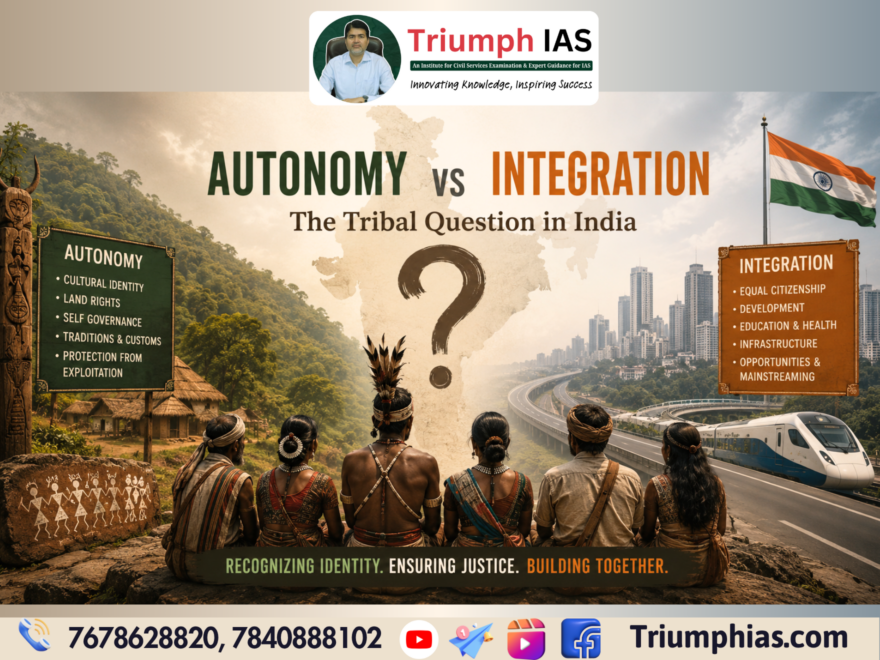
IntroductionIndia’s tribal communities, officially recognized as Scheduled Tribes under the Constitution, represent one of the most culturally diverse and historically marginalized sections of society. The “tribal question” in India revolves around a crucial dilemma: should tribal groups be allowed autonomous development based on their distinct cultural identities, or should they be integrated into the national mainstream for socio-economic progress? This debate between autonomy and integration has remained central to Indian sociology, anthropology, and public policy since independence. DimensionThe autonomy approach emphasizes the protection of tribal identity, customs, language, and traditional institutions. Anthropologists like Verrier Elwin advocated the policy of “protective isolation,” arguing that tribal societies should develop according to their own pace and cultural ethos. Elwin feared that rapid integration into mainstream society would expose tribal populations to exploitation, land alienation, and cultural erosion. Tribal communities often possess unique systems of governance, ecological knowledge, and communitarian lifestyles that differ significantly from urban-industrial society. Hence, proponents of autonomy believe that preserving tribal identity is essential for safeguarding India’s pluralistic social fabric. Constitutional provisions reflect this concern for autonomy. The Fifth and Sixth Schedules of the Indian Constitution provide administrative safeguards and varying degrees of self-governance to tribal areas. Institutions such as Autonomous District Councils in Northeast India attempt to preserve tribal customs and political autonomy. Similarly, laws like the Panchayats (Extension to Scheduled Areas) Act, 1996 (PESA) and the Forest Rights Act, 2006 recognize tribal rights over land, forests, and local governance. These measures acknowledge that tribal communities cannot be treated merely as backward sections requiring assimilation. On the other hand, the integration perspective argues that isolation can perpetuate poverty, illiteracy, and economic exclusion. Sociologist G. S. Ghurye viewed tribes as “backward Hindus” and supported their gradual assimilation into mainstream society. According to this view, integration is necessary to ensure access to education, healthcare, political participation, infrastructure, and employment opportunities. Development planners have often argued that tribal regions rich in minerals, forests, and natural resources must be integrated into national economic growth processes. However, the process of integration has frequently produced displacement and marginalization rather than empowerment. Large dams, mining projects, industrial corridors, and wildlife conservation programs have displaced millions of tribal people from their ancestral lands. Sociologists identify this as “development-induced displacement,” where tribal populations bear disproportionate costs of modernization without equitable benefits. The Narmada Valley Project, mining expansion in central India, and deforestation in tribal belts illustrate how integration into capitalist development often weakens tribal livelihoods and social structures. Contemporary sociology therefore advocates a balanced approach between autonomy and integration. Tribal communities should neither remain isolated from modern opportunities nor be forcefully absorbed into dominant cultural frameworks. The challenge lies in achieving inclusive development while respecting cultural distinctiveness. This perspective aligns with the idea of “integration without assimilation,” where tribal populations participate in national development without losing their identity and rights. Education, healthcare, digital connectivity, and political representation are essential for tribal empowerment, but these must be implemented sensitively. Development policies should incorporate tribal participation in decision-making processes rather than imposing top-down models. Environmental sustainability and community ownership of resources are also critical because tribal societies maintain a close relationship with ecology. The growing assertion of tribal movements across India reflects demands for dignity, self-determination, and equitable development. Conclusionthe tribal question in India is not merely an issue of backwardness but a deeper sociological debate about identity, citizenship, development, and democracy. The future of tribal communities depends upon balancing constitutional protections, cultural autonomy, and socio-economic integration. A democratic society must ensure that development does not become a tool of dispossession but a means of empowerment rooted in justice and participation. |
UPSC Civil Services (Mains) Question
Q. “Discuss the debate between autonomy and integration in tribal development in India. Examine how modern development policies have affected tribal identity and livelihood.” (250 words)
To Read more topics, visit: www.triumphias.com/blogs
Read more Blogs:
History repeats itself, first as a tragedy, second as a farce – Triumph IAS & Vikash Ranjan Sir
 SANDESH JAIN [B.Tech] SOCIOLOGY STRATEGY #UPSC CSE 2025
 𝐖𝐡𝐚𝐭 𝐦𝐚𝐤𝐞𝐬 𝐭𝐡𝐢𝐬 𝐚𝐜𝐡𝐢𝐞𝐯𝐞𝐦𝐞𝐧𝐭 𝐞𝐱𝐭𝐫𝐚𝐨𝐫𝐝𝐢𝐧𝐚𝐫𝐲 𝐢𝐬 𝐡𝐢𝐬 𝐒𝐨𝐜𝐢𝐨𝐥𝐨𝐠𝐲 𝐎𝐩𝐭𝐢𝐨𝐧𝐚𝐥 𝐬𝐜𝐨𝐫𝐞:
 𝐓𝐎𝐓𝐀𝐋 𝐒𝐎𝐂𝐈𝐎𝐋𝐎𝐆𝐘 𝐌𝐀𝐑𝐊𝐒: 𝟑𝟎𝟗
 𝐏𝐚𝐩𝐞𝐫 𝟏 – 173 Marks 𝐏𝐚𝐩𝐞𝐫 𝟐 – 136 Marks
 Single Source Preparation- Only #Vikash #Ranjan Sir’s Sociology Foundation Class Notes, Discussions, Application Strategies & Answer Writing Practice. No multiple books or Scattered Materials, No PDFs, No Free YouTube Time Wastes, No other Essentials.
 Offline Classroom Program
 Live Online Classes
 Tablet Course (Learn Anytime)
2 comments