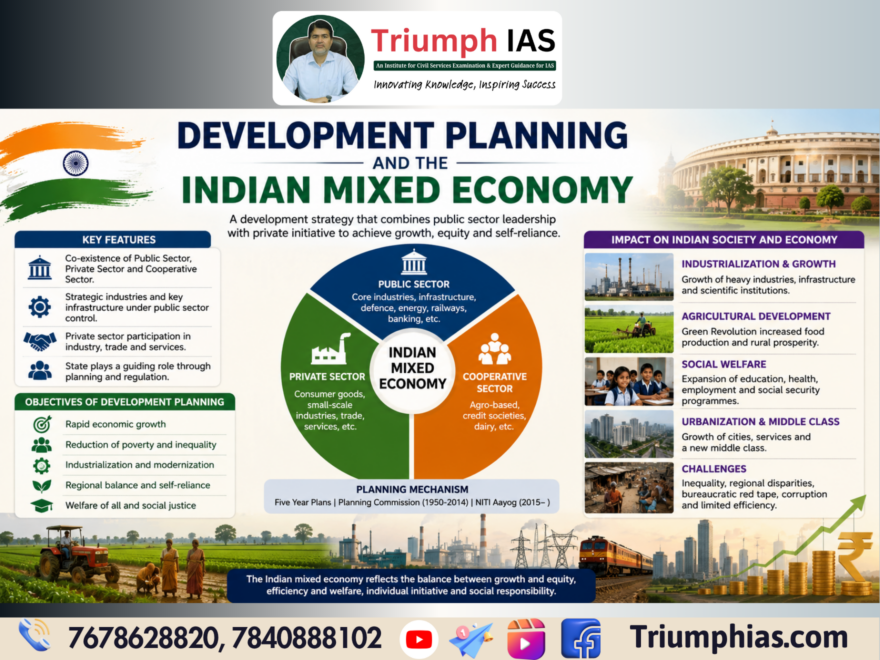
India’s development trajectory after independence was deeply shaped by the idea of a mixed economy. The Indian state adopted a model that combined elements of socialism and capitalism to achieve economic growth along with social justice. Development planning became a major instrument through which the state sought to reduce poverty, promote industrialization, ensure regional balance, and create an inclusive society. From a sociological perspective, development planning is not merely an economic exercise; it is closely linked with social transformation, class relations, inequality, caste dynamics, and state-society relations.
Dimension
After 1947, India inherited a colonial economy characterized by poverty, unemployment, agrarian backwardness, and limited industrial infrastructure. Inspired by socialist ideals and the Soviet model of planning, the Indian leadership under Jawaharlal Nehru established the Planning Commission in 1950. The objective was to guide economic development through Five-Year Plans while maintaining democratic institutions and private enterprise. This arrangement came to be known as the mixed economy model.
The Indian mixed economy rested on three major pillars: the public sector, the private sector, and cooperative institutions. The public sector controlled heavy industries, infrastructure, defense, and strategic sectors, while private enterprises operated in consumer goods and small-scale industries. Sociologically, this arrangement reflected an attempt to balance economic efficiency with welfare and social equity.
Development planning in India aimed at modernization and nation-building. Industrialization was seen as a means to overcome traditional social structures and create a rational, scientific, and progressive society. Sociologists such as M. N. Srinivas and A. R. Desai examined how development policies transformed rural and urban India. While Srinivas emphasized social mobility and processes such as Sanskritization and Westernization, A. R. Desai critically argued that development often benefited dominant classes rather than marginalized groups.
Land reforms, community development programmes, and Green Revolution policies were central components of planned development. These initiatives increased agricultural productivity and food security, but they also generated new inequalities. Rich peasants and dominant castes gained greater economic and political power, whereas small farmers and landless labourers often remained excluded. Thus, development planning produced uneven social outcomes.
Urbanization and industrial growth under the mixed economy also transformed social relations. The expansion of cities, migration, and the rise of a middle class altered traditional caste-based occupations and family structures. However, slums, informal labour, and urban poverty reflected the unequal nature of development. Sociologists point out that planned development did not eliminate social stratification; rather, it created new forms of inequality linked to class, education, and access to resources.
The Indian mixed economy also reflected the welfare role of the state. Programmes related to education, health, employment, and rural development aimed to improve the quality of life of disadvantaged sections. Reservation policies and poverty alleviation schemes attempted to address historical injustices faced by Scheduled Castes, Scheduled Tribes, and Other Backward Classes. Yet, implementation gaps, corruption, and bureaucratic inefficiencies limited the effectiveness of many programmes.
The economic reforms of 1991 marked a major shift in India’s development model. Liberalization, privatization, and globalization reduced the role of state planning and increased market-oriented growth. While these reforms accelerated economic expansion and integration with the global economy, sociologists highlight their social consequences such as rising inequality, agrarian distress, job insecurity, and consumerism. The transition from a state-led mixed economy to a market-driven economy changed the relationship between the state, market, and society.
Conclusion
In conclusion, development planning and the Indian mixed economy played a crucial role in shaping modern India. They promoted industrialization, agricultural growth, and social welfare while attempting to balance economic growth with social justice. However, the benefits of development were unevenly distributed across classes, castes, and regions. Sociology helps in understanding that development is not only about economic indicators but also about social inclusion, equality, and human well-being. The Indian experience demonstrates that planning and development must continuously address structural inequalities to achieve sustainable and inclusive progress.

 SANDESH JAIN [B.Tech] SOCIOLOGY STRATEGY #UPSC CSE 2025
 𝐖𝐡𝐚𝐭 𝐦𝐚𝐤𝐞𝐬 𝐭𝐡𝐢𝐬 𝐚𝐜𝐡𝐢𝐞𝐯𝐞𝐦𝐞𝐧𝐭 𝐞𝐱𝐭𝐫𝐚𝐨𝐫𝐝𝐢𝐧𝐚𝐫𝐲 𝐢𝐬 𝐡𝐢𝐬 𝐒𝐨𝐜𝐢𝐨𝐥𝐨𝐠𝐲 𝐎𝐩𝐭𝐢𝐨𝐧𝐚𝐥 𝐬𝐜𝐨𝐫𝐞:
 𝐓𝐎𝐓𝐀𝐋 𝐒𝐎𝐂𝐈𝐎𝐋𝐎𝐆𝐘 𝐌𝐀𝐑𝐊𝐒: 𝟑𝟎𝟗
 𝐏𝐚𝐩𝐞𝐫 𝟏 – 173 Marks
 Single Source Preparation- Only #Vikash #Ranjan Sir’s Sociology Foundation Class Notes, Discussions, Application Strategies & Answer Writing Practice.
 Offline Classroom Program
 Live Online Classes
 Tablet Course (Learn Anytime)
2 comments