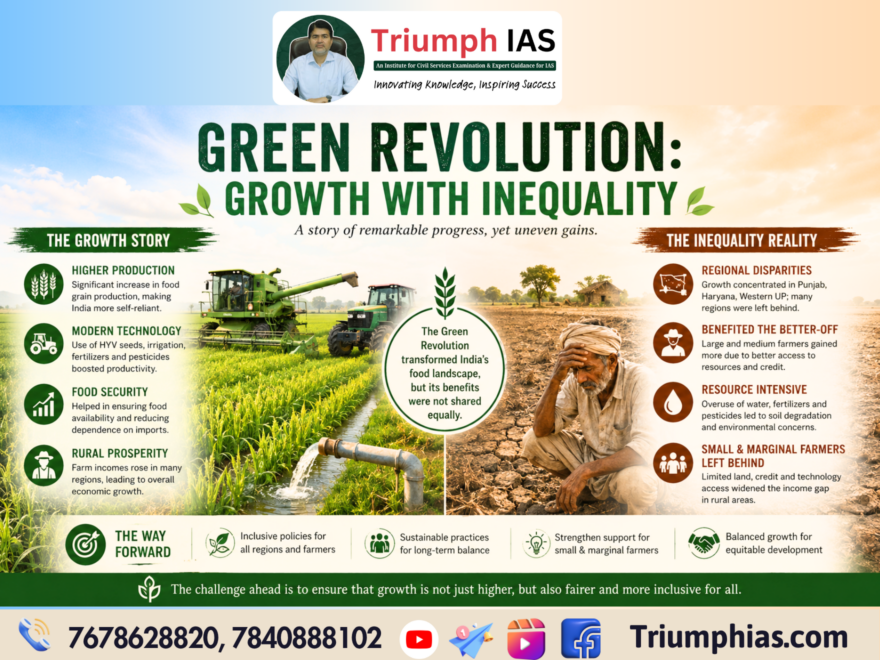
Green Revolution: Growth with Inequality

Green Revolution: Growth with Inequality

Relevant for Sociology Optional Paper 1, Paper 2, and GS Paper I (Indian Society)

Introduction

The Green Revolution marked a turning point in Indian agriculture during the 1960s and 1970s. It introduced high-yielding variety (HYV) seeds, chemical fertilizers, pesticides, irrigation facilities, and modern agricultural technology to increase food grain production. India, which was facing food shortages and dependence on imports, achieved self-sufficiency in food production through this transformation. However, from a sociological perspective, the Green Revolution was not merely an agricultural change; it also reshaped rural society, class relations, caste dynamics, and regional inequalities.

The primary objective of the Green Revolution was to ensure food security. States such as Punjab, Haryana, and western Uttar Pradesh witnessed tremendous growth in wheat and rice production. Agricultural productivity increased rapidly, leading to economic growth in many rural regions. Large farmers benefited immensely as they had access to land, irrigation, machinery, institutional credit, and market networks. The emergence of capitalist farming transformed agriculture into a commercial activity rather than merely subsistence production.

Yet, the benefits of the Green Revolution were unevenly distributed. Sociologists have highlighted that the process deepened existing social and economic inequalities in rural India. Large landowners gained disproportionately, while small and marginal farmers often remained excluded. Since HYV seeds and modern inputs required substantial investment, wealthy farmers were better positioned to adopt the new technology. Small farmers frequently fell into debt due to rising input costs and uncertain market prices.

This unequal distribution of benefits widened the gap between rich and poor peasants. The Green Revolution thus strengthened agrarian class differentiation. Rich peasants emerged as a dominant political and economic class in many regions. Sociologist Andre BΓ©teille observed that rural stratification became more visible as economic power increasingly determined social status alongside caste.

The Green Revolution also affected caste relations in rural society. Dominant castes that traditionally owned land consolidated their power further because they could utilize new agricultural technologies effectively. Landless laborers, many of whom belonged to Scheduled Castes, often faced economic insecurity. Mechanization reduced the demand for manual labor, leading to seasonal unemployment and migration. Thus, while agricultural output increased, social justice remained limited.

Regional inequality became another major consequence. The Green Revolution was concentrated in regions with assured irrigation and better infrastructure. States like Punjab and Haryana progressed rapidly, whereas eastern India, rain-fed areas, and tribal regions lagged behind. This uneven development created disparities in income, infrastructure, and opportunities between regions. Sociologists interpret this as a classic example of β€œdevelopment with imbalance.”

Gender inequality also persisted within the Green Revolution framework. Women contributed significantly to agricultural labor, yet ownership of land, access to credit, and decision-making remained largely male-dominated. Feminist sociologists argue that technological modernization in agriculture often ignored women’s role and reinforced patriarchal structures.

Environmental consequences further complicated the picture. Excessive use of fertilizers, groundwater extraction, and monoculture cropping patterns led to soil degradation, water depletion, and ecological imbalance. Contemporary sociological debates connect these environmental challenges with questions of sustainable development and rural distress.

Despite its limitations, the Green Revolution remains an important milestone in India’s developmental history. It prevented famine, increased food production, and strengthened national food security. However, sociology reminds us that economic growth alone cannot guarantee social equality. Development policies must address structural inequalities related to class, caste, gender, and region to ensure inclusive growth.

Thus, the Green Revolution can be understood as a process of β€œgrowth with inequality.” It transformed Indian agriculture but also revealed how technological progress, when combined with unequal social structures, can produce uneven outcomes. The sociological study of the Green Revolution therefore provides valuable insights into the relationship between development, power, and social justice in rural India.

UPSC Civil Services (Mains) Question

Q. β€œThe Green Revolution increased agricultural productivity but also intensified rural inequalities.” Critically examine the sociological implications of the Green Revolution in India. (250 Words)

To Read more topics,Β visit:Β www.triumphias.com/blogs

Read more Blogs:

Rural Development Programmes: Outcomes and Contradictions

Rise of Artificial Intelligence: the threat of jobless future or better job opportunities through reskilling and upskilling – Triumph IAS & Vikash Ranjan Sir

πŸ”₯ YOUR FINAL UPSC RANK CAN BE DECIDED BY JUST TWO PAPERS β€” ESSAY & OPTIONAL!

Most aspirants study hard.
But very few know how to convert knowledge into MARKS.

That’s where **Triumph IAS** creates the difference. πŸš€

✍️ EMTS – Essay Mentorship & Test Series (CSE Mains 2026–27)

Under the mentorship of **Vikash Ranjan Sir**, master the art of writing structured, philosophical, multidimensional, and topper-level essays.

βœ… Scientific Essay Writing Approach
βœ… Knowledge Matrix Framework
βœ… 5 Exclusive Essay Approach Classes
βœ… 2 Thematic Tests + 4 UPSC Mock Tests
βœ… Detailed Model Essay Hints
βœ… Flexible Writing & Discussion Sessions
βœ… Personal 1-to-1 Mentorship

πŸ† Trusted by UPSC Essay Toppers
━━━━━━━━━━━━━━━━━━

πŸ“š SMTS – Sociology Mentorship & Test Series + Quick Revision Session (QRS)

🎯 SCORE 300+ MARKS IN SOCIOLOGY OPTIONAL

A structured, analytical, and result-oriented mentorship program designed to maximize your Sociology score under the guidance of **Vikash Ranjan Sir**.

Program Highlights:

βœ… 26 Full-Length Tests with Detailed Evaluation
βœ… PYQ–NYQ Trend Analysis
βœ… Quick Revision Sessions on Unconventional Questions
βœ… Brainstorming & Concept Enrichment Sessions
βœ… 1-to-1 Personal Mentorship Discussions
βœ… Topic-wise Answer Writing Practice
βœ… Current Social Issues Compilation
βœ… Home-based Practice Tests with Model Hints
βœ… Thinkers Integration & Value Addition Notes
βœ… Essay & GS Enrichment through Sociology

  • πŸ† Legacy of High Scores Continues:
  • 🌟 G.R. Raghavendra, IPS – 318
  • 🌟 Medha Anand, IAS – 310
  • 🌟 Sandesh Jain, IPS – 309
  • 🌟 Gauravjeet Singh, IPS – 309
  • 🌟 Deepanshu Khurana, IFS – 303
  • 🌟 Pradeep Singh, IAS – 302
  • 🌟 Swati Sharma, IAS – 296
  • 🌟 Gunjita Agarwal, IAS – 295

…and many more successful aspirants.

━━━━━━━━━━━━━━━━━

  • *Batch Starts: 01 June*
  • πŸ“ Available in OFFLINE & ONLINE Mode
  • πŸ“ž Call/WhatsApp: 7678628820 | 7840888102
  • 🌐 triumphias.com
  • πŸ“ Triumph IAS
  • 23-B, 3rd Floor, Pusa Road
  • Near Karol Bagh Metro Pillar No. 114, New Delhi

EMTS – Essay Mentorship & Test Series (CSE Mains 2026–27)

One comment

Leave a Reply

Your email address will not be published. Required fields are marked *