
𝐑𝐞𝐥𝐞𝐯𝐚𝐧𝐭 𝐟𝐨𝐫: Essay for IAS
INTRODUCTIONHuman societies are constituted by individuals, yet they are sustained by collective norms, shared responsibilities, and moral constraints. This intrinsic tension between individual interest and social good lies at the heart of political philosophy, economics, ethics, and governance. The statement “Best for an individual is not necessarily best for the society” captures a fundamental paradox of social life: actions that maximize individual benefit may, when generalized or left unchecked, undermine collective welfare. While modern liberal thought celebrates individual freedom, choice, and self-interest as drivers of progress, social experience reveals that unregulated individualism often produces inequality, conflict, and ecological degradation. Consequently, the challenge before societies is not to suppress individual aspirations, but to harmonize them with the larger social good. Thus, understanding this delicate balance is essential for evaluating moral conduct, public policy, and sustainable development. MAIN BODY:To begin with, the individual and society exist in a relationship of mutual dependence. Individuals derive identity, security, and opportunity from society, while society relies on individuals for productivity, innovation, and continuity. However, this interdependence does not imply automatic harmony. Philosophers such as Thomas Hobbes emphasized individual self-interest as a natural human condition, warning that unchecked pursuit of personal gain leads to social chaos. In contrast, thinkers like Aristotle viewed humans as inherently social beings whose flourishing is possible only within a just community. Therefore, the debate is not whether individuals matter, but whether individual good can be pursued in isolation from collective consequences. Hence, the proposition that what is best for an individual may not be best for society arises from this inherent divergence between personal rationality and social rationality. Economic behavior provides one of the clearest illustrations of this tension. From an individual perspective, maximizing profit, minimizing tax liability, or consuming more resources may appear rational and beneficial. However, when such behavior becomes widespread, it can result in market failures, inequality, and environmental degradation. For instance, tax evasion may benefit an individual financially, yet it deprives the state of resources needed for public goods such as education, healthcare, and infrastructure. Similarly, excessive consumption driven by individual preference contributes to resource depletion and climate change, imposing costs on society at large. Thus, what appears optimal at the micro level often becomes destructive at the macro level, underscoring the limits of individual rationality when detached from social responsibility. The concept of the “tragedy of the commons” powerfully illustrates how individual self-interest can undermine collective welfare. When shared resources such as forests, water bodies, or grazing lands are exploited by individuals acting independently in their own interest, the resource is eventually depleted, harming everyone. Each individual’s action may seem insignificant or justified, yet collectively they produce irreversible damage. Therefore, what is best for each user individually—extracting maximum benefit—becomes disastrous for society. Consequently, this example demonstrates that societal well-being often requires restraint, regulation, and collective norms that limit individual freedom for the greater good. Unregulated pursuit of individual success can also intensify social inequality. While competition can drive excellence and innovation, excessive emphasis on individual achievement often marginalizes those with fewer resources or opportunities. Meritocratic ideals, when divorced from social context, tend to ignore structural disadvantages such as caste, gender, and class. As a result, individuals who succeed may view their success as purely personal, while society bears the burden of exclusion, resentment, and instability. Thus, individual success stories, though inspiring, do not automatically translate into social progress unless accompanied by inclusive institutions and redistributive mechanisms. From an ethical standpoint, morality begins where self-interest ends. Philosophers like Immanuel Kant argued that actions should be guided by principles that can be universalized without contradiction. If an action benefits an individual but cannot be adopted universally without harming society, it fails the moral test. For example, corruption may offer short-term gains to an individual, but when normalized, it erodes trust, weakens institutions, and undermines justice. Therefore, individual advantage achieved through unethical means ultimately corrodes the social fabric upon which individual security depends. Hence, ethical reasoning reinforces the idea that individual good must be constrained by moral duties to others. Political systems also reflect the tension between individual liberty and social order. Democracies guarantee fundamental freedoms such as speech, movement, and expression. However, these freedoms are not absolute; they are subject to reasonable restrictions in the interest of public order, morality, and national security. For instance, freedom of expression does not justify hate speech or incitement to violence, even if such expression serves an individual’s agenda. Thus, society imposes limits to ensure that individual actions do not harm collective harmony. Therefore, political freedom remains meaningful only when balanced with social responsibility. Public health crises vividly demonstrate how individual choices affect societal outcomes. Refusal to follow public health guidelines—whether regarding vaccination, sanitation, or quarantine—may stem from personal beliefs or convenience, but it can endanger community health. In such situations, individual autonomy must be weighed against collective survival. The legitimacy of state intervention arises precisely because individual actions, when aggregated, can pose existential threats to society. Thus, safeguarding societal well-being often necessitates curbing certain individual preferences. Environmental degradation presents perhaps the most compelling case where individual benefit conflicts with societal and intergenerational interests. Activities such as deforestation, overfishing, and pollution may generate immediate profits for individuals or corporations, yet they impose long-term costs on ecosystems and future generations. Here, the conflict extends beyond present society to unborn individuals who cannot assert their rights. Therefore, ethical development requires individuals to accept limits on exploitation in the interest of sustainability. Hence, what is best for an individual today may be disastrous for society tomorrow. Sociologically, societies survive by regulating individual behavior through norms, laws, and institutions. Émile Durkheim emphasized that excessive individualism leads to anomie—a breakdown of social norms resulting in alienation and instability. While individual autonomy is essential for creativity and innovation, its unregulated expansion weakens collective conscience. Consequently, societies evolve mechanisms to align personal goals with social expectations. Thus, social order depends on balancing freedom with obligation. While the statement highlights conflict, it does not imply that individual and social interests are always opposed. In fact, enlightened self-interest recognizes that long-term individual well-being depends upon a healthy, stable, and just society. Thinkers like Adam Smith acknowledged that markets require moral sentiments and institutional frameworks to function effectively. Similarly, modern welfare states attempt to reconcile individual enterprise with social security. Therefore, the challenge lies not in choosing between individual and society, but in designing systems that integrate both. Indian philosophical traditions have long emphasized the primacy of collective welfare. The concept of dharma integrates individual duty with social harmony, while the idea of sarvodaya envisions progress for all. However, contemporary India faces tensions between consumerist individualism and social responsibility. Balancing aspiration with equity, growth with sustainability, and freedom with fraternity remains an ongoing challenge. Thus, the relevance of this theme is particularly acute in a rapidly transforming society. CONCLUSION:In conclusion, the assertion that “Best for an individual is not necessarily best for the society” reflects a profound truth about human coexistence. While individual aspirations drive progress, their unchecked pursuit can undermine social cohesion, ethical integrity, and long-term sustainability. A just society does not negate individual freedom, but it contextualizes it within collective responsibility. Laws, ethics, and institutions exist precisely to ensure that personal gain does not come at the cost of public good. Ultimately, true progress lies in aligning individual ambition with social welfare, recognizing that the highest form of self-interest is one that contributes to the well-being of all. Only then can societies ensure harmony, resilience, and enduring development. |
Read more blog:
Simplicity is the ultimate sophistication – Triumph IAS & Vikash Ranjan Sir
Best Essay Writing Course for UPSC CSE
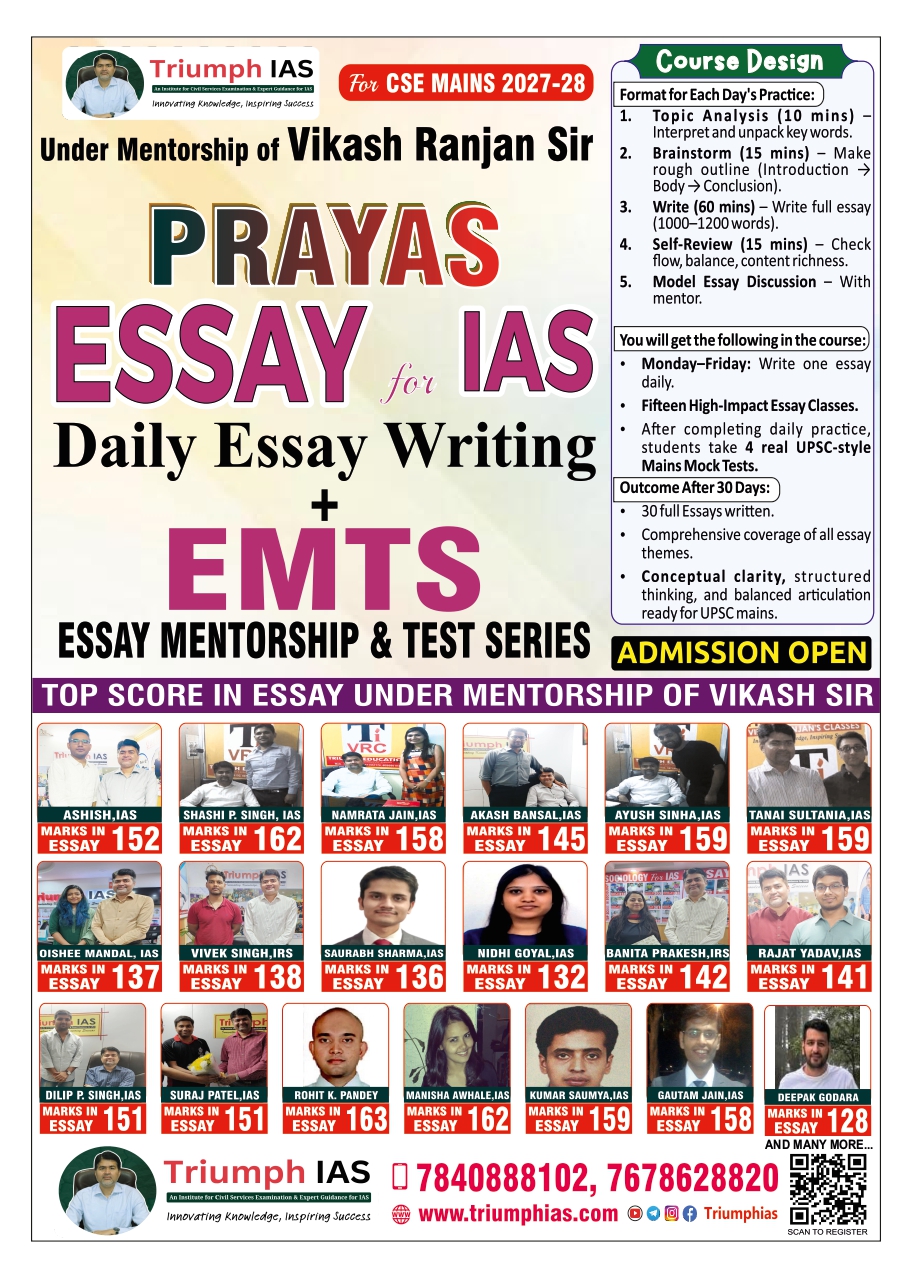
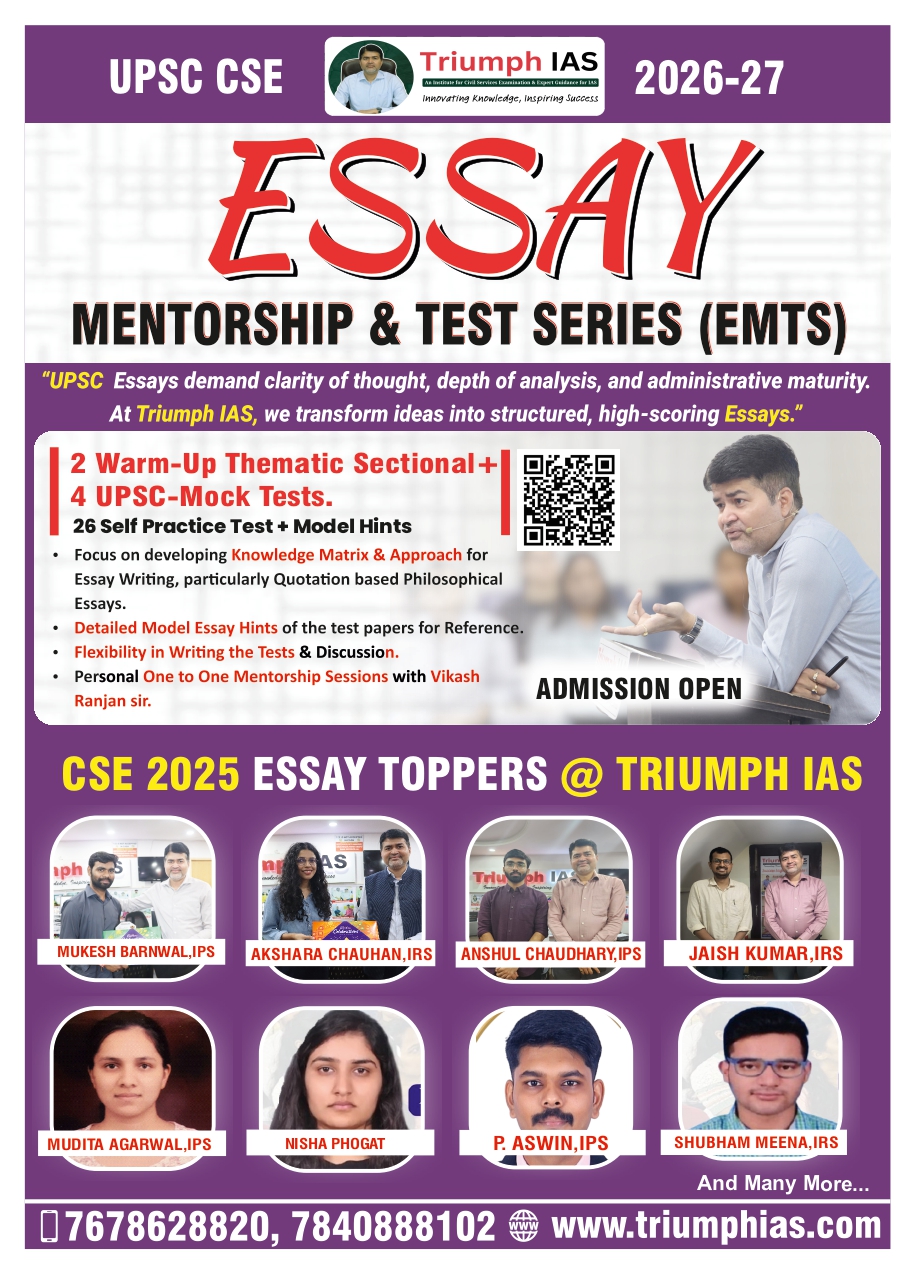
If you’re preparing for the UPSC Civil Services Examination (CSE), one paper that can unlock exceptional scores and a top rank is the Essay Paper. While General Studies and Optional Subjects are structured and syllabus-driven, the Essay writing segment is where individuality, critical thinking, and articulation truly shine.
Among various Essay programs available across India, Triumph IAS, under the expert mentorship of Vikash Ranjan Sir, offers the Best Essay writing Course for UPSC CSE. This comprehensive guide explores what makes this program unparalleled and why it should be part of every serious aspirant’s preparation strategy.

One comment