Religious Diversity and Social Integration in India
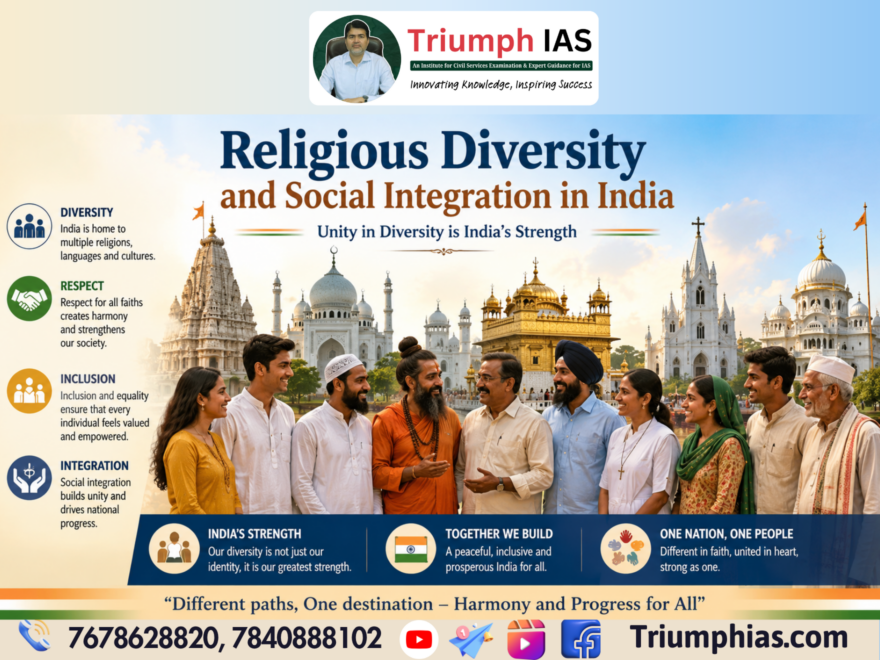
India represents one of the most religiously diverse societies in the world. Hinduism, Islam, Christianity, Sikhism, Buddhism, Jainism, Zoroastrianism, Judaism, and several tribal belief systems coexist within the same social framework. This diversity has historically shaped Indian civilization, influencing culture, politics, social institutions, and patterns of social interaction. From a sociological perspective, religious diversity in India is both a source of social cohesion and social tension. The challenge before Indian society is to maintain social integration while preserving pluralism and cultural autonomy.
Dimension
The sociological understanding of religion goes beyond spirituality. According to Émile Durkheim, religion acts as a mechanism of social solidarity by creating collective consciousness. In India, festivals, rituals, pilgrimage networks, and shared cultural traditions often strengthen interpersonal ties across communities. Celebrations such as Diwali, Eid, Christmas, Guru Nanak Jayanti, and Buddha Purnima frequently transcend religious boundaries and encourage inter-community participation. Such practices reinforce the idea of “unity in diversity.”
At the same time, India’s religious diversity is deeply connected with its historical evolution. The Bhakti and Sufi movements played a major role in promoting tolerance, syncretism, and social harmony. Saints like Kabir and Guru Nanak emphasized universal brotherhood and criticized rigid religious orthodoxy. These traditions contributed to a composite culture that sociologists often describe as “Ganga-Jamuni Tehzeeb.”
The Indian Constitution institutionalizes religious pluralism through the principles of secularism, equality, and freedom of religion. Unlike Western secularism, Indian secularism does not imply strict separation between state and religion; rather, it emphasizes equal respect for all religions. Articles 25 to 28 guarantee religious freedom, while minority rights ensure protection of cultural identities. This constitutional framework acts as an important instrument of social integration.
However, religious diversity also generates challenges. Communalism, religious polarization, hate speech, and identity politics can weaken social solidarity. Sociologists argue that political mobilization based on religious identity often transforms cultural differences into social conflicts. Communal riots, discrimination, and sectarian violence create mistrust among communities and threaten national integration. M. N. Srinivas observed that modernization and democratization sometimes intensify identity-based mobilization instead of reducing it.
Globalization and media have further complicated religious relations. On one hand, digital communication promotes interfaith dialogue and awareness. On the other hand, misinformation and online radicalization can amplify social divisions. The rise of majoritarian tendencies and competitive communalism demonstrates how religion can become a political resource rather than merely a cultural institution.
Despite these challenges, Indian society has repeatedly demonstrated resilience and accommodation. Everyday social interactions in markets, workplaces, educational institutions, and neighborhoods often reflect cooperation rather than conflict. Urbanization, education, constitutional values, and civil society initiatives continue to promote interfaith understanding. Interfaith marriages, multicultural workplaces, and youth-led social movements are emerging as new spaces of integration.
From a sociological perspective, sustainable social integration in India requires balancing diversity with equality. Policies promoting inclusive development, secular education, minority rights, and dialogue among communities are essential. Religion should function as a source of ethical values and social harmony rather than exclusion. Strengthening constitutional morality and democratic institutions can help preserve India’s pluralistic ethos.
Conclusion
In conclusion, religious diversity remains both a defining feature and a sociological challenge for India. While diversity enriches Indian society culturally and spiritually, social integration depends upon mutual tolerance, secular values, and inclusive citizenship. India’s success as a multicultural democracy lies in transforming religious plurality into a foundation of national unity rather than social fragmentation.

 SANDESH JAIN [B.Tech] SOCIOLOGY STRATEGY #UPSC CSE 2025
 𝐖𝐡𝐚𝐭 𝐦𝐚𝐤𝐞𝐬 𝐭𝐡𝐢𝐬 𝐚𝐜𝐡𝐢𝐞𝐯𝐞𝐦𝐞𝐧𝐭 𝐞𝐱𝐭𝐫𝐚𝐨𝐫𝐝𝐢𝐧𝐚𝐫𝐲 𝐢𝐬 𝐡𝐢𝐬 𝐒𝐨𝐜𝐢𝐨𝐥𝐨𝐠𝐲 𝐎𝐩𝐭𝐢𝐨𝐧𝐚𝐥 𝐬𝐜𝐨𝐫𝐞:
 𝐓𝐎𝐓𝐀𝐋 𝐒𝐎𝐂𝐈𝐎𝐋𝐎𝐆𝐘 𝐌𝐀𝐑𝐊𝐒: 𝟑𝟎𝟗
 𝐏𝐚𝐩𝐞𝐫 𝟏 – 173 Marks
 Single Source Preparation- Only #Vikash #Ranjan Sir’s Sociology Foundation Class Notes, Discussions, Application Strategies & Answer Writing Practice.
 Offline Classroom Program
 Live Online Classes
 Tablet Course (Learn Anytime)
2 comments