
Relevant for Sociology Optional Paper 1, Paper 2, and GS Paper I (Indian Society)
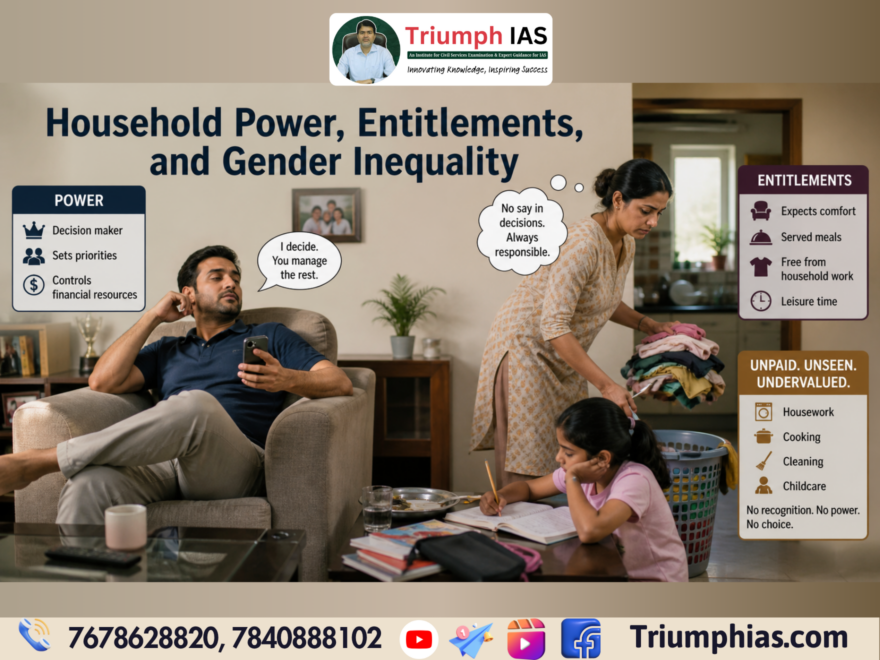
IntroductionThe household is often perceived as a unit of cooperation, affection, and shared interests. However, sociological analysis reveals that it is equally a site of power relations, negotiation, and inequality. Within households, access to resources, decision-making authority, and distribution of benefits are structured by gender norms, economic roles, and social institutions. The concepts of household power and entitlements are therefore central to understanding persistent gender inequality. DimensionHousehold Power: Beyond the Myth of HarmonyTraditional economic models treated the household as a unified entity with a common utility function. This “unitary model” assumed that resources are pooled and decisions are made collectively for the welfare of all members. However, sociological and feminist critiques dismantle this assumption by highlighting intra-household inequalities. Power within households is not equally distributed. It depends on factors such as income contribution, ownership of assets, education, and social norms. In patriarchal societies, men typically dominate decision-making due to their control over economic resources and their socially sanctioned authority. Women’s labor, especially unpaid domestic work, remains undervalued, weakening their bargaining position. Thus, the household must be understood as a site of negotiation and contestation, rather than pure cooperation. Entitlements and Access to ResourcesThe concept of entitlements, developed in development economics and sociology, refers to the set of resources and opportunities individuals can command within a given institutional framework. Within households, entitlements determine who gets what, when, and how. Gender plays a decisive role in shaping entitlements:
These disparities are not merely outcomes of poverty but are embedded in social norms, kinship systems, and inheritance laws. Bargaining Models and Gender InequalityContemporary sociological and economic theories adopt a bargaining approach to the household. This approach views household outcomes as the result of negotiations among members with different preferences and resources. Women’s bargaining power is influenced by:
For instance, women who are economically dependent on male members often have limited say in household decisions, including those affecting their own well-being. Conversely, employment and education can enhance women’s agency, enabling them to negotiate better outcomes. However, structural constraints—such as patriarchy, cultural norms, and lack of institutional support—often restrict women’s effective bargaining power despite economic participation. Intersection of Gender with Social StructuresGender inequality within households is further shaped by class, caste, and rural-urban divides. In agrarian households, women’s labor participation may be high, yet control over income remains male-dominated. In urban middle-class settings, women may be educated but still confined by cultural expectations of caregiving. Caste norms also regulate women’s mobility, marriage choices, and access to resources, reinforcing gender hierarchies. Thus, household inequality must be analyzed through an intersectional lens. Policy Implications and Way ForwardAddressing gender inequality within households requires both structural and normative interventions:
Programs such as self-help groups and conditional cash transfers have shown potential in enhancing women’s agency within households. ConclusionThe household is not merely a private domain but a microcosm of broader social inequalities. Power and entitlements within households are deeply gendered, reflecting and reinforcing patriarchal structures. A nuanced understanding of these dynamics is essential for addressing gender inequality in society. Transforming households into spaces of equity requires not only economic change but also a fundamental shift in social norms and institutional frameworks. |
UPSC Civil Services (Mains) Question
Q. “The household is a site of both cooperation and conflict.” Discuss in the context of gendered power relations and entitlements.
To Read more topics, visit: www.triumphias.com/blogs
Read more Blogs:
What is research, but a blind date with knowledge! – Triumph IAS & Vikash Ranjan Sir
 SANDESH JAIN [B.Tech] SOCIOLOGY STRATEGY #UPSC CSE 2025
 𝐖𝐡𝐚𝐭 𝐦𝐚𝐤𝐞𝐬 𝐭𝐡𝐢𝐬 𝐚𝐜𝐡𝐢𝐞𝐯𝐞𝐦𝐞𝐧𝐭 𝐞𝐱𝐭𝐫𝐚𝐨𝐫𝐝𝐢𝐧𝐚𝐫𝐲 𝐢𝐬 𝐡𝐢𝐬 𝐒𝐨𝐜𝐢𝐨𝐥𝐨𝐠𝐲 𝐎𝐩𝐭𝐢𝐨𝐧𝐚𝐥 𝐬𝐜𝐨𝐫𝐞:
 𝐓𝐎𝐓𝐀𝐋 𝐒𝐎𝐂𝐈𝐎𝐋𝐎𝐆𝐘 𝐌𝐀𝐑𝐊𝐒: 𝟑𝟎𝟗
 𝐏𝐚𝐩𝐞𝐫 𝟏 – 173 Marks 𝐏𝐚𝐩𝐞𝐫 𝟐 – 136 Marks
 Single Source Preparation- Only #Vikash #Ranjan Sir’s Sociology Foundation Class Notes, Discussions, Application Strategies & Answer Writing Practice. No multiple books or Scattered Materials, No PDFs, No Free YouTube Time Wastes, No other Essentials.
 Offline Classroom Program
 Live Online Classes
 Tablet Course (Learn Anytime)
3 comments