
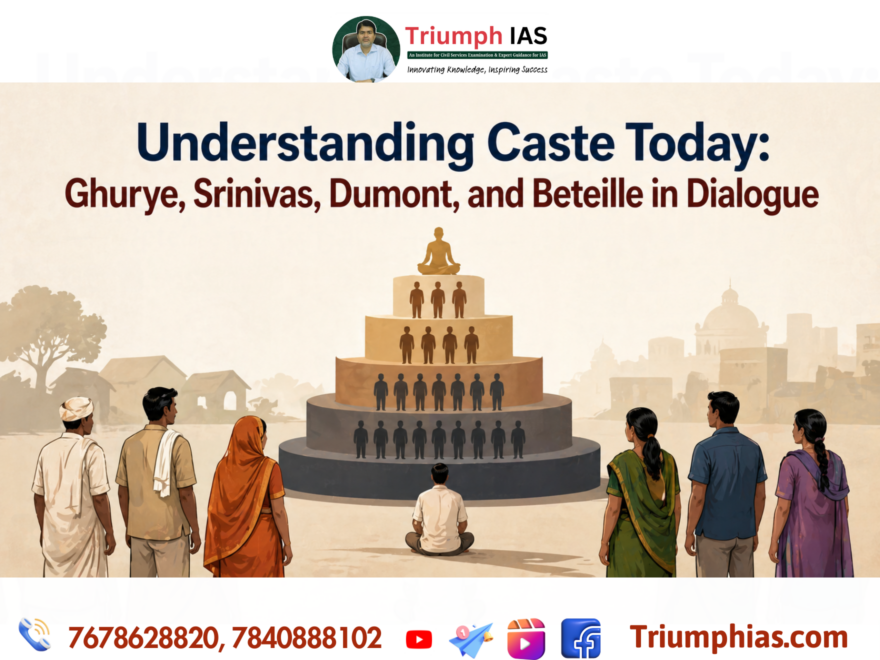
Relevant for Sociology Optional Paper 1, Paper 2, and GS Paper I (Indian Society)
IntroductionCaste remains one of the most enduring and debated institutions in Indian society. While its traditional features—hierarchy, endogamy, and occupational specialization—have been widely documented, contemporary transformations demand a re-evaluation through multiple sociological lenses. A comparative dialogue between G.S. Ghurye, M.N. Srinivas, Louis Dumont, and Andre Beteille provides a nuanced understanding of caste in present-day India. DimensionGhurye’s classical Indological approach conceptualized caste as a system defined by segmental division, hierarchy, restrictions on commensality, and civil and religious disabilities. He viewed caste as a pan-Indian cultural system rooted in Brahmanical traditions. Even today, his framework helps explain the persistence of ritual hierarchies, especially in rural India. However, Ghurye’s approach tends to underplay the dynamic and changing nature of caste in modern contexts such as urbanization and globalization. In contrast, Srinivas introduced a more dynamic and field-based perspective. His concepts of Sanskritization and Dominant Caste shifted the focus from static hierarchy to social mobility and power. Sanskritization explains how lower castes attempt upward mobility by emulating upper-caste practices, while the dominant caste concept highlights the role of numerical strength, landownership, and political power. In contemporary India, caste is deeply intertwined with electoral politics, reservations, and identity assertion—validating Srinivas’s argument that caste adapts rather than disappears. Louis Dumont, in his seminal work Homo Hierarchicus, emphasized caste as an ideological system based on the principle of purity and pollution. He contrasted the “holistic” Indian society with the “individualistic” West. Dumont argued that hierarchy, not inequality, is the central organizing principle of caste. While his structuralist interpretation offers deep insights into traditional values, critics argue that it overlooks material realities such as power, class, and conflict. In today’s India, where economic and political factors increasingly shape social relations, Dumont’s framework appears somewhat limited. Andre Beteille provides a more balanced and empirical approach by integrating caste, class, and power. He argues that caste cannot be understood in isolation but must be analyzed alongside economic and political structures. His studies in villages like Sripuram show that while caste persists, it increasingly intersects with class inequalities. In urban settings, caste identities may weaken in everyday interactions but continue to influence access to opportunities, social networks, and marriage alliances. Beteille’s approach is particularly relevant for understanding contemporary India, where caste operates in both visible and subtle forms. When placed in dialogue, these perspectives reveal that caste is neither static nor obsolete. Ghurye explains its cultural foundations, Srinivas highlights its adaptability, Dumont provides its ideological core, and Beteille situates it within broader socio-economic realities. Together, they show that caste today is a hybrid institution—traditional in form yet modern in function. In contemporary India, caste manifests in new ways: digital communities, identity politics, reservation debates, and urban discrimination. While legal frameworks promote equality, social practices often reproduce hierarchy. Thus, caste has transformed from a rigid system of ritual status to a flexible instrument of social, economic, and political negotiation. ConclusionIn conclusion, understanding caste today requires moving beyond single-theory explanations. A dialogical approach combining classical, structural, and empirical perspectives provides a more comprehensive understanding. Caste persists not merely as a relic of the past but as a dynamic institution continuously reshaped by modern forces. |
UPSC Civil Services (Mains) Question
Q. “Caste in contemporary India is both a traditional institution and a modern instrument of social and political mobilization.” Discuss with reference to sociological perspectives (250 words)
To Read more topics, visit: www.triumphias.com/blogs
Read more Blogs:
The Indian Middle Class: Engine of Growth or Agent of Inequality?
You cannot step twice in the same river – Triumph IAS & Vikash Ranjan Sir
Poets are the unacknowledged legislators of the world – Triumph IAS & Vikash Ranjan Sir
 SANDESH JAIN [B.Tech] SOCIOLOGY STRATEGY #UPSC CSE 2025
 𝐖𝐡𝐚𝐭 𝐦𝐚𝐤𝐞𝐬 𝐭𝐡𝐢𝐬 𝐚𝐜𝐡𝐢𝐞𝐯𝐞𝐦𝐞𝐧𝐭 𝐞𝐱𝐭𝐫𝐚𝐨𝐫𝐝𝐢𝐧𝐚𝐫𝐲 𝐢𝐬 𝐡𝐢𝐬 𝐒𝐨𝐜𝐢𝐨𝐥𝐨𝐠𝐲 𝐎𝐩𝐭𝐢𝐨𝐧𝐚𝐥 𝐬𝐜𝐨𝐫𝐞:
 𝐓𝐎𝐓𝐀𝐋 𝐒𝐎𝐂𝐈𝐎𝐋𝐎𝐆𝐘 𝐌𝐀𝐑𝐊𝐒: 𝟑𝟎𝟗
 𝐏𝐚𝐩𝐞𝐫 𝟏 – 173 Marks 𝐏𝐚𝐩𝐞𝐫 𝟐 – 136 Marks
 Single Source Preparation- Only #Vikash #Ranjan Sir’s Sociology Foundation Class Notes, Discussions, Application Strategies & Answer Writing Practice. No multiple books or Scattered Materials, No PDFs, No Free YouTube Time Wastes, No other Essentials.
 Offline Classroom Program
 Live Online Classes
 Tablet Course (Learn Anytime)
One comment