
Relevant for Sociology Optional Paper 1, Paper 2, and GS Paper I (Indian Society)
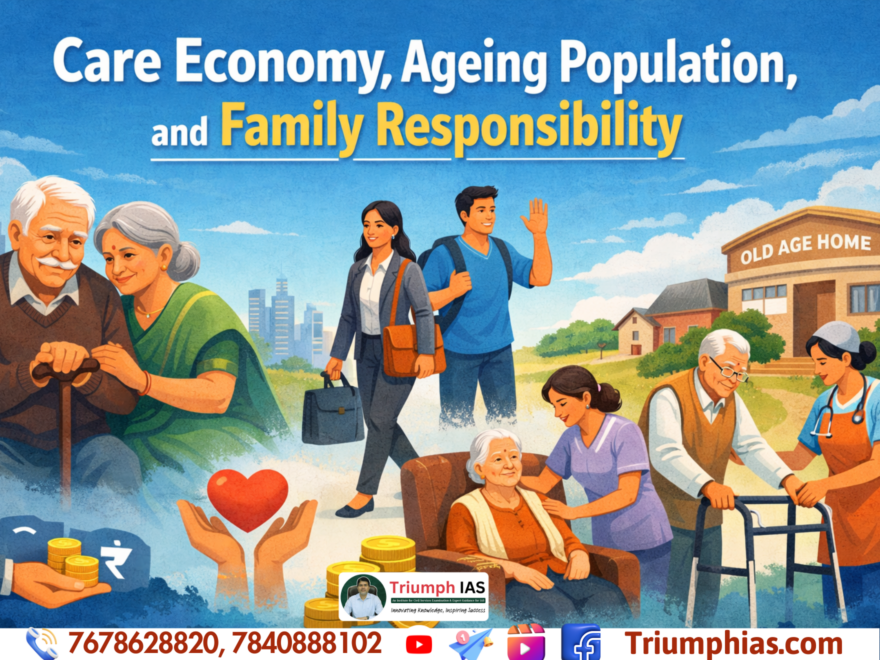
IntroductionIndia is undergoing a silent demographic transformation marked by a rapidly ageing population. According to recent estimates, the proportion of elderly persons (60+) is steadily increasing, posing significant challenges to social institutions—particularly the family. In this context, the concept of the care economy has emerged as a critical lens to understand how societies organize care work and distribute responsibilities across households, markets, and the state. DimensionUnderstanding the Care EconomyThe care economy refers to both paid and unpaid activities involved in caring for individuals—children, the elderly, the sick, and persons with disabilities. It includes domestic labor, emotional support, and health-related assistance. Feminist sociologists have emphasized that much of this work remains invisible and undervalued, primarily performed by women within households. In India, the care economy is predominantly informal and family-based. Unlike Western welfare states where institutional care systems are more developed, Indian society relies heavily on kinship networks to provide support to the elderly. Ageing Population: Emerging TrendsThe ageing of India’s population is driven by declining fertility rates and increasing life expectancy. This demographic shift has several sociological implications:
Changing Family Structures and Care ResponsibilityTraditionally, the joint family system in India ensured collective responsibility for elder care. However, modernization, industrialization, and urbanization have led to the rise of nuclear families, fundamentally altering caregiving patterns. Key shifts include:
Sociologists argue that this transition reflects a shift from ascribed obligations to negotiated responsibilities, where care is no longer taken for granted but must be consciously arranged. State, Market, and Institutional ResponsesWith the weakening of family-based care, the role of the state and market becomes crucial:
However, these alternatives often remain inaccessible to lower-income groups, reinforcing inequalities in elder care. Gender Dimension of Care WorkThe burden of caregiving continues to fall disproportionately on women, reflecting entrenched patriarchal norms. Even in dual-income households, women perform a “double burden” of paid work and unpaid care work. This raises critical questions about gender justice and redistribution of care responsibilities. Way Forward: Towards a Balanced Care RegimeA sustainable response to ageing requires a multi-institutional approach:
The challenge lies in balancing traditional family values with modern socio-economic realities. |
UPSC Civil Services (Mains) Question
Q. “Discuss the implications of the growing ageing population on family structures in India. How does the concept of the care economy help in understanding these changes?” (250 words)
To Read more topics, visit: www.triumphias.com/blogs
Read more Blogs:
The Empires of the future will be the empires of the mind – Triumph IAS & Vikash Ranjan Sir
 SANDESH JAIN [B.Tech] SOCIOLOGY STRATEGY #UPSC CSE 2025
 𝐖𝐡𝐚𝐭 𝐦𝐚𝐤𝐞𝐬 𝐭𝐡𝐢𝐬 𝐚𝐜𝐡𝐢𝐞𝐯𝐞𝐦𝐞𝐧𝐭 𝐞𝐱𝐭𝐫𝐚𝐨𝐫𝐝𝐢𝐧𝐚𝐫𝐲 𝐢𝐬 𝐡𝐢𝐬 𝐒𝐨𝐜𝐢𝐨𝐥𝐨𝐠𝐲 𝐎𝐩𝐭𝐢𝐨𝐧𝐚𝐥 𝐬𝐜𝐨𝐫𝐞:
 𝐓𝐎𝐓𝐀𝐋 𝐒𝐎𝐂𝐈𝐎𝐋𝐎𝐆𝐘 𝐌𝐀𝐑𝐊𝐒: 𝟑𝟎𝟗
 𝐏𝐚𝐩𝐞𝐫 𝟏 – 173 Marks 𝐏𝐚𝐩𝐞𝐫 𝟐 – 136 Marks
 Single Source Preparation- Only #Vikash #Ranjan Sir’s Sociology Foundation Class Notes, Discussions, Application Strategies & Answer Writing Practice. No multiple books or Scattered Materials, No PDFs, No Free YouTube Time Wastes, No other Essentials.
 Offline Classroom Program
 Live Online Classes
 Tablet Course (Learn Anytime)
One comment