
Relevant for Sociology Optional Paper 1, Paper 2, and GS Paper I (Indian Society)
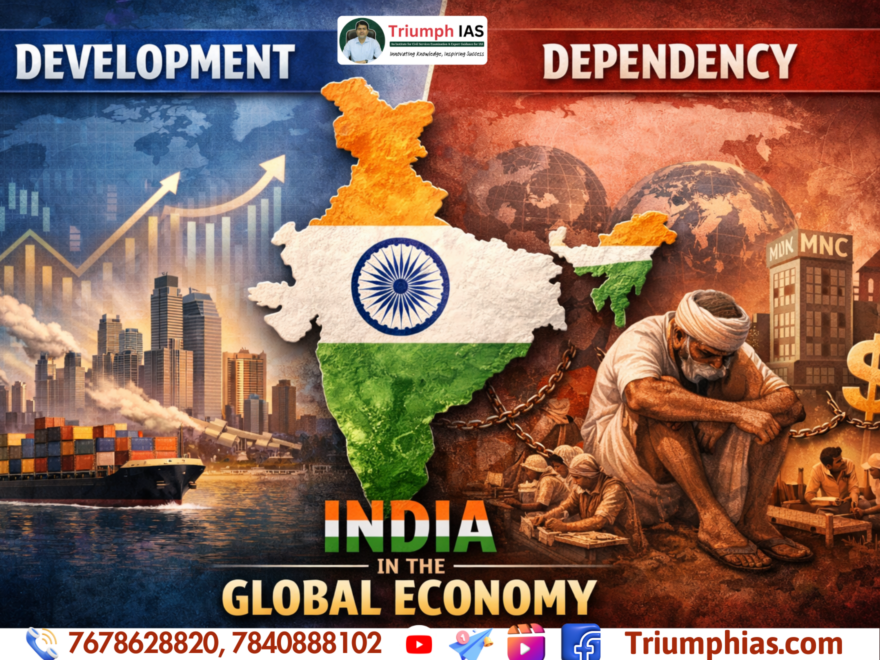
IntroductionThe debate between development and dependency has remained central to sociological analyses of the global economic order. Rooted in contrasting theoretical traditions—modernization theory and dependency theory—this discourse provides a critical lens to understand India’s trajectory in the global economy. DimensionModernization theorists argue that integration into the global capitalist system fosters economic growth, technological advancement, and institutional development. India’s post-1991 economic liberalization appears to validate this perspective. With the opening of markets, deregulation, and increased foreign investment, India has emerged as one of the fastest-growing major economies. The expansion of sectors such as information technology, pharmaceuticals, and services reflects its successful integration into global production networks. However, dependency theorists offer a counter-narrative. According to this view, global capitalism is structured in a way that perpetuates inequality between core (developed) and periphery (developing) nations. India’s integration into the global economy, while beneficial in some respects, has also deepened structural dependencies. For instance, reliance on foreign capital, technology, and global markets exposes the economy to external shocks, as seen during global financial crises. From a sociological standpoint, the Indian experience represents a complex interplay of development and dependency. On one hand, globalization has facilitated the rise of a new middle class, urbanization, and consumer culture. On the other hand, it has intensified regional disparities, informalization of labour, and agrarian distress. The benefits of economic growth remain unevenly distributed, often bypassing marginalized communities such as rural populations, informal workers, and lower castes. Moreover, India’s position in global value chains often remains limited to low-cost labour and outsourcing services rather than high-value innovation. This raises concerns about “dependent development,” where growth occurs but is shaped and constrained by external forces. Multinational corporations, while generating employment, may also influence domestic policy priorities, thereby limiting economic sovereignty. At the same time, India has attempted to navigate this dependency through strategic policies such as “Make in India,” digital economy initiatives, and efforts toward self-reliance (Atmanirbhar Bharat). These initiatives aim to strengthen domestic manufacturing, reduce import dependence, and enhance global competitiveness. Yet, the tension between integration and autonomy persists. ConclusionIn conclusion, India’s experience in the global economy cannot be understood through a binary lens of development versus dependency. Instead, it reflects a hybrid model where growth coexists with structural constraints. A nuanced sociological analysis reveals that while globalization has opened avenues for development, it has also reproduced inequalities and dependencies, necessitating a balanced and inclusive approach to economic policy. |
UPSC Civil Services (Mains) Question
Q. Critically examine India’s position in the global economy through the lens of development and dependency theories. (250 words)
To Read more topics, visit: www.triumphias.com/blogs
Read more Blogs:
The doubter is a true man of Science – Triumph IAS & Vikash Ranjan Sir
 SANDESH JAIN [B.Tech] SOCIOLOGY STRATEGY #UPSC CSE 2025
 𝐖𝐡𝐚𝐭 𝐦𝐚𝐤𝐞𝐬 𝐭𝐡𝐢𝐬 𝐚𝐜𝐡𝐢𝐞𝐯𝐞𝐦𝐞𝐧𝐭 𝐞𝐱𝐭𝐫𝐚𝐨𝐫𝐝𝐢𝐧𝐚𝐫𝐲 𝐢𝐬 𝐡𝐢𝐬 𝐒𝐨𝐜𝐢𝐨𝐥𝐨𝐠𝐲 𝐎𝐩𝐭𝐢𝐨𝐧𝐚𝐥 𝐬𝐜𝐨𝐫𝐞:
 𝐓𝐎𝐓𝐀𝐋 𝐒𝐎𝐂𝐈𝐎𝐋𝐎𝐆𝐘 𝐌𝐀𝐑𝐊𝐒: 𝟑𝟎𝟗
 𝐏𝐚𝐩𝐞𝐫 𝟏 – 173 Marks 𝐏𝐚𝐩𝐞𝐫 𝟐 – 136 Marks
 Single Source Preparation- Only #Vikash #Ranjan Sir’s Sociology Foundation Class Notes, Discussions, Application Strategies & Answer Writing Practice. No multiple books or Scattered Materials, No PDFs, No Free YouTube Time Wastes, No other Essentials.
 Offline Classroom Program
 Live Online Classes
 Tablet Course (Learn Anytime)
One comment