Urbanisation is one of the most significant social transformations of the modern era. Across the world, cities have emerged as centres of economic growth, innovation, and social mobility. In India, rapid urbanisation has been closely linked with large-scale migration from rural areas to urban centres. While cities offer opportunities for employment and better living standards, they also generate new challenges, particularly the expansion of informal settlements such as slums, unauthorized colonies, and temporary housing clusters.
From a sociological perspective, urbanisation, migration, and informal settlements are interconnected processes that reveal the complexities of social change, inequality, and development in contemporary society.
Dimension
Urbanisation as a Process of Social Transformation
Urbanisation refers to the increasing concentration of population in urban areas and the expansion of urban lifestyles. Sociologists view urbanisation not merely as demographic growth but as a transformation in social relationships, occupational structures, and cultural patterns.
Classical sociologists such as Emile Durkheim associated urbanisation with the transition from mechanical solidarity to organic solidarity, where increasing division of labour creates interdependence among individuals. Similarly, Louis Wirth described urbanism as a way of life characterized by impersonal relations, social heterogeneity, and increased individualism.
In India, urbanisation has accelerated due to industrialisation, service-sector growth, infrastructure development, and globalization. Metropolitan cities such as Delhi, Mumbai, Bengaluru, and Hyderabad continue to attract migrants seeking economic opportunities.
Migration and the Search for Opportunities
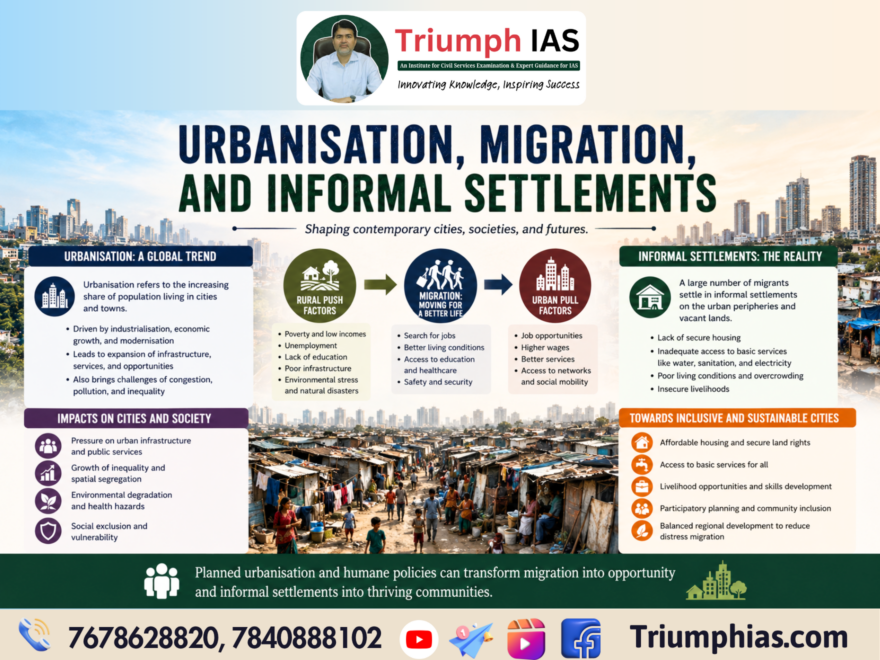
Migration serves as a crucial driver of urbanisation. According to the push-pull theory, individuals migrate due to adverse conditions in rural areas and attractive opportunities in urban centres.
Rural poverty, agrarian distress, unemployment, environmental degradation, and lack of educational facilities act as push factors. Conversely, higher wages, better healthcare, educational institutions, and employment opportunities function as pull factors.
Sociologists emphasize that migration is not merely an economic phenomenon but also a social process. Migrants often rely on kinship networks, caste associations, and community ties for survival in cities. These social networks facilitate access to jobs, housing, and social support, highlighting the importance of social capital in urban adaptation.
However, migration also produces challenges such as social exclusion, precarious employment, and vulnerability to economic shocks. The experiences of migrant workers during the COVID-19 pandemic revealed the fragile position many migrants occupy within urban economies.
Informal Settlements: The Urban Reality
One of the most visible consequences of rapid urbanisation and migration is the growth of informal settlements. These settlements emerge when urban infrastructure and affordable housing fail to keep pace with population growth.
Urban sociologists argue that informal settlements are not merely signs of poverty but manifestations of structural inequalities within cities. Residents contribute significantly to urban economies through informal labour, domestic work, construction, transportation, and small-scale enterprises, yet they often lack secure housing, sanitation, healthcare, and legal recognition.
The concept of the “informal sector,” popularized by Keith Hart, helps explain how large sections of urban populations survive outside formal economic structures. Informal settlements become spaces where economic necessity, social networks, and community resilience intersect.
Many scholars also view informal settlements as examples of the “right to the city,” where marginalized groups claim access to urban resources despite institutional barriers.
Sociological Implications
Urbanisation and migration reshape social stratification, family structures, and community life. Traditional social identities based on caste and village affiliations often undergo transformation in urban settings. Nevertheless, caste, class, gender, and ethnicity continue to influence access to housing, employment, and public services.
The expansion of informal settlements highlights issues of urban inequality, social exclusion, environmental vulnerability, and governance deficits. Sustainable urban development therefore requires inclusive planning, affordable housing policies, improved public services, and recognition of migrants as integral contributors to urban growth.
Conclusion
Urbanisation, migration, and informal settlements represent interconnected dimensions of contemporary social change. While cities provide opportunities for economic advancement and social mobility, they also reveal deep inequalities in access to resources and rights. Sociological analysis demonstrates that informal settlements are not simply urban problems but reflections of broader structural conditions. Understanding these processes is essential for creating inclusive, equitable, and sustainable urban futures in India and beyond.



4 comments