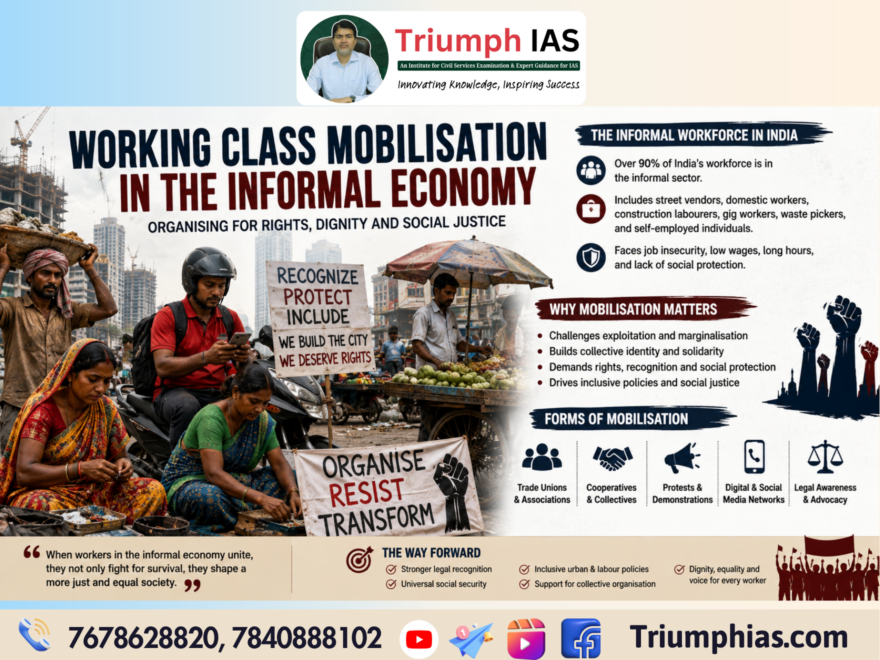
The informal economy has emerged as one of the defining features of contemporary labour markets, particularly in developing countries like India. According to various estimates, more than 90% of India’s workforce is engaged in informal employment. These workers include street vendors, domestic workers, construction labourers, gig workers, waste pickers, and self-employed individuals who often operate outside formal labour regulations. Despite their significant contribution to economic growth, they face precarious working conditions, low wages, job insecurity, and limited social protection. In this context, working-class mobilisation in the informal economy has become an important sociological phenomenon.
Dimension
Traditionally, labour movements were associated with factory workers employed in formal industries. Classical sociologists such as Karl Marx viewed the working class as a collective force capable of organizing against exploitation. However, the expansion of informal labour has transformed the nature of class relations. Informal workers are dispersed across multiple occupations, lack stable employer-employee relationships, and often experience fragmented identities. These characteristics make collective mobilisation more challenging than in the formal sector.
Despite these obstacles, informal workers have increasingly organized themselves through unions, associations, cooperatives, and social movements. Sociologists argue that such mobilisation reflects a broader struggle for recognition, dignity, and rights. Informal workers seek not only economic benefits but also social inclusion and citizenship rights. Their movements challenge the traditional understanding of labour politics by expanding the scope of collective action beyond factories and industrial workplaces.
One notable example is the Self-Employed Women’s Association (SEWA), which has successfully organized women workers in the informal sector. SEWA combines trade unionism with cooperative development, enabling workers to access credit, healthcare, insurance, and legal support. Similarly, street vendors’ associations across Indian cities have mobilized for legal recognition and protection against eviction. These movements demonstrate how informal workers can build collective identities despite occupational diversity.
The rise of digital platforms has further transformed working-class mobilisation. Gig workers employed by ride-hailing and food delivery companies increasingly use social media and digital networks to coordinate protests and demand fair wages, social security, and improved working conditions. Such mobilisations highlight the emergence of new forms of labour activism in the platform economy. Sociologists describe this phenomenon as “networked collective action,” where digital technologies facilitate organization among geographically dispersed workers.
From a theoretical perspective, working-class mobilisation in the informal economy can be understood through multiple sociological lenses. Marxist scholars emphasize the persistence of exploitation under capitalism, while neo-Marxists highlight the informal sector as a reserve labour force that supports capital accumulation. Max Weber’s perspective draws attention to issues of status, power, and market opportunities. Contemporary social movement theories focus on resource mobilization, identity formation, and political opportunities that enable collective action.
In India, state policies have increasingly recognized the need to address the vulnerabilities of informal workers. Measures such as labour codes, social security initiatives, and welfare schemes represent attempts to integrate informal workers into broader frameworks of labour protection. However, implementation challenges persist, making collective mobilisation an essential mechanism for securing rights and accountability.
The sociological significance of working-class mobilisation lies in its ability to reveal changing patterns of inequality, citizenship, and social justice. Informal workers challenge the assumption that precarious labour is inherently unorganizable. Their struggles demonstrate how marginalized groups can create new forms of solidarity and collective power even in fragmented labour markets.
As economies become increasingly flexible, digitalized, and informalized, the future of labour politics will depend largely on the capacity of informal workers to organize and negotiate with both the state and market actors. Understanding these processes is crucial for analyzing contemporary social change and the evolving nature of class relations in the twenty-first century.
Conclusion
In conclusion, working-class mobilisation in the informal economy represents one of the most significant developments in modern labour sociology. It highlights the resilience of collective action, the transformation of labour movements, and the continuing relevance of sociological theories in understanding the struggles of workers in an era of economic uncertainty.



One comment