Child Labour, Precarity, and Urban Poverty | Sociology Optional UPSC

Child Labour, Precarity, and Urban Poverty

Relevant for Sociology Optional Paper 1, Paper 2, and GS Paper I (Indian Society)

Introduction

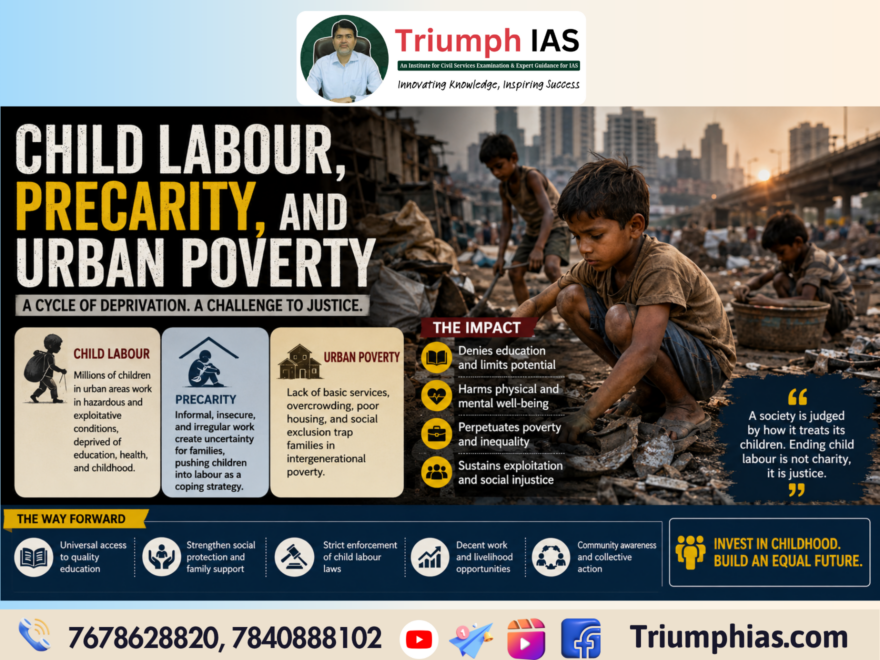
Urbanization is often associated with economic opportunity, modern infrastructure, and social mobility. Yet beneath the glittering skylines of cities lies a harsh reality of poverty, insecurity, and exploitation. One of the most visible manifestations of this contradiction is child labour. The persistence of child labour in urban areas reflects not only economic deprivation but also deeper structural inequalities that characterize contemporary societies. From a sociological perspective, child labour is closely linked to precarity and urban poverty, forming a vicious cycle that reproduces social disadvantage across generations.

Child labour refers to the engagement of children in economic activities that deprive them of education, health, and normal childhood development. In many developing countries, including India, children work in roadside eateries, workshops, construction sites, domestic service, waste collection, and informal businesses. While legal frameworks prohibit hazardous child labour, economic necessity often forces families to depend on children’s earnings for survival.

The concept of precarity has gained significant importance in contemporary sociology. Precarity refers to conditions of uncertainty, instability, and insecurity experienced by individuals in employment and everyday life. Urban poor households often face irregular incomes, informal employment, inadequate housing, and limited access to social protection. In such circumstances, child labour becomes a coping strategy for families struggling to meet basic needs.

Sociologists argue that child labour cannot be understood merely as an individual or family problem. It is deeply embedded within broader social structures. Karl Marx viewed labour exploitation as a consequence of capitalist production systems that seek to maximize profits by reducing labour costs. Child labour represents an extreme form of such exploitation, where vulnerable children become part of a cheap and flexible workforce. The informal economy, characterized by weak regulation and low wages, provides fertile ground for the continuation of child labour.

Urban poverty further reinforces this phenomenon. Rapid urbanization has led to the growth of slums and informal settlements where millions of migrants reside. These communities often lack quality schools, healthcare facilities, and employment opportunities. Children growing up in such environments face multiple forms of deprivation. Pierre Bourdieu’s concept of cultural capital helps explain why children from poor households often remain trapped in cycles of poverty. Limited educational opportunities restrict their ability to acquire the skills and resources necessary for upward mobility.

The relationship between child labour and urban poverty is also shaped by social stratification. Marginalized groups, including lower castes, tribal communities, religious minorities, and migrant populations, are disproportionately represented among child labourers. This highlights the intersection of class, caste, and social exclusion in producing unequal life chances. Such patterns demonstrate how structural inequalities continue to shape access to education, employment, and social mobility.

Globalization and economic restructuring have added new dimensions to the problem. The expansion of informal labour markets and subcontracting systems has increased demand for low-cost labour. Consequently, children often become invisible workers within supply chains, particularly in sectors such as garment production, recycling, and small-scale manufacturing. The gig economy and platform-based work have also intensified employment insecurity for adults, indirectly increasing the economic pressures that contribute to child labour.

Addressing child labour requires more than legal prohibition. Sociological analysis emphasizes the need for comprehensive interventions that tackle the root causes of poverty and precarity. Strengthening social security systems, improving access to quality education, ensuring decent work for adults, and promoting inclusive urban development are essential steps. Community participation, civil society initiatives, and effective implementation of labour laws can further contribute to reducing child labour.

In conclusion, child labour, precarity, and urban poverty are interconnected social phenomena rooted in structural inequalities. They reveal how economic insecurity and social exclusion undermine the rights and well-being of children. A sociological understanding of these issues highlights the importance of addressing not only immediate symptoms but also the broader social and economic conditions that sustain them. Creating equitable and inclusive cities requires protecting children from exploitation and ensuring that every child has the opportunity to learn, grow, and thrive.

UPSC Civil Services (Mains) Question

Q. “Child labour in urban India is a manifestation of structural poverty and labour precarity rather than merely a legal issue.” Examine this statement using sociological perspectives. (20 Marks)

To Read more topicsvisit: www.triumphias.com/blogs

Read more Blogs:

Working Class Mobilisation in the Informal Economy

Poverty Anywhere is a Threat to Prosperity Everywhere – Triumph IAS & Vikash Ranjan Sir


🔥 YOUR FINAL UPSC RANK CAN BE DECIDED BY JUST TWO PAPERS — ESSAY & OPTIONAL!

Most aspirants study hard.
But very few know how to convert knowledge into MARKS.

That’s where Triumph IAS creates the difference. 🚀

✍️ EMTS – Essay Mentorship & Test Series (CSE Mains 2026–27)

Under the mentorship of Vikash Ranjan Sir, master the art of writing structured, philosophical, multidimensional, and topper-level essays.

Scientific Essay Writing Approach
Knowledge Matrix Framework
5 Exclusive Essay Approach Classes
2 Thematic Tests + 4 UPSC Mock Tests
Detailed Model Essay Hints
Flexible Writing & Discussion Sessions
Personal 1-to-1 Mentorship

🏆 Trusted by UPSC Essay Toppers
━━━━━━━━━━━━━━━━━━

📚 SMTS – Sociology Mentorship & Test Series + Quick Revision Session (QRS)

🎯 SCORE 300+ MARKS IN SOCIOLOGY OPTIONAL

A structured, analytical, and result-oriented mentorship program designed to maximize your Sociology score under the guidance of Vikash Ranjan Sir.

Program Highlights:

26 Full-Length Tests with Detailed Evaluation
PYQ–NYQ Trend Analysis
Quick Revision Sessions on Unconventional Questions
Brainstorming & Concept Enrichment Sessions
1-to-1 Personal Mentorship Discussions
Topic-wise Answer Writing Practice
Current Social Issues Compilation
Home-based Practice Tests with Model Hints
Thinkers Integration & Value Addition Notes
Essay & GS Enrichment through Sociology

  • 🏆 Legacy of High Scores Continues:
  • 🌟 G.R. Raghavendra, IPS – 318
  • 🌟 Medha Anand, IAS – 310
  • 🌟 Sandesh Jain, IPS – 309
  • 🌟 Gauravjeet Singh, IPS – 309
  • 🌟 Deepanshu Khurana, IFS – 303
  • 🌟 Pradeep Singh, IAS – 302
  • 🌟 Swati Sharma, IAS – 296
  • 🌟 Gunjita Agarwal, IAS – 295

…and many more successful aspirants.

━━━━━━━━━━━━━━━━━

Batch Starts: 01 June

  • 📍 Available in OFFLINE & ONLINE Mode
  • 📞 Call/WhatsApp: 7678628820 | 7840888102
  • 🌐 triumphias.com
  • 📍 Triumph IAS
  • 23-B, 3rd Floor, Pusa Road
  • Near Karol Bagh Metro Pillar No. 114, New Delhi

EMTS – Essay Mentorship & Test Series (CSE Mains 2026–27)


Leave a Reply

Your email address will not be published. Required fields are marked *