
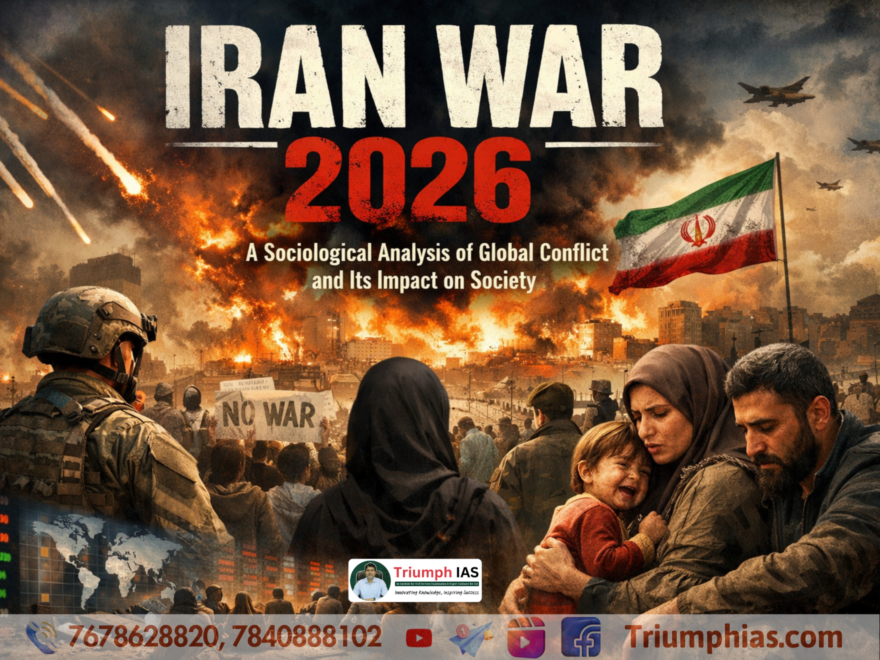
Relevant for Sociology Optional Paper 1, Paper 2, and GS Paper I (Indian Society)
IntroductionThe unfolding Iran War of 2026 is not merely a geopolitical confrontation confined to the Middle East; it represents a transformative global event with profound sociological implications. In an era of deep globalization, wars are no longer localized—they ripple across economies, identities, institutions, and everyday life worldwide. From rising fuel prices in India to shifting global alliances, the war exemplifies how conflict becomes a “total social phenomenon.” This blog examines the sociological impact of the Iran war across macro, meso, and micro levels, while situating it within key theoretical frameworks. 1. War and the Restructuring of Global Power DynamicsThe Iran war reflects a broader reconfiguration of global power structures. It involves multiple actors—Western powers, regional states, and non-state militias—transforming it into a complex, multi-layered conflict. From a sociological standpoint, this aligns with Conflict Theory, which views war as an extension of struggles over resources, dominance, and ideological control. Control over oil routes, particularly the Strait of Hormuz, highlights how economic interests underpin geopolitical strategies. Simultaneously, World-System Theory helps explain the hierarchical nature of this conflict:
This restructuring signals a shift from a unipolar to a more fragmented and contested global order. 2. Economic Shockwaves and the Rise of InequalityOne of the most immediate consequences of the war is economic disruption. Rising oil prices, inflation, and supply chain breakdowns have affected economies globally, including India. From a sociological lens:
This reflects the expansion of what sociologists call the “precariat class”—a group characterized by unstable employment and economic insecurity. Furthermore, the crisis reinforces global dependency structures, as energy-importing nations become more vulnerable to geopolitical instability. Thus, economic consequences are not merely financial—they reshape class relations and deepen structural inequalities. 3. Crisis of Globalization: From Integration to FragmentationThe Iran war exposes the fragility of globalization. Disruptions in shipping routes, airspace closures, and trade bottlenecks challenge the idea of a seamlessly connected world. We are witnessing a transition from:
Countries are increasingly prioritizing self-reliance, supply chain security, and domestic production. This shift has long-term sociological implications:
Globalization is not ending, but it is being restructured along strategic and security lines. 4. Militarization and the Expansion of the Security StateWar often leads to the strengthening of state power, and the Iran conflict is no exception. Governments across the region—and even beyond—are expanding surveillance systems, military spending, and internal security measures. This reflects a shift toward what political sociologists call the “national security state”, characterized by:
In such contexts, democratic institutions may weaken, and authoritarian tendencies can gain legitimacy under the pretext of national defense. 5. Migration, Displacement, and Social TensionsThe war has triggered large-scale displacement, leading to refugee flows across borders. Migration, in sociological terms, is not just a demographic process—it is a social transformation. Key consequences include:
Host societies often experience “othering”, where migrants are seen as outsiders, leading to social fragmentation. At the same time, migrant communities develop new forms of solidarity and resilience. 6. The Rise of Information Warfare and Digital SocietyUnlike traditional wars, the Iran conflict is also being fought in the digital realm. Cyberattacks, misinformation campaigns, and media narratives are central to shaping public perception. This marks the emergence of “information warfare society”, where:
The blurring of civilian and military domains reflects the transformation of modern warfare into a total social process. 7. Everyday Life in a Global Risk SocietyOne of the most striking aspects of the war is its impact on everyday life—even in countries far removed from the conflict zone. Rising fuel prices, inflation, and uncertainty influence:
This aligns with Ulrich Beck’s concept of the “Risk Society”, where global risks—such as war, climate change, or pandemics—shape individual behavior across borders. In this context, the Iran war is not distant—it is embedded in daily routines, from transportation costs to food prices. 8. Identity, Nationalism, and Social PolarizationWars tend to intensify identity politics. The Iran conflict has contributed to:
Such processes often lead to social polarization, where societies become divided along ideological, religious, or ethnic lines. Media and political discourse further amplify these divisions, creating a climate of suspicion and moral panic. 9. Long-Term Sociological ImplicationsThe long-term effects of the Iran war are likely to include:
These trends suggest that the war is not an isolated event but part of a broader transformation toward a “polycrisis world”, where multiple crises intersect and reinforce each other. ConclusionThe Iran War 2026 demonstrates that modern conflicts are not confined to battlefields—they permeate every layer of society. From global power structures to individual lifestyles, the war reshapes economic systems, political institutions, and social identities. In sociological terms, it represents a total social phenomenon, where war becomes a lens through which we understand globalization, inequality, risk, and human behavior. Ultimately, the conflict underscores a critical reality of the 21st century: |
UPSC Civil Services (Mains) Question
Q.“Wars in the contemporary world are not merely political events but total social phenomena.” Examine this statement in the context of the Iran war. (250 words)
To Read more topics, visit: www.triumphias.com/blogs
Read more Blogs:
The Empires of the future will be the empires of the mind – Triumph IAS & Vikash Ranjan Sir
 SANDESH JAIN [B.Tech] SOCIOLOGY STRATEGY #UPSC CSE 2025
 𝐖𝐡𝐚𝐭 𝐦𝐚𝐤𝐞𝐬 𝐭𝐡𝐢𝐬 𝐚𝐜𝐡𝐢𝐞𝐯𝐞𝐦𝐞𝐧𝐭 𝐞𝐱𝐭𝐫𝐚𝐨𝐫𝐝𝐢𝐧𝐚𝐫𝐲 𝐢𝐬 𝐡𝐢𝐬 𝐒𝐨𝐜𝐢𝐨𝐥𝐨𝐠𝐲 𝐎𝐩𝐭𝐢𝐨𝐧𝐚𝐥 𝐬𝐜𝐨𝐫𝐞:
 𝐓𝐎𝐓𝐀𝐋 𝐒𝐎𝐂𝐈𝐎𝐋𝐎𝐆𝐘 𝐌𝐀𝐑𝐊𝐒: 𝟑𝟎𝟗
 𝐏𝐚𝐩𝐞𝐫 𝟏 – 173 Marks 𝐏𝐚𝐩𝐞𝐫 𝟐 – 136 Marks
 Single Source Preparation- Only #Vikash #Ranjan Sir’s Sociology Foundation Class Notes, Discussions, Application Strategies & Answer Writing Practice. No multiple books or Scattered Materials, No PDFs, No Free YouTube Time Wastes, No other Essentials.
 Offline Classroom Program
 Live Online Classes
 Tablet Course (Learn Anytime)
2 comments