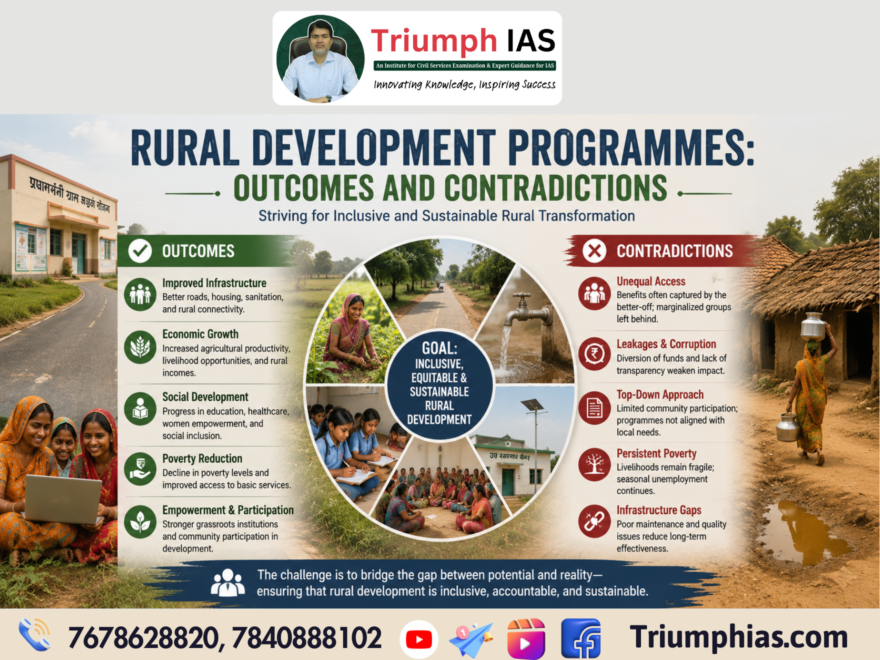
Rural development has remained one of the central concerns of post-independence India. Since nearly two-thirds of India’s population resides in rural areas, the state has introduced several programmes aimed at poverty alleviation, employment generation, agricultural modernization, infrastructure development, and social empowerment. Programmes such as the Mahatma Gandhi National Rural Employment Guarantee Act (MGNREGA), Pradhan Mantri Gram Sadak Yojana (PMGSY), National Rural Livelihood Mission (NRLM), and Swachh Bharat Mission have transformed many dimensions of rural life.
However, sociology highlights that development is not merely an economic process; it also involves changes in social relations, power structures, inequality, and cultural patterns. Thus, while rural development programmes have achieved significant outcomes, they also reveal several contradictions.
Dimension
One major achievement of rural development programmes has been poverty reduction and employment generation. MGNREGA, for example, has provided wage employment to millions of rural households, particularly during periods of agrarian distress. Sociologically, it has strengthened the bargaining power of rural labourers against exploitative landlords. Similarly, self-help groups under NRLM have increased women’s participation in economic activities and enhanced their financial autonomy. Rural roads under PMGSY have improved connectivity, facilitating access to markets, schools, and healthcare services.
Another important outcome is the expansion of social infrastructure. Programmes related to sanitation, electrification, and housing have improved the quality of life in villages. The Swachh Bharat Mission has contributed to awareness regarding hygiene and sanitation, while schemes such as PM Awas Yojana have reduced housing insecurity. Rural development programmes have also encouraged decentralization through Panchayati Raj Institutions, promoting local participation in governance.
Despite these achievements, several contradictions persist. One major contradiction is the unequal distribution of benefits. Sociologists point out that dominant castes and rural elites often capture state resources due to their control over local institutions. Marginalized communities, including Dalits, Adivasis, and landless labourers, frequently remain excluded from the full benefits of development schemes. Thus, rural development sometimes reproduces existing inequalities instead of eliminating them.
Another contradiction lies between economic growth and social justice. Development projects such as dams, mining, and industrial corridors have often displaced tribal and rural communities. While such projects are justified in the name of national development, they create social dislocation and loss of traditional livelihoods. This reflects the conflict between modernization and community-based ways of life.
Rural development programmes also reveal the contradiction between state policy and ground-level implementation. Corruption, bureaucratic inefficiency, fake beneficiaries, and political patronage reduce the effectiveness of many schemes. MGNREGA, for instance, has faced issues related to delayed wage payments and ghost workers in some regions. Such problems demonstrate the gap between policy intentions and administrative realities.
From a sociological perspective, another contradiction is cultural transformation. Development programmes promote modernization, consumerism, and market-oriented values, which sometimes weaken traditional institutions and collective solidarity. Rural societies experience increasing individualism, migration, and changing family structures. While modernization creates opportunities, it may also generate social tensions and identity crises.
Thinkers like André Béteille and A.R. Desai argued that rural development in India cannot be understood only through economic indicators. A.R. Desai, using a Marxist perspective, emphasized that state-led development often serves the interests of dominant classes rather than the rural poor. On the other hand, participatory development approaches stress the need for inclusive and community-driven models of development.
Conclusion
In conclusion, rural development programmes in India have produced significant improvements in employment, infrastructure, and social welfare. However, they also expose deep contradictions related to inequality, exclusion, displacement, and uneven implementation. Sociology helps us understand that development is not a neutral process; it is shaped by power relations, class structures, caste hierarchies, and political interests. Therefore, sustainable rural development requires not only economic investment but also social justice, participatory governance, and equitable distribution of resources.





2 comments