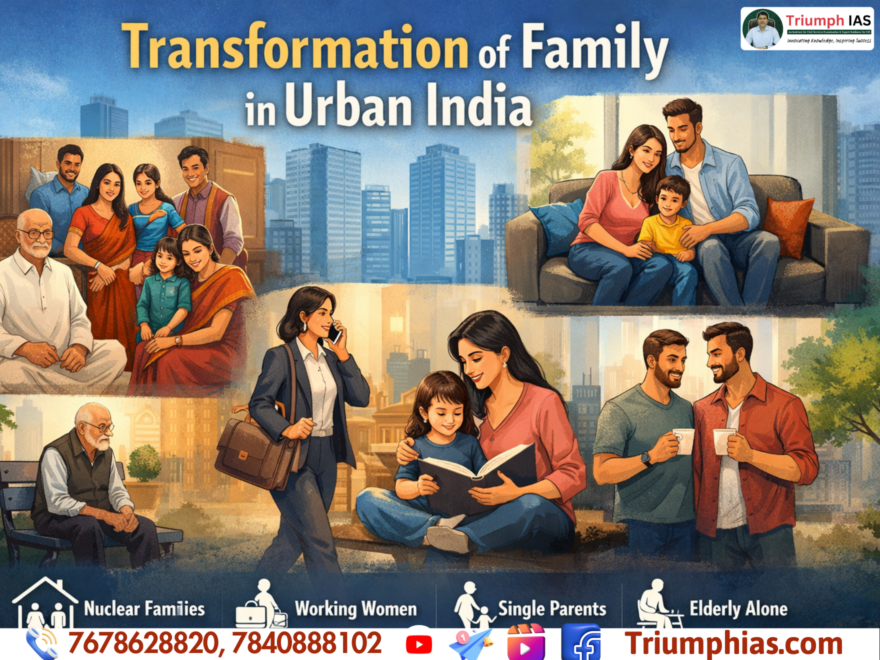
The institution of family in India has historically been regarded as the cornerstone of social organization, deeply embedded in traditions, kinship ties, and cultural norms. However, rapid urbanization, industrialization, and globalization have significantly altered the structure, functions, and values associated with the family, especially in urban India. From large, joint family systems to nuclear and individualized arrangements, this transformation reflects broader socio-economic and cultural shifts.
Dimension
One of the most visible changes is the decline of the joint family system and the rise of nuclear families. Urban living conditions—characterized by limited space, high cost of living, and increased mobility—have made joint family arrangements less feasible. Nuclear families, consisting of parents and their children, offer greater privacy and autonomy, aligning with the demands of modern urban life. This shift also reflects a movement from collectivism to individualism, where personal aspirations and career priorities often take precedence over familial obligations.
Another significant transformation is the changing role of women within the family. With increased access to education and employment opportunities, women in urban India are no longer confined to domestic roles. Dual-income households have become common, leading to a redefinition of gender roles and power dynamics within the family. Decision-making is increasingly shared, and patriarchal authority is gradually weakening, although not uniformly across all social strata.
Urbanization has also led to the functional transformation of the family. Traditionally, the family was responsible for functions such as education, economic production, socialization, and care of the elderly. In urban settings, many of these functions have been taken over by specialized institutions like schools, daycare centers, hospitals, and old-age homes. As a result, the family’s role is becoming more emotion-centric, focusing on companionship, emotional support, and psychological well-being rather than economic or educational functions.
The emergence of new family forms further illustrates this transformation. Live-in relationships, single-parent families, child-free couples, and even same-sex partnerships (though still socially contested) are increasingly visible in urban India. These forms challenge traditional norms of marriage and family, indicating a shift towards more flexible and diverse familial arrangements. Sociologically, this reflects the influence of Western values, legal reforms, and changing attitudes toward individual freedom and choice.
At the same time, the transformation is not without challenges. The weakening of extended kinship ties can lead to social isolation, particularly among the elderly. The pressure of urban life, work stress, and lack of support systems often contribute to marital instability and rising divorce rates. Moreover, the commercialization of care services raises concerns about the quality and emotional adequacy of such arrangements.
Importantly, the transformation of family in urban India is not linear or uniform. It varies across class, caste, and regional contexts. While the middle and upper classes are more likely to adopt nuclear and modern family forms, elements of traditional structures often persist, especially in terms of values, rituals, and social expectations. Thus, the contemporary urban family represents a hybrid model, combining traditional norms with modern practices.
Conclusion
In conclusion, the transformation of family in urban India reflects broader processes of social change driven by urbanization, economic development, and cultural globalization. While it has led to greater autonomy, gender equality, and diversity in family forms, it also poses challenges related to social cohesion and support systems. Understanding these changes is crucial for sociological analysis as well as for policy-making aimed at strengthening family well-being in a rapidly changing society.

 SANDESH JAIN [B.Tech] SOCIOLOGY STRATEGY #UPSC CSE 2025
 𝐖𝐡𝐚𝐭 𝐦𝐚𝐤𝐞𝐬 𝐭𝐡𝐢𝐬 𝐚𝐜𝐡𝐢𝐞𝐯𝐞𝐦𝐞𝐧𝐭 𝐞𝐱𝐭𝐫𝐚𝐨𝐫𝐝𝐢𝐧𝐚𝐫𝐲 𝐢𝐬 𝐡𝐢𝐬 𝐒𝐨𝐜𝐢𝐨𝐥𝐨𝐠𝐲 𝐎𝐩𝐭𝐢𝐨𝐧𝐚𝐥 𝐬𝐜𝐨𝐫𝐞:
 𝐓𝐎𝐓𝐀𝐋 𝐒𝐎𝐂𝐈𝐎𝐋𝐎𝐆𝐘 𝐌𝐀𝐑𝐊𝐒: 𝟑𝟎𝟗
 𝐏𝐚𝐩𝐞𝐫 𝟏 – 173 Marks
 Single Source Preparation- Only #Vikash #Ranjan Sir’s Sociology Foundation Class Notes, Discussions, Application Strategies & Answer Writing Practice.
 Offline Classroom Program
 Live Online Classes
 Tablet Course (Learn Anytime)
2 comments