
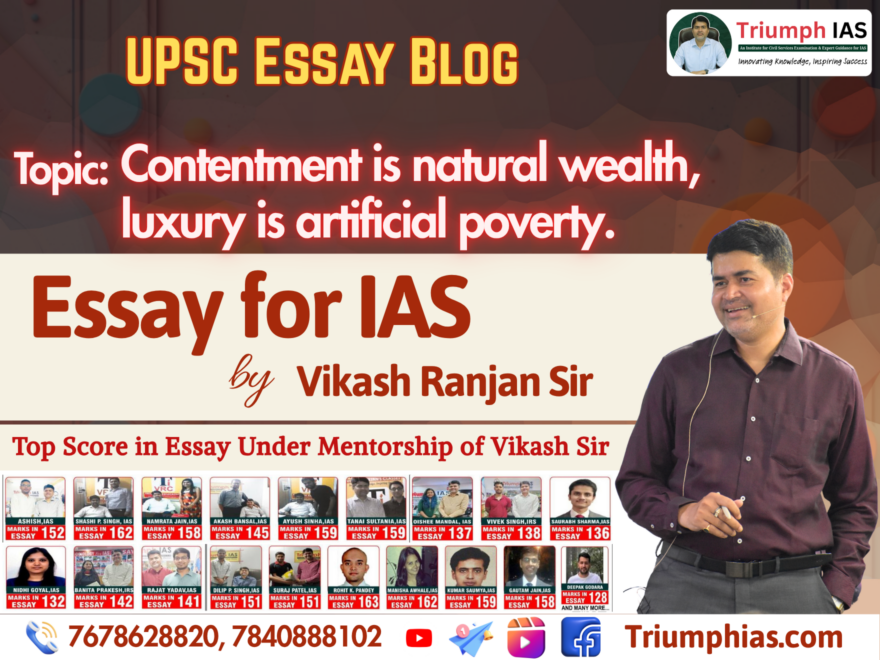
𝐑𝐞𝐥𝐞𝐯𝐚𝐧𝐭 𝐟𝐨𝐫: Essay for IAS
INTRODUCTION:The ancient Greek philosopher Epicurus observed, “Contentment is natural wealth, luxury is artificial poverty.” In this seemingly simple statement lies a profound insight into human nature, happiness, and civilization. Wealth is commonly understood as the accumulation of material possessions, income, and resources. Poverty, conversely, is seen as the absence of such material means. However, Epicurus challenges this conventional understanding by shifting the discussion from external possessions to internal satisfaction. According to him, contentment itself is true wealth because it frees an individual from endless wants, whereas luxury creates ever-expanding desires, making even the affluent feel deprived. In an age marked by consumerism, hyper-competition, social media comparison, and relentless pursuit of material success, this idea acquires renewed relevance. Modern societies have achieved unprecedented prosperity, yet anxiety, stress, dissatisfaction, and mental health crises continue to rise. The paradox suggests that abundance of possessions does not necessarily translate into abundance of happiness. Therefore, the distinction between contentment and luxury is not merely an ethical or philosophical issue but also a social, economic, environmental, and psychological concern. Understanding this distinction is essential for both individual well-being and collective progress. MAIN BODY:Contentment refers to a state of inner satisfaction arising from the acceptance and appreciation of what one possesses. It does not imply stagnation, passivity, or lack of ambition. Rather, it signifies freedom from excessive craving and the ability to derive happiness from meaningful experiences. Natural wealth emerges from the alignment between desires and available resources. A contented individual experiences a sense of abundance because expectations remain realistic and needs remain limited. Such a person enjoys peace of mind, emotional stability, and gratitude. Consequently, happiness becomes independent of external circumstances. This understanding finds resonance across civilizations. Indian philosophy repeatedly emphasizes the virtue of “Santosha” or contentment. The yogic tradition identifies contentment as one of the essential disciplines for inner growth. Similarly, Buddhist thought locates suffering in unending desire and advocates moderation as the path to liberation. Thus, different intellectual traditions converge on the belief that happiness is primarily an internal condition rather than an external acquisition. Moreover, contentment enables individuals to appreciate life’s simple joys—relationships, health, nature, knowledge, and service. Unlike material possessions, these sources of fulfillment often deepen with use rather than diminish. Hence, contentment creates a sustainable form of wealth that neither inflation nor economic downturns can erode. While contentment limits desires, luxury often expands them. Luxury is not merely the possession of expensive goods; it is a mindset that equates happiness with continuous acquisition. Once luxury becomes a necessity rather than an occasional indulgence, it generates dependency. Consequently, luxury creates artificial poverty. The individual may possess immense resources, yet feel deprived because aspirations constantly outpace achievements. Every attainment becomes temporary, and every satisfaction is short-lived. The horizon of desire recedes endlessly. Modern psychology describes this phenomenon through the concept of the “hedonic treadmill.” Individuals rapidly adapt to improved circumstances and soon return to their previous level of satisfaction. A larger house, a luxury vehicle, or a higher salary may provide temporary pleasure, but soon become the new normal. Thereafter, even greater acquisitions are required to sustain happiness. Therefore, luxury can create a paradoxical condition in which material affluence coexists with emotional deprivation. The poor person lacking necessities suffers from real poverty, but the affluent individual trapped in limitless desires experiences a different form of scarcity—the scarcity of satisfaction. The modern economy is increasingly driven not by needs but by wants. Advertising, branding, and digital platforms continuously create new aspirations. Products are marketed not merely for utility but for status, identity, and social recognition. As a result, individuals often measure success through consumption rather than character. Social media further intensifies this tendency by transforming lifestyles into spectacles. Curated images of luxury vacations, expensive gadgets, and lavish celebrations create unrealistic benchmarks against which people evaluate their own lives. Consequently, comparison becomes a permanent source of dissatisfaction. Even substantial achievements appear inadequate when contrasted with the perceived success of others. Thus, consumer culture systematically converts contentment into discontent and sufficiency into inadequacy. Furthermore, this cycle benefits economic expansion but often undermines psychological well-being. When desires are continuously manufactured, no level of consumption can produce lasting fulfillment. Hence, luxury becomes an engine of artificial poverty. The relationship between contentment and mental health is increasingly evident in contemporary societies. Despite rising incomes and technological conveniences, stress, anxiety, loneliness, and depression have become widespread. One reason is that modern life often encourages individuals to pursue external validation rather than internal fulfillment. Success is measured through rankings, possessions, and social approval. Such metrics are inherently unstable because they depend on comparison and competition. Contentment, by contrast, provides psychological resilience. It fosters gratitude, self-acceptance, and emotional balance. Individuals who appreciate what they possess are less vulnerable to envy and frustration. They experience greater life satisfaction even when faced with challenges. Moreover, contentment promotes mindfulness. Instead of constantly chasing future rewards, individuals learn to value the present moment. This capacity to remain anchored in the present enhances emotional health and reduces stress. Therefore, contentment functions not only as a moral virtue but also as a practical strategy for psychological well-being. At first glance, contentment may appear incompatible with economic development. Critics argue that if people become content, innovation, productivity, and growth may decline. However, such criticism rests on a misunderstanding of contentment. Contentment does not oppose aspiration; it opposes greed. It encourages purposeful ambition rather than endless accumulation. A scientist seeking knowledge, a teacher nurturing students, or an entrepreneur solving social problems may be deeply content while remaining highly motivated. In fact, some of history’s greatest achievements emerged from individuals driven by purpose rather than material gain. Their fulfillment arose from creativity, service, and excellence rather than consumption. Furthermore, economic growth that ignores contentment often produces inequality, environmental degradation, and social tensions. Therefore, the challenge is not to choose between growth and contentment but to harmonize them. Sustainable development requires prosperity guided by wisdom rather than excess. The relevance of contentment extends beyond individual life to planetary survival. Contemporary environmental crises are closely linked to patterns of excessive consumption. The pursuit of luxury frequently demands disproportionate use of natural resources. Excessive energy consumption, waste generation, deforestation, and carbon emissions are often driven by lifestyles that prioritize indulgence over necessity. Consequently, ecological degradation can be viewed as a collective manifestation of unrestrained desire. The Earth possesses sufficient resources to meet human needs but not unlimited greed. Contentment offers an alternative paradigm. By encouraging moderation and responsible consumption, it reduces pressure on ecosystems. Sustainable lifestyles become possible when individuals distinguish genuine needs from manufactured wants. Therefore, contentment is not merely a personal virtue; it is an ecological necessity in the age of climate change. Societies characterized by extreme materialism often experience growing inequality and social fragmentation. When wealth becomes the primary measure of worth, human relationships are reduced to transactions. In contrast, contentment nurtures empathy and social responsibility. Individuals who are not consumed by excessive self-interest are more likely to contribute to the welfare of others. They recognize that happiness derives not only from receiving but also from giving. Moreover, contentment strengthens community bonds. It shifts attention from competition to cooperation and from possession to participation. Families, neighborhoods, and institutions become healthier when mutual respect outweighs material comparison. Hence, contentment serves as a foundation for social cohesion and ethical citizenship. Many influential thinkers and leaders embodied the principle that inner richness surpasses material abundance. Their lives demonstrate that simplicity can coexist with greatness. The teachings of Mahatma Gandhi emphasized that voluntary simplicity liberates individuals from dependence on possessions. Likewise, Henry David Thoreau argued that reducing unnecessary wants expands human freedom. Spiritual traditions across the world have similarly celebrated moderation as a path to wisdom. Importantly, these thinkers did not reject progress. Rather, they questioned the assumption that material accumulation alone constitutes progress. Their message remains relevant in a world where economic indicators often overshadow measures of human well-being. Nevertheless, the celebration of contentment must avoid romanticizing poverty. Real poverty deprives individuals of food, healthcare, education, and dignity. Contentment cannot substitute for social justice or economic opportunity. Therefore, society must distinguish between necessities and excesses. Ensuring basic needs for all remains a moral imperative. Once those needs are met, however, the pursuit of happiness requires more than material accumulation. A balanced approach combines material sufficiency with inner fulfillment. Economic growth should create opportunities, while ethical values should guide consumption. Ambition should inspire excellence, but contentment should prevent greed. Such a synthesis allows individuals to prosper without becoming prisoners of desire. CONCLUSION:The statement “Contentment is natural wealth, luxury is artificial poverty” captures a timeless truth about the human condition. True wealth lies not merely in what one possesses but in one’s capacity to appreciate and wisely use what one has. Contentment liberates individuals from the tyranny of endless desires, while luxury, when elevated into a way of life, often creates perpetual dissatisfaction. Furthermore, the significance of this insight extends beyond personal happiness. It has implications for mental health, social harmony, economic sustainability, and environmental preservation. In a world increasingly driven by consumption and comparison, contentment offers a countervailing philosophy rooted in balance, gratitude, and self-mastery. Ultimately, civilization advances not when desires become infinite, but when wisdom governs desire. A society that combines material prosperity with inner contentment can achieve both progress and peace. Thus, natural wealth is not measured by the abundance of possessions but by the abundance of satisfaction, for the richest person is not the one who has the most, but the one who needs the least. |
Read more blog:
It is best to see life as a journey, not as a destination – Triumph IAS & Vikash Ranjan Sir
Best Essay Writing Course for UPSC CSE
If you’re preparing for the UPSC Civil Services Examination (CSE), one paper that can unlock exceptional scores and a top rank is the Essay Paper. While General Studies and Optional Subjects are structured and syllabus-driven, the Essay writing segment is where individuality, critical thinking, and articulation truly shine.
Among various Essay programs available across India, Triumph IAS, under the expert mentorship of Vikash Ranjan Sir, offers the Best Essay writing Course for UPSC CSE. This comprehensive guide explores what makes this program unparalleled and why it should be part of every serious aspirant’s preparation strategy.


2 comments