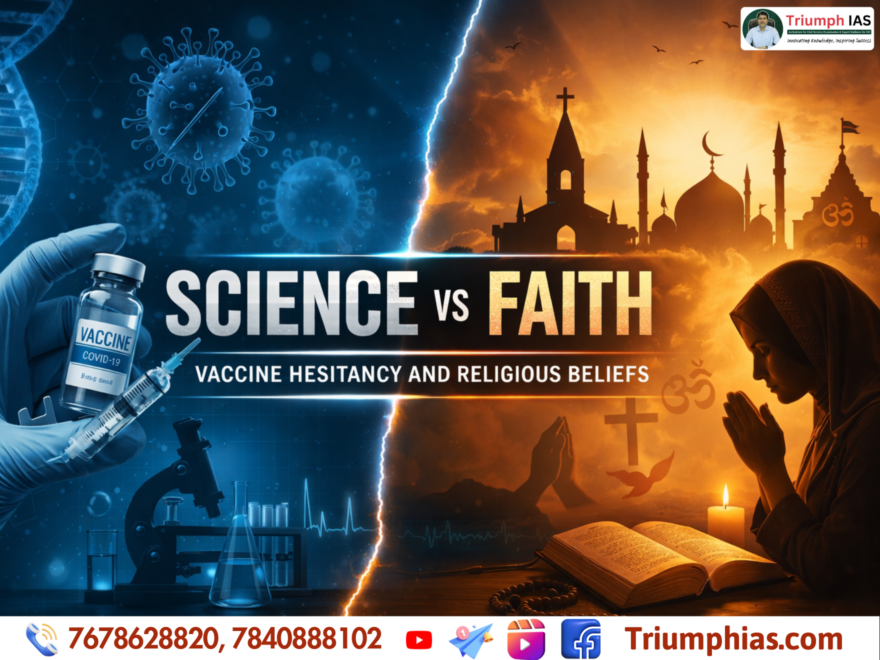
In modern societies, science is often seen as the most reliable path to truth, especially in matters of health and medicine. Yet, the persistence of vaccine hesitancy across communities shows that scientific evidence alone does not always determine human action. Belief systems, cultural traditions, and religious worldviews deeply shape how people understand illness, risk, healing, and authority. From a sociological perspective, vaccine hesitancy is not simply a matter of ignorance; it is a social phenomenon rooted in trust, identity, values, and collective meaning.
Dimension
Vaccination is one of the most significant achievements of modern science. It has reduced mortality, prevented epidemics, and strengthened public health systems across the world. However, the acceptance of vaccines depends not only on medical availability but also on public confidence. Sociologists point out that people do not make health decisions in isolation. Their choices are influenced by family, community leaders, social networks, and institutions they trust. In many societies, religion plays a central role in shaping these networks of trust.
Religious beliefs may affect vaccine attitudes in multiple ways. In some cases, communities raise moral or theological concerns about the ingredients, development, or perceived side effects of vaccines. In others, faith-based understandings of health may encourage reliance on divine protection, prayer, or traditional healing methods over biomedical intervention. Sometimes, religious hesitation is not directly based on doctrine but on the social authority of religious leaders, who may influence public opinion more strongly than doctors or state officials. Thus, vaccine hesitancy becomes embedded in a wider social structure where faith, culture, and identity interact.
This issue can be better understood through major sociological perspectives. From the functionalist perspective, both science and religion perform social functions. Science supports societal stability by promoting health, reducing disease, and increasing life expectancy. Religion, meanwhile, provides moral order, emotional security, and a sense of belonging. Conflict emerges when these two institutions prescribe different responses to a public health crisis. The challenge for society is not to eliminate one in favor of the other, but to create coordination between them.
From the conflict perspective, vaccine hesitancy can also reflect mistrust in institutions of power. Many marginalized communities, including religious minorities, may view state-led vaccination campaigns with suspicion due to past experiences of exclusion, discrimination, or medical neglect. In such contexts, faith-based resistance may represent not only belief but also a critique of unequal power relations. Sociology reminds us that distrust often has a historical and structural basis.
Symbolic interactionism offers another insight. People attach meanings to vaccines through everyday communication, symbols, and narratives. Rumours, sermons, family conversations, and social media messages shape how vaccines are interpreted. A vaccine may be seen by one person as protection and by another as danger, impurity, or external control. These meanings are socially constructed, and they influence behaviour just as strongly as scientific facts.
The debate between science and faith should therefore not be framed as a simple opposition. In reality, many religious communities support vaccination and have actively contributed to public health awareness. Faith leaders can become powerful allies in reducing misinformation and encouraging collective responsibility. When public health communication respects religious sentiments and engages communities with sensitivity, the gap between scientific policy and social acceptance can be narrowed.
For India and other plural societies, this issue is especially important. Public health policies must recognize social diversity and the role of religion in everyday life. A purely technocratic approach may fail if it ignores cultural contexts. Sociology helps us understand that health behaviour is shaped by social institutions, collective beliefs, and lived experiences. Vaccine hesitancy, therefore, is not merely a medical issue; it is also a question of social trust, cultural legitimacy, and the relationship between modernity and tradition.
Conclusion
In conclusion, vaccine hesitancy linked to religious beliefs highlights the complex interaction between science, faith, and society. Sociology moves the discussion beyond blame and helps explain why people resist, accept, or negotiate scientific interventions within their social worlds. The real solution lies not in dismissing faith, but in building trust, dialogue, and inclusive institutions that connect scientific knowledge with social reality.

 SANDESH JAIN [B.Tech] SOCIOLOGY STRATEGY #UPSC CSE 2025
 𝐖𝐡𝐚𝐭 𝐦𝐚𝐤𝐞𝐬 𝐭𝐡𝐢𝐬 𝐚𝐜𝐡𝐢𝐞𝐯𝐞𝐦𝐞𝐧𝐭 𝐞𝐱𝐭𝐫𝐚𝐨𝐫𝐝𝐢𝐧𝐚𝐫𝐲 𝐢𝐬 𝐡𝐢𝐬 𝐒𝐨𝐜𝐢𝐨𝐥𝐨𝐠𝐲 𝐎𝐩𝐭𝐢𝐨𝐧𝐚𝐥 𝐬𝐜𝐨𝐫𝐞:
 𝐓𝐎𝐓𝐀𝐋 𝐒𝐎𝐂𝐈𝐎𝐋𝐎𝐆𝐘 𝐌𝐀𝐑𝐊𝐒: 𝟑𝟎𝟗
 𝐏𝐚𝐩𝐞𝐫 𝟏 – 173 Marks
 Single Source Preparation- Only #Vikash #Ranjan Sir’s Sociology Foundation Class Notes, Discussions, Application Strategies & Answer Writing Practice.
 Offline Classroom Program
 Live Online Classes
 Tablet Course (Learn Anytime)
2 comments