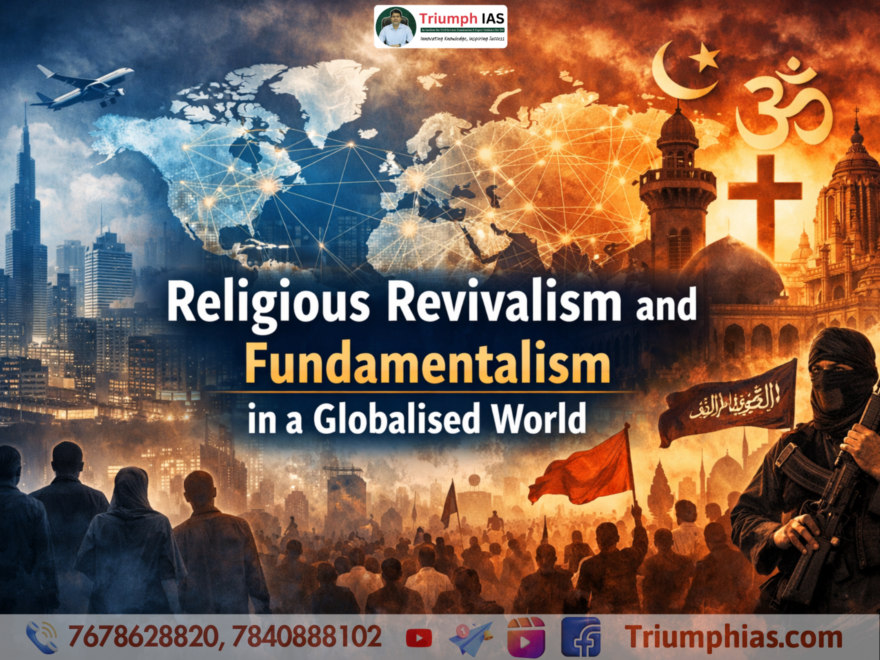
Globalisation was once expected to weaken religion by spreading secular values, consumer culture, scientific temper, and transnational institutions. Yet the contemporary world presents a different sociological reality. Instead of disappearing, religion has re-emerged in powerful and often politicised forms. Across regions, one can witness religious revivalism, identity-based mobilisation, and, in some cases, rigid fundamentalist movements. This makes the relationship between religion and modernity far more complex than classical secularisation theories had predicted.
Dimension
From a sociological perspective, religious revivalism refers to the renewed assertion of religious beliefs, practices, symbols, and institutions in public and private life. It is not always reactionary; sometimes it reflects a search for meaning, morality, and community in an increasingly fragmented world. Globalisation, by intensifying migration, urbanisation, media flows, and market forces, often produces anxiety, dislocation, and cultural insecurity. In such a setting, religion can provide emotional anchorage, collective identity, and moral certainty.
Fundamentalism, however, is a more rigid and exclusivist response. It is characterised by an insistence on absolute truth, literal interpretation of sacred texts, intolerance of dissent, and resistance to pluralism. Sociologists view fundamentalism not as a residue of tradition alone, but as a modern phenomenon shaped by the very forces of globalisation it opposes. It uses modern communication technologies, digital networks, transnational funding, and mass politics to defend what it imagines as a pure, authentic tradition.
Several sociological thinkers help explain this paradox. Peter Berger, who earlier supported secularisation theory, later acknowledged that the world remains “furiously religious.” Anthony Giddens linked fundamentalism to the insecurity generated by late modernity, where rapid social change disturbs established norms. Manuel Castells’ idea of “resistance identity” is also relevant: groups facing marginalisation or perceived cultural erosion often turn to religion as a source of resistance. Similarly, Emile Durkheim’s emphasis on religion as a source of social solidarity remains useful in understanding why people rally around sacred symbols in uncertain times.
Globalisation contributes to revivalism and fundamentalism in multiple ways. First, it creates identity crises by weakening traditional communities and exposing individuals to diverse lifestyles. Second, economic inequality and uneven development foster resentment, which can be channelled through religious narratives. Third, media and social platforms amplify religious discourse, mobilise followers, and spread both devotional as well as extremist messages across borders. Fourth, political elites often instrumentalise religion to consolidate power, especially where nationalism and religion become intertwined.
The phenomenon is visible worldwide. Islamic revivalist movements in West Asia and South Asia, evangelical resurgence in parts of the Americas and Africa, Buddhist nationalism in Myanmar and Sri Lanka, and Hindu religious assertion in India all demonstrate that religion remains deeply embedded in public life. However, it is important not to equate all revivalism with extremism. Many revivalist movements focus on reform, spirituality, ethics, social service, or cultural renewal. The sociological challenge lies in distinguishing faith-based renewal from exclusionary and violent fundamentalism.
In the Indian context, the theme is particularly significant. India’s plural and secular constitutional framework coexists with strong religious identities. Global media, diaspora networks, competitive politics, and social inequalities have all shaped the contemporary religious sphere. Religious revival may strengthen cultural confidence, but when mixed with communal polarisation, it can threaten social cohesion and democratic values. Therefore, the issue must be examined through the lenses of secularism, identity politics, nationalism, and social change.
Conclusion
In conclusion, religious revivalism and fundamentalism in a globalised world reveal that modernity does not erase religion; rather, it transforms it. Globalisation expands choices, but it also deepens insecurities. Religion then returns not merely as belief, but as identity, politics, and sometimes resistance. Sociology helps us move beyond simplistic binaries of tradition versus modernity and understand how religion adapts, resurges, and reshapes societies in an interconnected world.

 SANDESH JAIN [B.Tech] SOCIOLOGY STRATEGY #UPSC CSE 2025
 𝐖𝐡𝐚𝐭 𝐦𝐚𝐤𝐞𝐬 𝐭𝐡𝐢𝐬 𝐚𝐜𝐡𝐢𝐞𝐯𝐞𝐦𝐞𝐧𝐭 𝐞𝐱𝐭𝐫𝐚𝐨𝐫𝐝𝐢𝐧𝐚𝐫𝐲 𝐢𝐬 𝐡𝐢𝐬 𝐒𝐨𝐜𝐢𝐨𝐥𝐨𝐠𝐲 𝐎𝐩𝐭𝐢𝐨𝐧𝐚𝐥 𝐬𝐜𝐨𝐫𝐞:
 𝐓𝐎𝐓𝐀𝐋 𝐒𝐎𝐂𝐈𝐎𝐋𝐎𝐆𝐘 𝐌𝐀𝐑𝐊𝐒: 𝟑𝟎𝟗
 𝐏𝐚𝐩𝐞𝐫 𝟏 – 173 Marks
 Single Source Preparation- Only #Vikash #Ranjan Sir’s Sociology Foundation Class Notes, Discussions, Application Strategies & Answer Writing Practice.
 Offline Classroom Program
 Live Online Classes
 Tablet Course (Learn Anytime)
One comment