In every democratic society, the idea of citizenship is linked with equality, rights, and participation. Yet, the experience of minorities often reveals a gap between constitutional promises and social realities. Sociology helps us understand how citizenship is not merely a legal status but also a social experience shaped by power relations, identity, culture, and access to opportunities.
Minorities may be religious, linguistic, ethnic, racial, tribal, or cultural groups that differ from the majority population. The issue is not only numerical inferiority but also unequal access to resources, representation, and dignity. Sociologists argue that modern societies are marked by diversity, but diversity alone does not guarantee equality. The real challenge lies in ensuring inclusion without forcing cultural assimilation.
Citizenship traditionally refers to membership in a political community with rights and duties. T.H. Marshall explained citizenship through three dimensions—civil rights, political rights, and social rights. Civil rights include freedom of speech and equality before law; political rights involve participation in governance; while social rights relate to education, health, and welfare. However, minorities often struggle to fully enjoy these rights because of discrimination, prejudice, and structural inequalities.
The Indian Constitution reflects a strong commitment to equality and minority protection. Articles 14, 15, and 16 guarantee equality before law and prohibit discrimination. Articles 29 and 30 protect the cultural and educational rights of minorities. Despite these constitutional safeguards, social realities often reveal exclusion based on caste, religion, language, ethnicity, and region. Sociology studies this contradiction between formal equality and substantive equality.
One of the central debates in sociology is whether equality means treating everyone the same or recognizing differences and accommodating them. Liberal democracies generally emphasize universal citizenship, where all individuals are equal before law. However, multicultural theorists like Will Kymlicka argue that minority groups may require special protections to preserve their identity and ensure genuine equality. Thus, equality sometimes demands differential treatment rather than identical treatment.
Globalization and migration have further complicated the citizenship debate. Across the world, increasing migration has created multicultural societies where questions of identity, belonging, and nationalism have become politically sensitive. Many states struggle to balance national unity with cultural pluralism. Debates over refugees, immigrants, and citizenship laws reflect deeper anxieties about identity and social cohesion.
In India, the question of minorities is deeply connected with secularism and democracy. Indian secularism differs from the Western model because it seeks principled distance rather than strict separation between state and religion. The state may intervene to protect minority rights while maintaining equal respect for all religions. However, communal tensions, hate speech, mob violence, and identity politics continue to challenge the ideal of inclusive citizenship.
Sociologists also emphasize that exclusion is not always direct or visible. Pierre Bourdieu’s concept of cultural capital explains how dominant groups maintain privilege through language, education, and social norms. Minority communities may face disadvantages in education, employment, and representation because institutions often reflect majority culture. Thus, inequality becomes embedded within social structures.
Another important issue is intersectionality. Minority experiences are shaped not only by religion or ethnicity but also by caste, class, gender, and region. For example, a poor Muslim woman or a tribal migrant may face multiple layers of disadvantage. Sociology therefore examines how different forms of inequality intersect and reinforce each other.
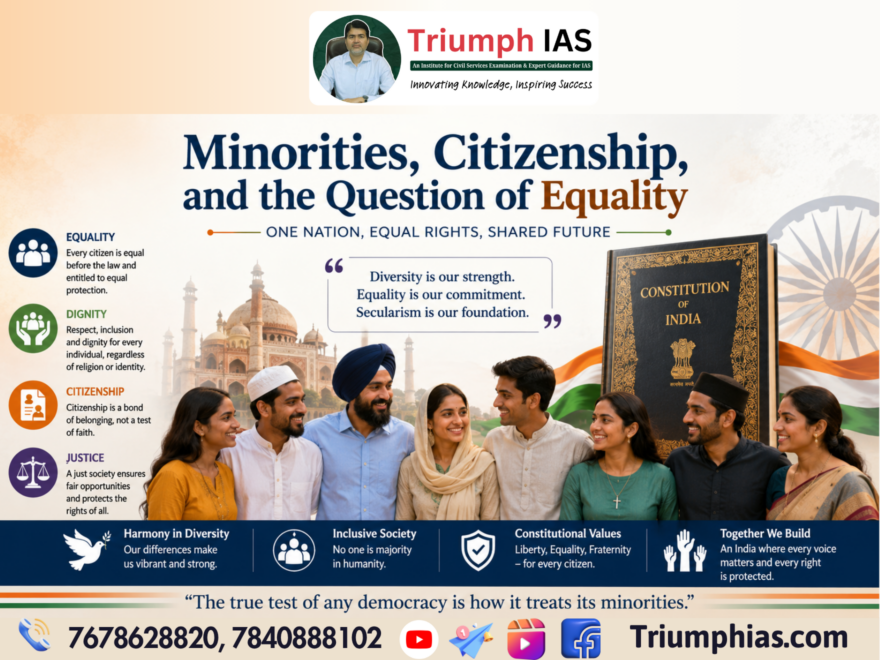
The future of democratic societies depends on creating inclusive citizenship. Equality should not merely exist in constitutional texts but also in everyday life. Respect for diversity, protection of minority rights, access to education, economic opportunities, and representation in public institutions are essential for social harmony. A society becomes truly democratic when minorities feel secure, respected, and empowered as equal citizens.
Thus, the sociology of minorities and citizenship highlights a fundamental truth: democracy is not judged only by majority rule, but by how it treats its minorities. Equality is meaningful only when every citizen, irrespective of identity, enjoys dignity, justice, and participation in collective life.

 SANDESH JAIN [B.Tech] SOCIOLOGY STRATEGY #UPSC CSE 2025
 𝐖𝐡𝐚𝐭 𝐦𝐚𝐤𝐞𝐬 𝐭𝐡𝐢𝐬 𝐚𝐜𝐡𝐢𝐞𝐯𝐞𝐦𝐞𝐧𝐭 𝐞𝐱𝐭𝐫𝐚𝐨𝐫𝐝𝐢𝐧𝐚𝐫𝐲 𝐢𝐬 𝐡𝐢𝐬 𝐒𝐨𝐜𝐢𝐨𝐥𝐨𝐠𝐲 𝐎𝐩𝐭𝐢𝐨𝐧𝐚𝐥 𝐬𝐜𝐨𝐫𝐞:
 𝐓𝐎𝐓𝐀𝐋 𝐒𝐎𝐂𝐈𝐎𝐋𝐎𝐆𝐘 𝐌𝐀𝐑𝐊𝐒: 𝟑𝟎𝟗
 𝐏𝐚𝐩𝐞𝐫 𝟏 – 173 Marks
 Single Source Preparation- Only #Vikash #Ranjan Sir’s Sociology Foundation Class Notes, Discussions, Application Strategies & Answer Writing Practice.
 Offline Classroom Program
 Live Online Classes
 Tablet Course (Learn Anytime)
3 comments