Caste Conflicts and Social Polarisation in Contemporary Society | Sociology UPSC Notes

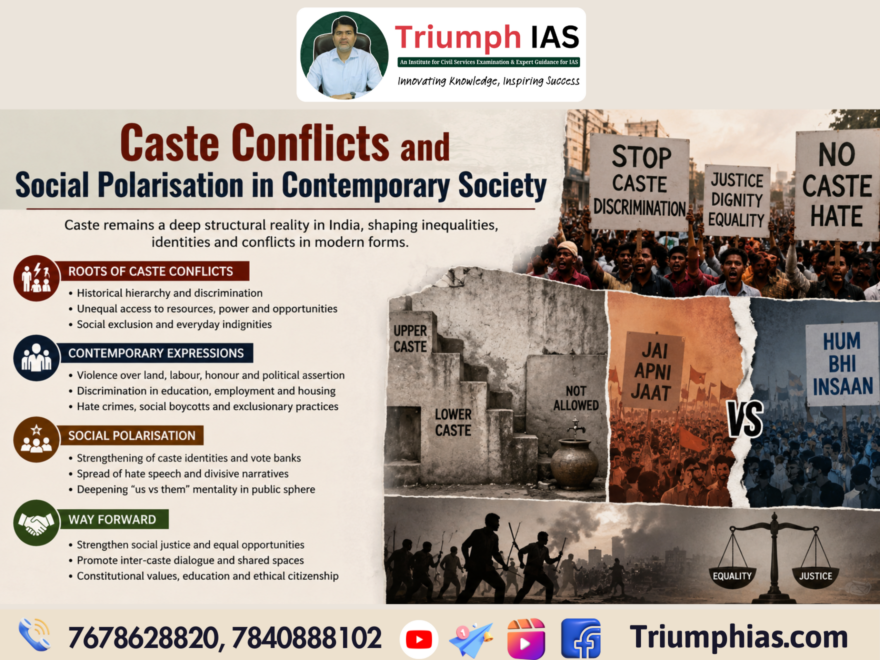
Caste Conflicts and Social Polarisation in Contemporary society

Relevant for Sociology Optional Paper 1, Paper 2, and GS Paper I (Indian Society)

Introduction

Caste remains one of the most enduring forms of social stratification, particularly in Indian society. Despite constitutional guarantees of equality, rapid urbanization, economic modernization, and globalization, caste continues to influence social relations, access to resources, political participation, and identity formation. Contemporary society has witnessed both the decline of certain traditional caste practices and the emergence of new forms of caste consciousness, conflicts, and social polarisation.

From a sociological perspective, caste conflicts are not merely disputes between social groups but manifestations of historical inequalities, competition over resources, political mobilization, and struggles for dignity and recognition. The persistence of caste-based tensions reveals the complex relationship between social change and traditional structures.

Understanding Caste Conflicts in Contemporary Society

Caste conflicts arise when different social groups compete for economic resources, political power, social status, and cultural recognition. The expansion of education, democratic participation, reservation policies, and increased awareness among historically marginalized communities have transformed the nature of caste relations.

Sociologist M. N. Srinivas explained social change within the caste system through concepts such as Sanskritization, Westernization, and the emergence of the dominant caste. While modernization has weakened certain ritual restrictions, it has also intensified competition among caste groups for political influence and state resources.

The process of democratization has empowered lower castes and marginalized communities, but it has also generated resistance from privileged groups seeking to preserve their traditional social and economic advantages.

Caste, Power, and Social Inequality

The conflict perspective, influenced by Karl Marx, interprets social conflicts as struggles over the distribution of resources and power. Although Marx primarily emphasized class relations, sociologists have extended conflict theories to understand caste-based inequalities and struggles.

The Indian sociologist B. R. Ambedkar viewed caste as a system of graded inequality that institutionalized social exclusion, discrimination, and unequal access to opportunities. According to Ambedkar, the annihilation of caste required not only legal reforms but also transformation of social consciousness and democratic values.

Caste inequalities continue to be reflected in access to land, education, employment, social prestige, and political representation. These structural disparities often become sources of social tension and conflict.

Social Polarisation and Identity Politics

Social polarisation refers to the process through which society becomes divided into opposing groups based on identities, interests, and ideological differences. In contemporary societies, caste identities are often mobilized through electoral politics, social movements, and collective action.

Identity-based mobilization has played a dual role. On one hand, it has provided marginalized communities with a platform to demand justice, representation, and recognition. On the other hand, excessive identity-based competition can deepen social divisions and reinforce boundaries between groups.

The rise of digital communication and social media has further transformed caste discourse by creating spaces for both social awareness and the spread of prejudice, hate speech, and group antagonism.

Contemporary Challenges and the Need for Social Integration

The persistence of caste conflicts challenges the ideals of equality, fraternity, and social harmony. Although legal measures such as affirmative action and anti-discrimination laws have improved the conditions of disadvantaged communities, social prejudices and institutional inequalities continue to exist.

A sociological solution requires strengthening inclusive education, promoting inter-caste interaction, ensuring equitable access to opportunities, and encouraging democratic dialogue. The objective should not be the erasure of cultural identities but the creation of a society where identities coexist with equality and mutual respect.

Conclusion

Caste conflicts and social polarisation represent the continuing transformation of traditional hierarchies within modern democratic societies. The interaction of historical inequalities, economic competition, political mobilization, and identity assertion shapes contemporary caste dynamics.

Sociological analysis reveals that the resolution of caste conflicts requires structural reforms, social justice, and a commitment to constitutional values of equality, dignity, and fraternity. A truly modern society must transform caste from a basis of hierarchy and exclusion into a sphere of cultural identity compatible with democratic citizenship.

UPSC Civil Services (Mains) Question

Q. “The persistence of caste conflicts in contemporary India reflects the transformation rather than the disappearance of caste in modern society.” Critically examine the statement with suitable sociological perspectives. (250 Words)

To Read more topicsvisit: www.triumphias.com/blogs

Read more Blogs:

Violence Against Women and Structural Patriarchy

If development is not engendered it is endangered – Triumph IAS & Vikash Ranjan Sir


🔥 YOUR FINAL UPSC RANK CAN BE DECIDED BY JUST TWO PAPERS — ESSAY & OPTIONAL!

Most aspirants study hard.
But very few know how to convert knowledge into MARKS.

That’s where Triumph IAS creates the difference. 🚀

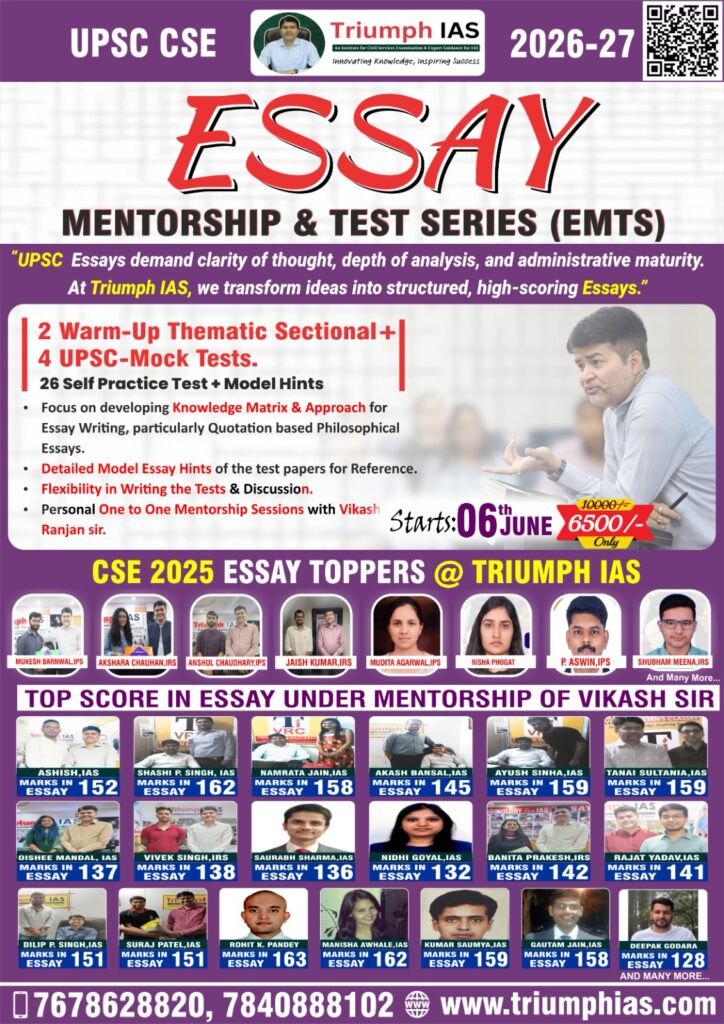
✍️ EMTS – Essay Mentorship & Test Series (CSE Mains 2026–27)

Under the mentorship of Vikash Ranjan Sir, master the art of writing structured, philosophical, multidimensional, and topper-level essays.

Scientific Essay Writing Approach
Knowledge Matrix Framework
5 Exclusive Essay Approach Classes
2 Thematic Tests + 4 UPSC Mock Tests
Detailed Model Essay Hints
Flexible Writing & Discussion Sessions
Personal 1-to-1 Mentorship

🏆 Trusted by UPSC Essay Toppers
━━━━━━━━━━━━━━━━━━

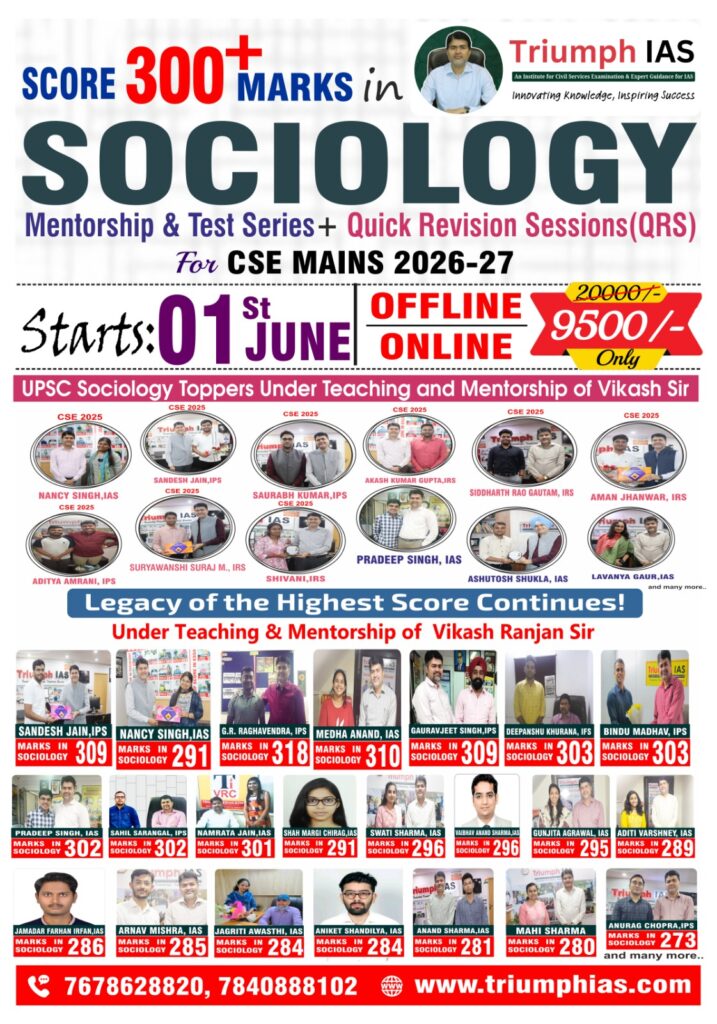
📚 SMTS – Sociology Mentorship & Test Series + Quick Revision Session (QRS)

🎯 SCORE 300+ MARKS IN SOCIOLOGY OPTIONAL

A structured, analytical, and result-oriented mentorship program designed to maximize your Sociology score under the guidance of Vikash Ranjan Sir.

Program Highlights:

26 Full-Length Tests with Detailed Evaluation
PYQ–NYQ Trend Analysis
Quick Revision Sessions on Unconventional Questions
Brainstorming & Concept Enrichment Sessions
1-to-1 Personal Mentorship Discussions
Topic-wise Answer Writing Practice
Current Social Issues Compilation
Home-based Practice Tests with Model Hints
Thinkers Integration & Value Addition Notes
Essay & GS Enrichment through Sociology

  • 🏆 Legacy of High Scores Continues:
  • 🌟 G.R. Raghavendra, IPS – 318
  • 🌟 Medha Anand, IAS – 310
  • 🌟 Sandesh Jain, IPS – 309
  • 🌟 Gauravjeet Singh, IPS – 309
  • 🌟 Deepanshu Khurana, IFS – 303
  • 🌟 Pradeep Singh, IAS – 302
  • 🌟 Swati Sharma, IAS – 296
  • 🌟 Gunjita Agarwal, IAS – 295

…and many more successful aspirants.

━━━━━━━━━━━━━━━━━

Batch Starts: 01 June

  • 📍 Available in OFFLINE & ONLINE Mode
  • 📞 Call/WhatsApp: 7678628820 | 7840888102
  • 🌐 triumphias.com
  • 📍 Triumph IAS
  • 23-B, 3rd Floor, Pusa Road
  • Near Karol Bagh Metro Pillar No. 114, New Delhi
EMTS – Essay Mentorship & Test Series (CSE Mains 2026–27)


Leave a Reply

Your email address will not be published. Required fields are marked *