Population dynamics are among the most significant determinants of social transformation. Contemporary societies across the world are experiencing profound demographic changes characterized by population ageing, declining fertility, imbalanced sex ratios, and changing reproductive health concerns. These developments are not merely biological or demographic phenomena; they are deeply embedded within social structures, cultural norms, economic arrangements, and gender relations.
Sociology studies these demographic changes by examining how institutions such as family, healthcare, economy, and the state respond to changing population structures. In the Indian context, an ageing population, persistent son preference leading to sex ratio imbalance, and unequal access to reproductive healthcare present complex challenges for social justice and sustainable development.
Main body:
Ageing and the Transformation of Social Structure
Ageing refers to the increasing proportion of elderly persons within a population due to declining fertility rates and improvements in life expectancy. The demographic transition experienced by many societies has transformed the age composition of populations, creating new social and economic challenges.
From a sociological perspective, ageing can be understood through various theoretical frameworks. Structural functionalists argue that society must develop new institutional mechanisms to accommodate the changing roles and needs of elderly citizens. The disengagement theory suggests that ageing involves a gradual withdrawal from social roles, whereas the activity theory emphasizes continued social participation as essential for successful ageing.
In India, traditional joint family systems historically provided care and social security for older individuals. However, urbanization, migration, and the rise of nuclear families have weakened traditional support systems, increasing concerns regarding elderly care, economic dependency, social isolation, and elder abuse.
The ageing population therefore requires comprehensive policies related to healthcare, social security, pension systems, and community-based care.
Sex Ratio Imbalance: A Reflection of Gender Inequality
Sex ratio represents the number of females per thousand males in a population and serves as a crucial indicator of gender equality. A distorted sex ratio, especially a low child sex ratio, reflects deep-rooted patriarchal values, son preference, and discrimination against girls.
Sociologists interpret sex ratio imbalance as a consequence of gendered power relations embedded within society. Feminist perspectives highlight that practices such as sex-selective abortion, neglect of female children, unequal healthcare access, and differential allocation of resources are manifestations of patriarchal control over women’s bodies and lives.
The consequences of a skewed sex ratio extend beyond demographic concerns. It can lead to increased violence against women, human trafficking, forced marriages, and psychological and social instability within communities. Correcting sex ratio imbalance requires not only legal interventions but also transformation in social attitudes regarding the value of daughters and gender equality.
Reproductive Health and Social Development
Reproductive health refers to a state of complete physical, mental, and social well-being related to the reproductive system and reproductive processes. It includes access to family planning, maternal healthcare, safe childbirth, sexual education, and reproductive rights.
A sociological analysis reveals that reproductive health is influenced by factors such as class, gender, education, caste, location, and access to healthcare services. Marginalized groups often experience inadequate reproductive healthcare due to social exclusion and economic inequalities.
The reproductive rights approach emphasizes individual autonomy, informed choices, and freedom from coercion in matters related to reproduction. The expansion of reproductive healthcare and awareness contributes to improved maternal health, gender equality, and human development.
Interconnection between Ageing, Sex Ratio, and Reproductive Health
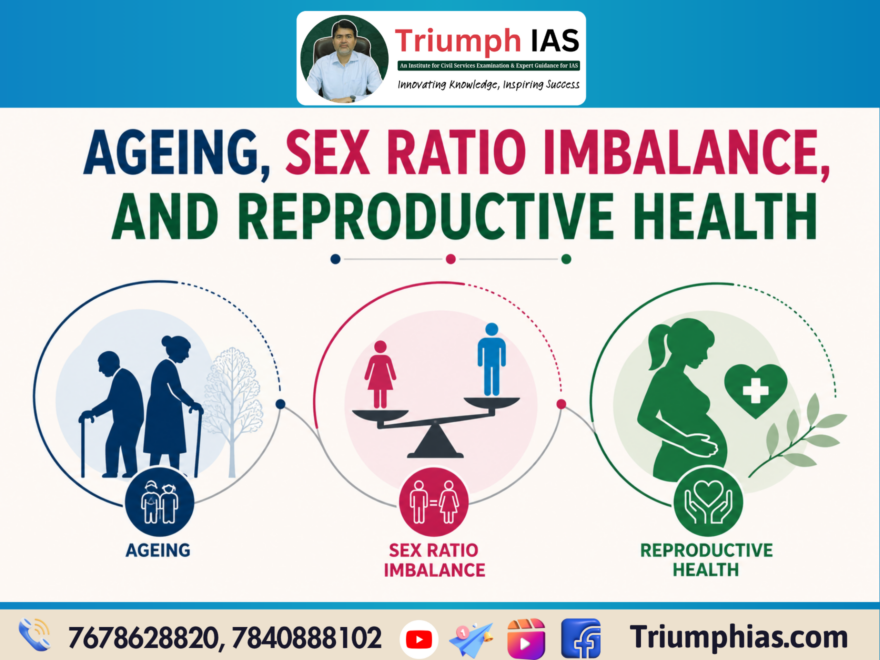
Ageing, sex ratio imbalance, and reproductive health are interconnected demographic processes. Declining fertility contributes to an ageing population, while gender-biased reproductive choices influence sex ratio patterns. Similarly, access to reproductive healthcare determines fertility behavior, maternal health outcomes, and overall population quality.
These issues demonstrate that demographic changes cannot be understood merely through statistics; they reflect broader patterns of social inequality, cultural beliefs, technological development, and state policies.
Conclusion:
The challenges of ageing, sex ratio imbalance, and reproductive health represent the changing demographic reality of modern societies. Addressing these concerns requires a multidimensional approach combining healthcare reforms, gender sensitization, social security measures, and inclusive development policies.
From a sociological standpoint, demographic processes are products of social relations and institutions. A society that ensures dignity for the elderly, equality for women, and universal reproductive rights moves closer toward achieving social justice and sustainable development.



4 comments