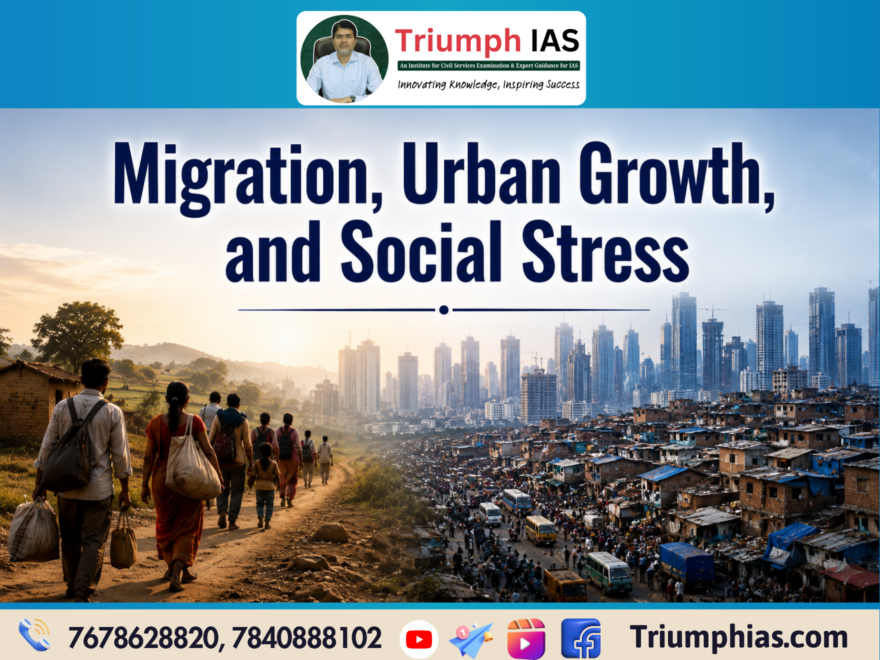
Migration and urbanization have been among the most transformative processes shaping modern societies. The movement of people from rural areas to cities in search of employment, education, security, and better living conditions has accelerated urban growth across the world. In India, rapid migration has played a crucial role in economic development, industrial expansion, and social mobility. However, unplanned urbanization has also generated significant social stress, exposing the contradictions between development and human well-being.
From a sociological perspective, migration is not merely a geographical movement but a process that reshapes social relationships, identities, communities, and institutions. The urban experience creates new opportunities for individuals while simultaneously generating challenges such as inequality, social isolation, housing crises, and cultural tensions.
Migration as an Agent of Social Change
Classical sociologists viewed urban transformation as a defining feature of modern society. Ferdinand Tönnies explained the shift from traditional Gemeinschaft (community-based relations) to Gesellschaft (impersonal and contractual relationships), highlighting the changing nature of social bonds in urban life.
Similarly, Émile Durkheim argued that increasing population density and division of labour led societies from mechanical solidarity to organic solidarity, creating greater interdependence but also possibilities of anomie—a condition of normlessness and social disintegration.
Migration often enables social mobility by allowing individuals to escape traditional constraints based on caste, kinship, and locality. Cities become spaces of anonymity and new opportunities, where people can construct new social identities.
Urban Growth and Emerging Opportunities
Urban centres function as engines of economic growth, innovation, and cultural exchange. Migration contributes to the availability of labour, expansion of markets, and growth of industries and services.
Urban life also promotes exposure to diverse cultures, greater individual freedom, and changing gender roles. Women’s participation in education and employment often increases in urban settings, challenging traditional patriarchal structures.
The city therefore represents not only economic advancement but also a site of social transformation and modernization.
Social Stress and the Urban Crisis
Despite these opportunities, uncontrolled urban growth often creates severe social stress. The concentration of populations in cities leads to housing shortages, growth of slums, environmental degradation, traffic congestion, and pressure on public infrastructure.
Migrants frequently experience precarious employment, poor living conditions, and limited access to healthcare and education. The informal sector, which absorbs a large number of migrants, often lacks job security and social protection.
Sociologist Robert Park of the Chicago School viewed cities as social laboratories where diverse groups compete for space and resources. Such competition can produce social disorganization, crime, alienation, and conflict.
Karl Marx’s concept of alienation also provides insight into the urban experience, where capitalist systems may reduce individuals to economic units, weakening social connections and increasing psychological stress.
Migration, Inequality, and Marginalization
Urban growth does not affect all groups equally. Caste, class, gender, and ethnicity continue to influence migrants’ access to opportunities. While some achieve upward mobility, many remain trapped in informal settlements and insecure employment.
Women migrants often face a dual burden of economic exploitation and domestic responsibilities. Migrant workers also suffer from lack of social networks and exclusion from welfare systems, as highlighted during the COVID-19 pandemic.
The emergence of “dual cities”—where affluent neighborhoods coexist alongside marginalized settlements—reveals the unequal nature of urban development.
Towards Inclusive and Sustainable Urbanization
The challenges of migration and urban stress require a human-centred approach to development. Urban planning must ensure affordable housing, accessible public services, social security, environmental sustainability, and inclusive employment opportunities.
Sociologist Manuel Castells emphasized that cities are not merely physical spaces but networks of social relations shaped by power, economy, and collective action. Therefore, sustainable urban development must focus on social justice and the right of all citizens to access urban resources.
Conclusion
Migration and urban growth represent the aspirations of millions seeking better lives. They are powerful forces of economic progress and social transformation, but when poorly managed, they can generate inequality, alienation, and social stress.
The future of urban India depends on transforming cities into inclusive spaces where development is measured not only by economic expansion but also by dignity, equality, and quality of life. A truly progressive society is one where migration becomes a pathway to opportunity rather than a journey into vulnerability.


4 comments