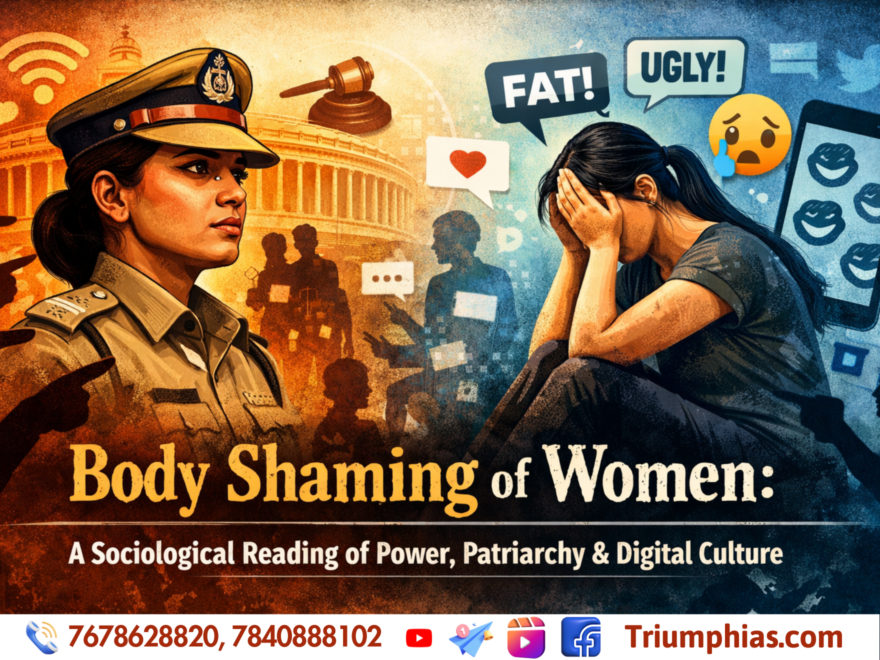
The recent trolling of IPS officer Aparna Rajat Kaushik after a video shared by Mirzapur Police is not just another episode of online misbehaviour. It is a sociologically significant event. A woman officer, appearing in a professional law-enforcement context, became the target of public comments not about her work, competence, or authority, but about her body and looks. The incident reveals how deeply gendered social attitudes continue to shape public discourse in India, even when women occupy elite and powerful state positions.
At one level, body shaming is a form of symbolic violence. Pierre Bourdieu’s concept helps explain how domination often operates subtly through language, ridicule, humour, mockery, and everyday judgment rather than direct physical force. Women are constantly reminded that their social worth is tied to appearance. Even when they enter institutions associated with discipline, rationality, and power, such as the police or civil services, patriarchal culture often pushes them back into the role of the “visible female body.” In such moments, the woman is not treated as an officer of the state but as an object open to public evaluation.
This is where patriarchy adapts itself to modernity. On paper, women’s participation in public institutions has expanded. In practice, however, society continues to view women through what feminist scholars call the male gaze. A male officer in a viral police video is usually judged on authority, action, or performance. A woman officer, by contrast, is often judged first through appearance. Her professional identity gets overshadowed by her bodily identity. This reflects a larger sociological pattern: women must constantly prove their legitimacy because their bodies are made socially available for comment.
The digital public sphere intensifies this tendency. Social media has created a culture of anonymous surveillance, where anyone can watch, comment, mock, and circulate visual content within seconds. The body becomes raw material for memes, trolling, and instant judgment. In this environment, body shaming is not merely an individual prejudice; it becomes a collective performance. Users participate in it for visibility, validation, and group belonging. Online misogyny thus turns into a form of social bonding among trolls, normalising humiliation as entertainment.
This incident also shows the persistence of disciplinary beauty norms. Feminist thinkers have argued that beauty standards often function as instruments of control over women. A woman who does not conform to dominant standards is mocked, while a woman who does conform is often sexualised. Either way, her body becomes a site of social control. The trolling of a woman IPS officer demonstrates that no rank, status, or uniform fully shields women from this patriarchal logic. Institutional authority may give women official power, but social power remains unequally distributed.
There is also a deeper link between gender and public authority here. A woman in uniform challenges traditional assumptions about femininity. She represents command, legality, discipline, and coercive state authority—qualities historically coded as masculine. Body shaming then acts as a method of social correction. It seeks to trivialise her authority, diminish her public standing, and restore patriarchal comfort. In this sense, trolling is not random. It is a reaction to women occupying spaces that unsettle male-dominated hierarchies.
From a broader sociological perspective, this episode reflects the contradiction of contemporary India. On one hand, women are entering bureaucracy, police services, academia, politics, and corporate leadership in increasing numbers. On the other hand, everyday culture continues to reproduce sexism through jokes, abusive comments, memes, and viral humiliation. Modern institutions may open doors, but social attitudes often refuse to change at the same pace. This is why body shaming must be seen not as a personal insult alone but as a structural issue linked to patriarchy, media culture, gender socialisation, and the weak ethical norms of the digital public sphere.
The issue is not only social but also legal. In India, body shaming of women in online spaces may attract liability under the Bharatiya Nyaya Sanhita, 2023 and the Information Technology Act, 2000. Section 79 of the Bharatiya Nyaya Sanhita deals with words, gestures, or acts intended to insult the modesty of a woman. Repeated harassment in digital spaces may also invite the application of provisions related to stalking under Section 78, while sexually coloured remarks may fall within the scope of sexual harassment under Section 75, depending on the nature of the abuse. In cases where private images are circulated without consent, Section 66E of the Information Technology Act becomes relevant, as it deals with violation of privacy. Further, Sections 67 and 67A of the IT Act punish the publication or transmission of obscene or sexually explicit material in electronic form. At the same time, it is important to note that Section 66A of the IT Act is no longer valid law, as it was struck down by the Supreme Court in Shreya Singhal v. Union of India (2015). Thus, the law does provide remedies, but legal protection alone cannot end the cultural normalisation of misogyny.
What is needed, therefore, is not only punishment for offenders but a wider social transformation. Schools, families, media institutions, digital platforms, and public agencies must cultivate gender sensitivity and digital ethics. The media must avoid sensationalising women’s bodies, and social media platforms must act more swiftly against abusive content. Most importantly, women in public life must be recognised for their work, competence, and dignity rather than reduced to appearance.
In the end, body shaming of women is not really about beauty. It is about power—who has the right to look, who gets judged, and who is allowed to exist in public life with dignity and authority. A society that body-shames its women officers is not merely insulting individuals; it is exposing the unfinished nature of its commitment to equality, democracy, and gender justice.

 SANDESH JAIN [B.Tech] SOCIOLOGY STRATEGY #UPSC CSE 2025
 𝐖𝐡𝐚𝐭 𝐦𝐚𝐤𝐞𝐬 𝐭𝐡𝐢𝐬 𝐚𝐜𝐡𝐢𝐞𝐯𝐞𝐦𝐞𝐧𝐭 𝐞𝐱𝐭𝐫𝐚𝐨𝐫𝐝𝐢𝐧𝐚𝐫𝐲 𝐢𝐬 𝐡𝐢𝐬 𝐒𝐨𝐜𝐢𝐨𝐥𝐨𝐠𝐲 𝐎𝐩𝐭𝐢𝐨𝐧𝐚𝐥 𝐬𝐜𝐨𝐫𝐞:
 𝐓𝐎𝐓𝐀𝐋 𝐒𝐎𝐂𝐈𝐎𝐋𝐎𝐆𝐘 𝐌𝐀𝐑𝐊𝐒: 𝟑𝟎𝟗
 𝐏𝐚𝐩𝐞𝐫 𝟏 – 173 Marks
 Single Source Preparation- Only #Vikash #Ranjan Sir’s Sociology Foundation Class Notes, Discussions, Application Strategies & Answer Writing Practice.
 Offline Classroom Program
 Live Online Classes
 Tablet Course (Learn Anytime)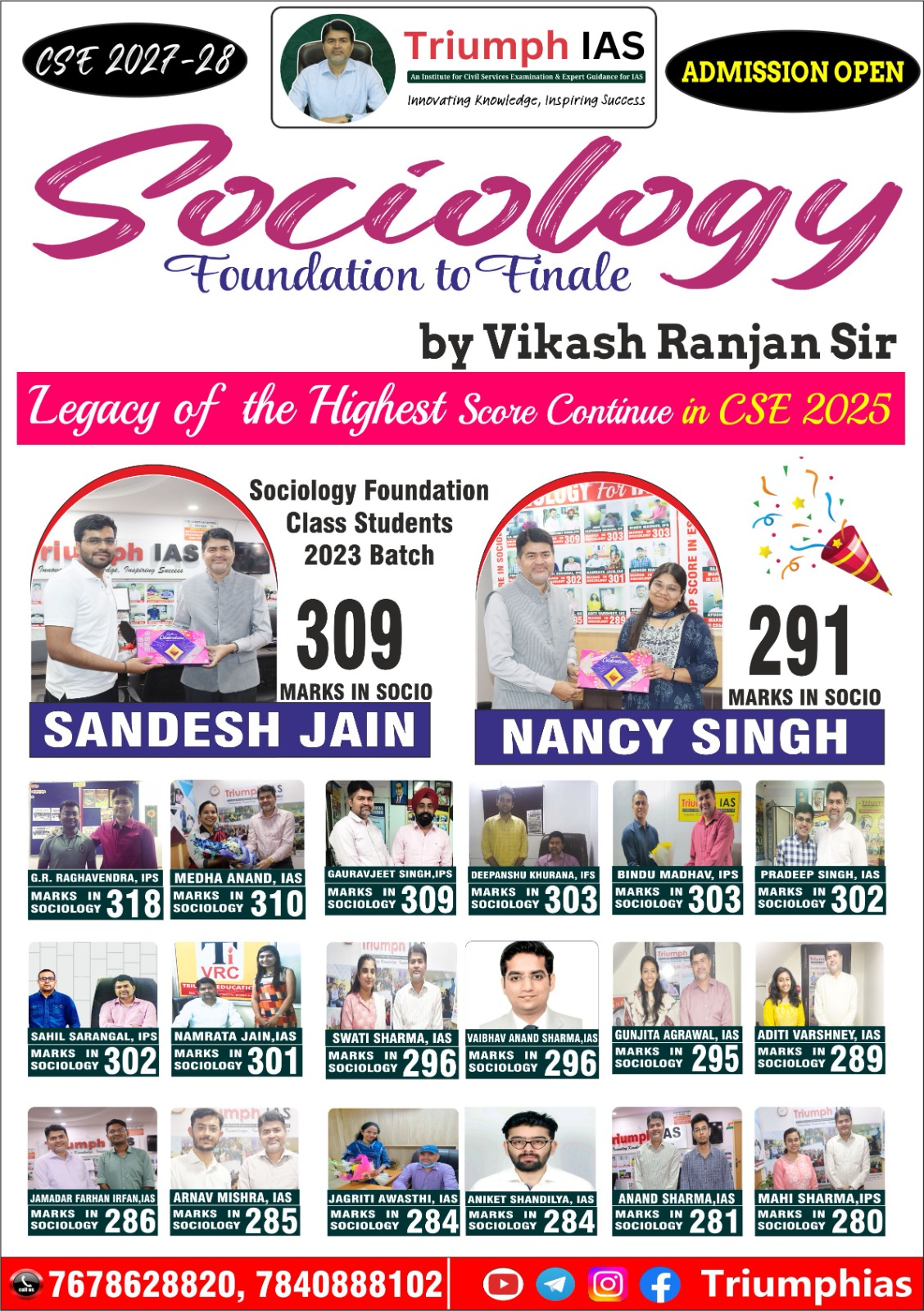
One comment