
Relevant for Sociology Optional Paper 1, Paper 2, and GS Paper I (Indian Society)
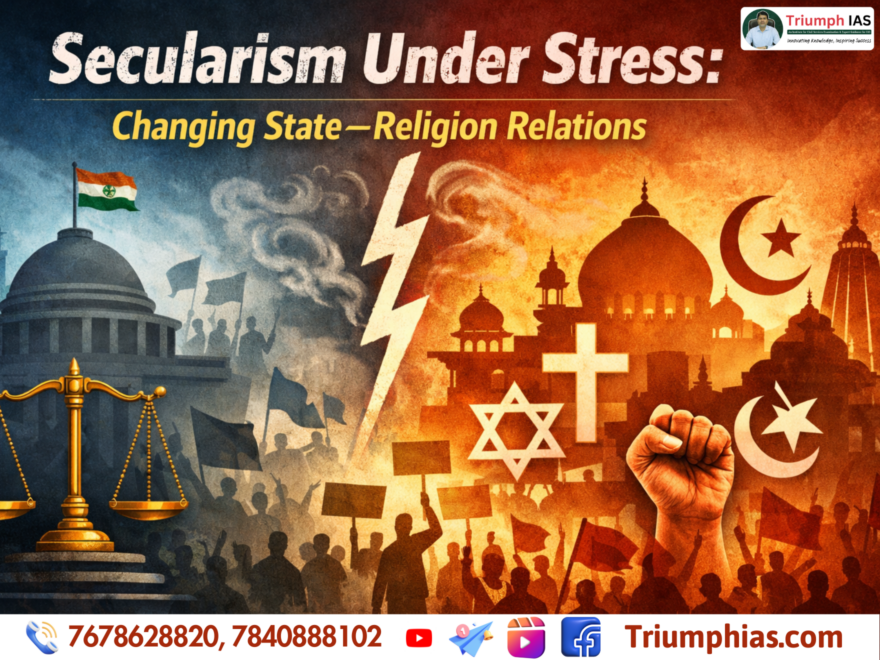
IntroductionSecularism has long been regarded as one of the foundational principles of modern democratic societies. In sociology, it refers not simply to the decline of religion, but to the changing relationship between religion, state, and society. Traditionally, secularism implies that the state maintains a principled distance from religious institutions, ensuring equality, freedom of conscience, and protection for diverse faiths. Yet in the contemporary world, secularism appears to be under stress. Across many societies, the state–religion relationship is being renegotiated in ways that reveal deeper tensions around identity, citizenship, democracy, and power.
DimensionClassical sociological thinkers offered important insights into this relationship. Max Weber viewed religion as a powerful force shaping social action and authority, while Émile Durkheim emphasized religion’s role in creating collective solidarity. Karl Marx, on the other hand, treated religion as a tool linked to domination and ideological control. These perspectives remain relevant today because secularism is not merely a legal arrangement; it is also a sociological process shaped by historical conflict, cultural values, and political interests. In its ideal form, secularism seeks to prevent the domination of one religion over others and to protect individual rights in plural societies. However, the model of secularism differs across countries. In Western societies, secularism often developed as a response to the historical domination of the Church over political life, leading to a sharp separation between religion and state. In India, however, secularism took a distinct form. Rather than strict separation, Indian secularism has traditionally meant equal respect for all religions, combined with state intervention when necessary to ensure reform, justice, and harmony. Thus, secularism in sociology must be understood as context-specific rather than universal. The present stress on secularism emerges from several social transformations. First, the rise of identity politics has made religion a powerful basis of collective mobilization. Political actors increasingly appeal to religious sentiments to build electoral support and define national belonging. This weakens the secular idea of citizenship based on equality and replaces it with majoritarian notions of identity. As a result, minority communities may feel excluded, and democratic institutions may become vulnerable to communal polarization. Second, globalization and rapid social change have paradoxically strengthened religious revivalism in many regions. Modernization once predicted a decline of religion, but sociologists now recognize that religion often re-emerges in new public forms. In times of uncertainty, displacement, and inequality, religious identities can provide moral certainty and social belonging. This challenges the older secularization thesis and shows that modernity does not necessarily eliminate religion; instead, it transforms its role in public life. Third, the expansion of media and digital platforms has amplified religious discourse in unprecedented ways. Social media has become a space where religious narratives, symbolism, and polarizing content circulate rapidly. This often intensifies social division, spreads stereotypes, and turns religion into a tool of mass mobilization. From a sociological perspective, this reflects how institutions of communication shape public consciousness and identity formation. The stress on secularism also raises important questions of state neutrality. When the state selectively intervenes in religious matters, supports symbolic majoritarianism, or fails to protect minorities effectively, secularism loses credibility. It begins to appear not as a constitutional value but as a contested political slogan. This erosion of trust can weaken social cohesion and challenge the legitimacy of democratic governance. For sociology, the debate on secularism is ultimately a debate about how diverse societies manage difference. Secularism is not the absence of religion from society; it is the regulation of religious diversity in a way that protects justice, equality, and peaceful coexistence. When secularism comes under stress, the issue is not only religious conflict but also the restructuring of power, citizenship, and public morality. ConclusionIn conclusion, changing state–religion relations reveal that secularism remains a dynamic and contested principle. Its future depends on whether democratic societies can uphold pluralism without allowing religion to become an instrument of exclusion. Sociology helps us see that secularism is not a fixed doctrine but an evolving social process, deeply connected to the broader struggles over identity, authority, and social order. |
UPSC Civil Services (Mains) Question
Q. “Secularism in contemporary society is less about the disappearance of religion and more about the changing relationship between state, religion, and politics.” Discuss sociologically. (250 words)
To Read more topics, visit: www.triumphias.com/blogs
Read more Blogs:
Body Shaming of Women: A Sociological Reading of Power, Patriarchy and Digital Culture
Best lessons are learnt through bitter experiences – Triumph IAS & Vikash Ranjan Sir
 SANDESH JAIN [B.Tech] SOCIOLOGY STRATEGY #UPSC CSE 2025
 𝐖𝐡𝐚𝐭 𝐦𝐚𝐤𝐞𝐬 𝐭𝐡𝐢𝐬 𝐚𝐜𝐡𝐢𝐞𝐯𝐞𝐦𝐞𝐧𝐭 𝐞𝐱𝐭𝐫𝐚𝐨𝐫𝐝𝐢𝐧𝐚𝐫𝐲 𝐢𝐬 𝐡𝐢𝐬 𝐒𝐨𝐜𝐢𝐨𝐥𝐨𝐠𝐲 𝐎𝐩𝐭𝐢𝐨𝐧𝐚𝐥 𝐬𝐜𝐨𝐫𝐞:
 𝐓𝐎𝐓𝐀𝐋 𝐒𝐎𝐂𝐈𝐎𝐋𝐎𝐆𝐘 𝐌𝐀𝐑𝐊𝐒: 𝟑𝟎𝟗
 𝐏𝐚𝐩𝐞𝐫 𝟏 – 173 Marks 𝐏𝐚𝐩𝐞𝐫 𝟐 – 136 Marks
 Single Source Preparation- Only #Vikash #Ranjan Sir’s Sociology Foundation Class Notes, Discussions, Application Strategies & Answer Writing Practice. No multiple books or Scattered Materials, No PDFs, No Free YouTube Time Wastes, No other Essentials.
 Offline Classroom Program
 Live Online Classes
 Tablet Course (Learn Anytime)
3 comments