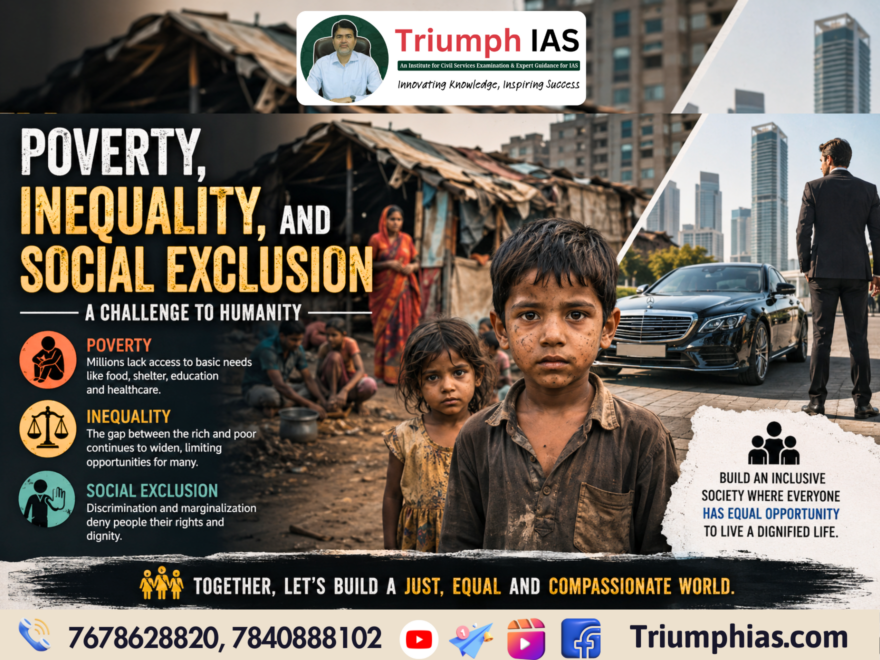
Poverty, inequality, and social exclusion are among the most persistent challenges confronting contemporary societies. Although economic growth and technological advancement have improved living standards for many, the benefits of development have not been equally distributed. Large sections of society continue to experience deprivation, discrimination, and limited access to opportunities. Sociology views these problems not merely as individual failures but as outcomes of broader social structures, unequal power relations, and institutional arrangements.
Poverty, inequality, and social exclusion are interconnected phenomena that reinforce one another and create cycles of disadvantage across generations.
Main Body:
Understanding Poverty: Beyond Lack of Income
Poverty is commonly defined as the inability to meet basic necessities such as food, housing, healthcare, and education. However, sociologists argue that poverty extends beyond economic deprivation and includes social, cultural, and political marginalization.
The concept of absolute poverty refers to the inability to maintain a minimum standard of living, whereas relative poverty emphasizes deprivation in comparison with prevailing social standards. The capability approach developed by economist Amartya Sen highlights that poverty should be understood as a deprivation of capabilities and opportunities necessary for leading a dignified life.
Structural perspectives argue that poverty is produced by unequal access to resources, employment opportunities, quality education, and social security systems rather than individual shortcomings.
Social Inequality and the Distribution of Resources
Social inequality refers to the unequal distribution of wealth, power, prestige, and opportunities among individuals and groups within society. It is embedded in social institutions and is reproduced through systems of class, caste, gender, ethnicity, and region.
According to the conflict perspective, particularly the ideas of Karl Marx, economic systems generate class inequalities by concentrating resources and power in the hands of dominant groups. Similarly, Max Weber expanded the understanding of inequality by emphasizing the role of class, status, and power in shaping social hierarchies.
In India, inequality is multidimensional, where economic disparities intersect with caste-based discrimination, gender inequalities, regional disparities, and unequal access to social resources.
Social Exclusion: Marginalization from Mainstream Society
Social exclusion refers to the process through which certain individuals or communities are systematically denied access to social, economic, political, and cultural participation. It is not only about being poor but also about being excluded from opportunities and social recognition.
Marginalized groups such as Scheduled Castes, Scheduled Tribes, religious minorities, persons with disabilities, and economically weaker sections often face barriers in accessing education, employment, healthcare, and political representation.
The concept of social exclusion highlights that inequality operates through institutional practices, cultural prejudices, and historical patterns of discrimination, leading to the persistence of social disadvantage.
The Interrelationship between Poverty, Inequality, and Social Exclusion
Poverty, inequality, and social exclusion form a mutually reinforcing cycle. Poverty limits access to education and healthcare, which reduces opportunities for social mobility. Inequality creates unequal distribution of resources and power, while social exclusion prevents marginalized communities from participating fully in society.
Sociologists emphasize that addressing these challenges requires a multidimensional approach involving economic redistribution, social inclusion, affirmative policies, universal access to education and healthcare, and the elimination of discriminatory practices.
Globalization and New Forms of Inequality
Globalization has created opportunities for economic growth and technological advancement but has also contributed to new forms of inequality. The digital divide, informal employment, unequal access to technology, and concentration of global wealth have intensified social disparities.
The challenge for modern societies is to ensure inclusive development where economic progress translates into greater social justice and equal opportunities for all sections of society.
Conclusion:
Poverty, inequality, and social exclusion are not isolated economic problems but complex social realities rooted in historical structures, power relations, and institutional inequalities. A sociological perspective demonstrates that sustainable development requires not only economic growth but also equitable distribution of resources, social empowerment, and inclusive institutions.
The pursuit of social justice depends upon creating a society where every individual has access to opportunities, dignity, and meaningful participation in collective life.



One comment