India is a land of immense cultural, linguistic, ethnic, and regional diversity. Managing this diversity while maintaining national unity has been one of the biggest challenges before the Indian state. In this context, the concepts of regionalism, federalism, and decentralisation become highly significant not only politically but also sociologically. These concepts explain how power, identity, and governance operate in a plural society like India.
Dimension
Understanding Regionalism
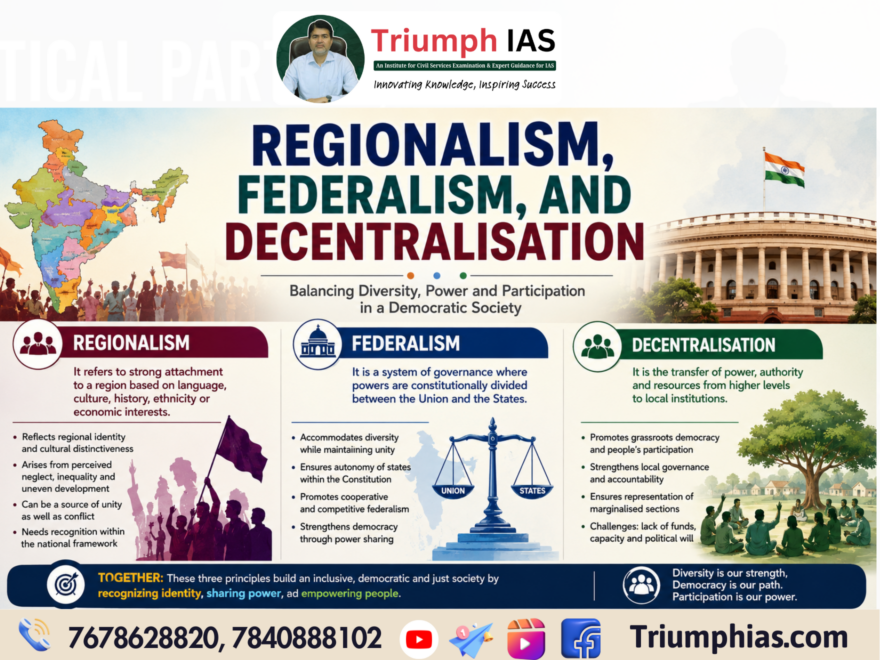
Regionalism refers to the strong attachment of people to a particular region based on shared language, culture, history, ethnicity, or economic interests. It emerges when regional identities become politically and socially significant. Sociologists view regionalism as both a unifying and divisive force.
In India, regionalism developed due to uneven economic development, linguistic diversity, cultural distinctiveness, and perceived neglect by the central government. Movements such as the Dravidian movement in Tamil Nadu, the demand for Telangana, and the Gorkhaland movement illustrate how regional aspirations shape political discourse.
From a sociological perspective, regionalism is not always anti-national. Yogendra Singh argued that regional identities can coexist with national identity within a framework of cultural pluralism. However, extreme regionalism may create separatist tendencies and inter-state conflicts over resources, language, and employment.
Federalism and the Indian State
Federalism refers to a system of governance where powers are constitutionally divided between the central government and state governments. India adopted a federal structure to accommodate its vast diversity while ensuring national integration.
Indian federalism is often described as “quasi-federal” because the Constitution provides greater powers to the Centre, especially during emergencies. Yet, over time, cooperative federalism has strengthened through institutions like the GST Council, Inter-State Council, and NITI Aayog.
Sociologically, federalism acts as a mechanism for conflict management in multicultural societies. It allows different linguistic and cultural groups to preserve their identity while participating in the larger national framework. The linguistic reorganisation of states in 1956 is considered a landmark example of democratic accommodation of regional aspirations.
However, federalism in India faces challenges such as regional disparities, fiscal imbalances, demand for greater state autonomy, and political centralisation. Conflicts between states and the Centre over issues like taxation, governors’ powers, and resource allocation often reflect deeper social and political tensions.
Decentralisation and Grassroots Democracy
Decentralisation refers to the transfer of power, authority, and resources from higher levels of government to local institutions. In India, decentralisation gained constitutional recognition through the 73rd and 74th Constitutional Amendments, which established Panchayati Raj Institutions and Urban Local Bodies.
The sociological importance of decentralisation lies in democratic participation and empowerment. It enables local communities to participate in decision-making processes affecting their lives. Decentralisation also promotes social justice by providing political representation to women, Scheduled Castes, and Scheduled Tribes through reservation policies.
Thinkers like M.N. Srinivas highlighted the role of village institutions in rural governance, while Gandhi advocated Gram Swaraj as the foundation of Indian democracy. Decentralisation strengthens accountability, local development, and participatory governance.
Nevertheless, several limitations remain. Local bodies often suffer from lack of financial autonomy, bureaucratic interference, political domination by local elites, and inadequate administrative capacity. In many regions, decentralisation exists more in theory than in practice.
Interrelationship Between the Three Concepts
Regionalism, federalism, and decentralisation are deeply interconnected. Regional aspirations often demand greater federal autonomy, while decentralisation ensures grassroots participation within states. Together, these mechanisms help manage diversity, distribute power, and deepen democracy.
In a diverse society like India, excessive centralisation may intensify regional discontent, whereas balanced federalism and effective decentralisation can promote inclusion and social harmony. Thus, these concepts are essential instruments for democratic governance and nation-building.
Conclusion
Regionalism, federalism, and decentralisation are central to understanding India’s sociopolitical structure. They reflect the dynamic relationship between unity and diversity, power and participation, identity and governance. While regionalism expresses local aspirations, federalism institutionalises diversity, and decentralisation strengthens grassroots democracy. Together, they contribute to the functioning of Indian democracy and the integration of a plural society.

 YOUR FINAL UPSC RANK CAN BE DECIDED BY JUST TWO PAPERS — ESSAY & OPTIONAL!
 Scientific Essay Writing Approach
 Trusted by UPSC Essay Toppers
 SMTS – Sociology Mentorship & Test Series + Quick Revision Session (QRS)
 SCORE 300+ MARKS IN SOCIOLOGY OPTIONAL
 G.R. Raghavendra, IPS – 318
 Available in OFFLINE & ONLINE Mode
 Call/WhatsApp: 7678628820 | 7840888102
 triumphias.com

4 comments