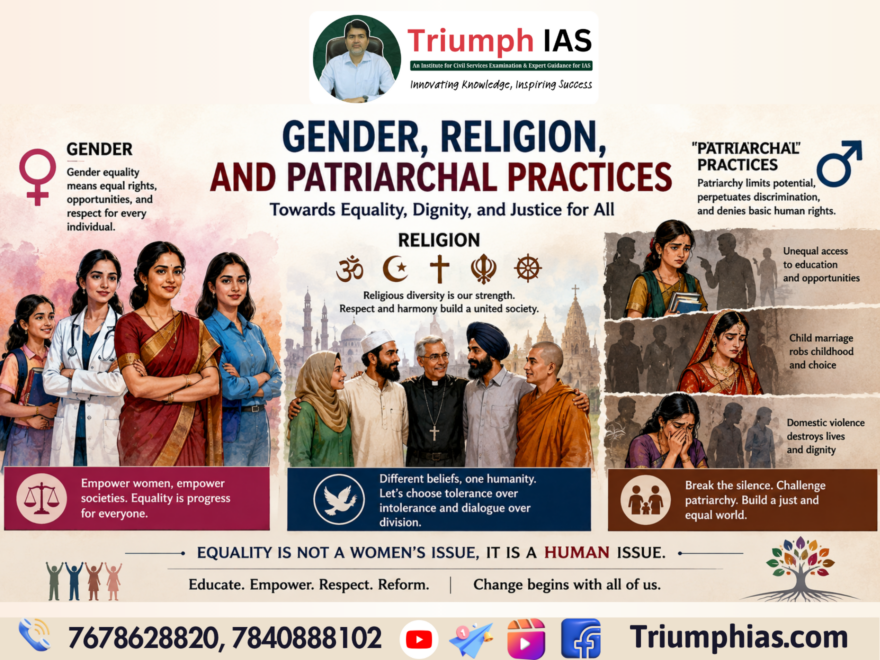
Gender and religion are two powerful institutions that shape human society. While religion provides moral guidance, social norms, and collective identity, patriarchal structures within religious traditions often influence gender relations and reinforce inequality. Sociologists study how religion interacts with patriarchy to regulate women’s roles, sexuality, labour, mobility, and participation in both private and public spheres.
Patriarchy refers to a system of social organization in which men hold dominant positions in family, religion, economy, and politics. In many societies, religious interpretations have historically legitimized male authority and gender hierarchy. Religious texts, rituals, customs, and traditions are often interpreted in ways that assign women subordinate roles while privileging men as decision-makers and authority figures.
Sociologists argue that religion acts both as a mechanism of social control and as a source of social solidarity. Émile Durkheim viewed religion as a force that creates collective consciousness and social integration. However, feminist sociologists critically examine how religious institutions often reproduce gender inequality through patriarchal norms and practices.
Across societies, patriarchal religious practices can be observed in restrictions on women’s inheritance rights, leadership roles, dress codes, mobility, and participation in religious rituals. In several communities, women are expected to conform to ideals of purity, obedience, sacrifice, and domesticity. Such expectations become socially normalized through religious socialization from childhood.
Indian society provides numerous examples of the intersection between gender, religion, and patriarchy. Practices such as child marriage, purdah, exclusion of women from certain religious spaces, preference for male children, and unequal inheritance rights have historically been justified through cultural and religious interpretations. Though many reforms have taken place, traces of patriarchal control continue to shape social attitudes.
Feminist thinkers like Simone de Beauvoir and Sylvia Walby argued that patriarchy operates through institutions such as family, religion, education, and media. Religion often becomes a cultural mechanism through which gender roles are legitimized and reproduced across generations.
At the same time, religion is not always oppressive for women. Many women derive identity, emotional support, community participation, and moral strength from religious traditions. Modern feminist movements within religions are reinterpreting sacred texts and challenging patriarchal readings. Women priests, female religious scholars, and reform movements are increasingly questioning gender discrimination within religious institutions.
Social reformers in India such as Raja Ram Mohan Roy, Ishwar Chandra Vidyasagar, Savitribai Phule, and Dr. B. R. Ambedkar challenged oppressive patriarchal practices justified in the name of religion. Constitutional values of equality, liberty, dignity, and secularism further provide a framework for gender justice.
Globalization, education, urbanization, constitutional awareness, and women’s movements have significantly transformed gender relations in contemporary society. Yet, conflicts between traditional religious norms and modern ideas of gender equality continue to shape debates around personal laws, marriage, inheritance, reproductive rights, and women’s autonomy.
For Sociology, the relationship between gender, religion, and patriarchy is important because it demonstrates how social institutions maintain power structures and social inequality. It also highlights the processes of resistance, reform, and social change within society.

 SANDESH JAIN [B.Tech] SOCIOLOGY STRATEGY #UPSC CSE 2025
 𝐖𝐡𝐚𝐭 𝐦𝐚𝐤𝐞𝐬 𝐭𝐡𝐢𝐬 𝐚𝐜𝐡𝐢𝐞𝐯𝐞𝐦𝐞𝐧𝐭 𝐞𝐱𝐭𝐫𝐚𝐨𝐫𝐝𝐢𝐧𝐚𝐫𝐲 𝐢𝐬 𝐡𝐢𝐬 𝐒𝐨𝐜𝐢𝐨𝐥𝐨𝐠𝐲 𝐎𝐩𝐭𝐢𝐨𝐧𝐚𝐥 𝐬𝐜𝐨𝐫𝐞:
 𝐓𝐎𝐓𝐀𝐋 𝐒𝐎𝐂𝐈𝐎𝐋𝐎𝐆𝐘 𝐌𝐀𝐑𝐊𝐒: 𝟑𝟎𝟗
 𝐏𝐚𝐩𝐞𝐫 𝟏 – 173 Marks
 Single Source Preparation- Only #Vikash #Ranjan Sir’s Sociology Foundation Class Notes, Discussions, Application Strategies & Answer Writing Practice.
 Offline Classroom Program
 Live Online Classes
 Tablet Course (Learn Anytime)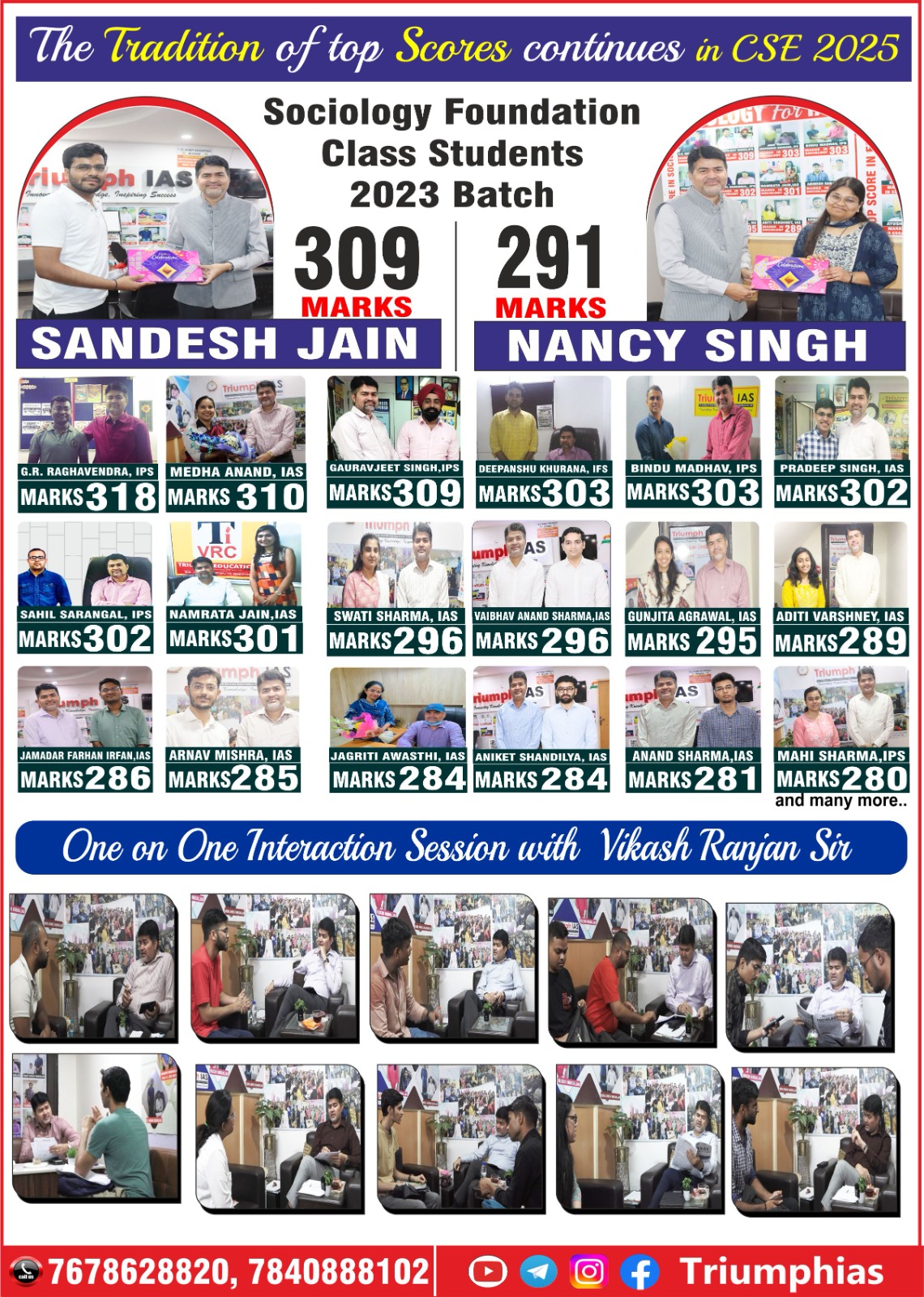
One comment