
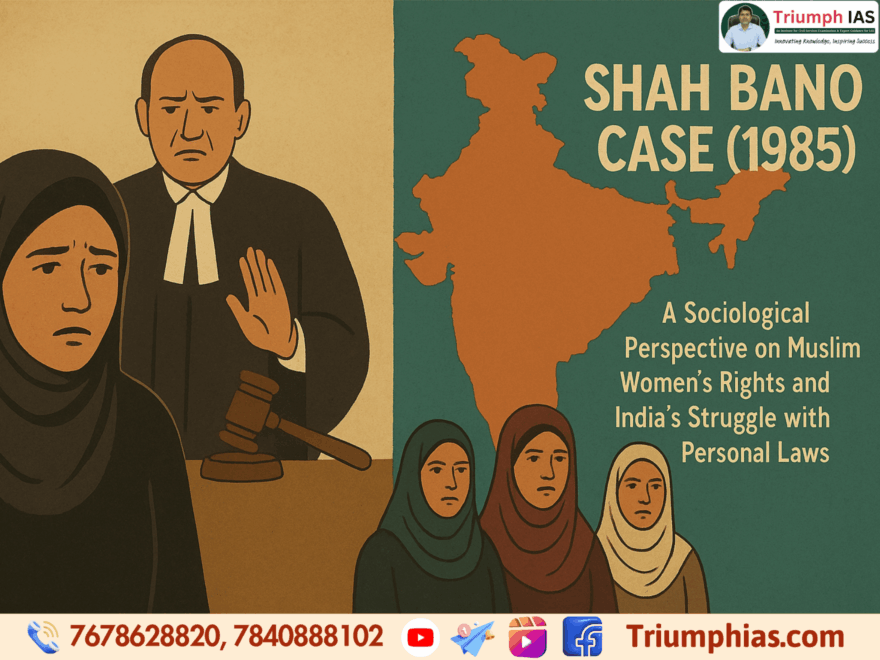
Shah Bano Case (1985): A Sociological Perspective on Muslim Women’s Rights and India’s Struggle with Personal Laws
(Relevant for Sociology Paper 1 and 2: Stratification and Mobility, and System of Kinship in India)
|
The Shah Bano case of 1985 remains one of the most pivotal legal and sociological landmarks in post-independence India, reflecting the intricate interplay between law, religion, gender, and societal transformation. While it is often cited in legal texts for its jurisprudential significance, it also provides a rich case study for understanding how personal laws, social norms, and constitutional ideals collide in a diverse society like India. Background: The Case and Its ContextIn 1978, Shah Bano Begum, a 62-year-old Muslim woman from Indore, sought maintenance from her husband under Section 125 of the Code of Criminal Procedure (CrPC) after being divorced. This section, a secular legal provision, ensures that a dependent spouse or child can claim maintenance irrespective of religious identity. Shah Bano’s husband, however, argued that under Muslim personal law, his obligation ended after the iddat period, a three-month post-divorce window during which a woman cannot remarry. The Madhya Pradesh High Court sided with Shah Bano, increasing her maintenance, prompting her husband to appeal to the Supreme Court (SC). This case thus pitted religious personal law against a secular, constitutional mandate, highlighting the tension between individual rights and community norms. The Supreme Court Verdict and Its Sociological ImplicationsIn a unanimous verdict in 1985, the five-judge bench of the SC ruled in favor of Shah Bano. The Court declared that Section 125 CrPC applies to all citizens, including Muslims, and that she was entitled to maintenance beyond the iddat period. The judgment also lamented that Article 44 of the Constitution, which advocates for a Uniform Civil Code (UCC), remained largely a “dead letter.” Importantly, the Court referenced Islamic texts to argue that maintenance beyond iddat was consistent with religious injunctions, attempting to bridge secular law and faith-based norms. From a sociological perspective, the verdict represented a crucial step towards gender justice in a patriarchal society, particularly in minority communities where religious prescriptions often limit women’s autonomy. The decision challenged deeply entrenched patriarchal structures and social norms that confined divorced women to dependency on male relatives or charitable boards. Backlash and Legislative Intervention: The Politics of ReligionThe Shah Bano verdict triggered widespread protests from conservative Muslim groups, who perceived the SC judgment as an intrusion into religious practices. In response, the government passed the Muslim Women (Protection of Rights on Divorce) Act, 1986, which curtailed the husband’s liability to the iddat period and shifted the burden of long-term support to the woman’s relatives or the Waqf Board. Sociologically, this development illustrates the politicization of religion in India, where legal reforms intended to ensure equality often clash with community-specific traditions. The act, while politically expedient, diluted the SC’s attempt to promote constitutional morality over communal norms. It revealed how gender justice initiatives can be subordinated to the imperatives of political appeasement and the management of religious sentiment. Reaffirmation in Later Judgments
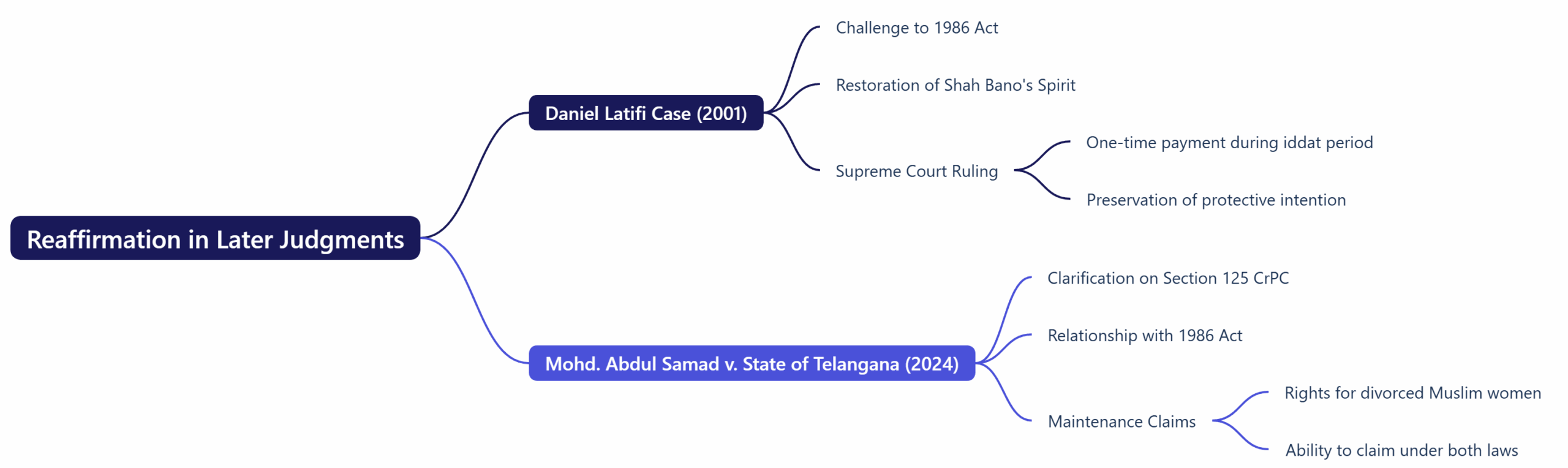
Subsequent cases attempted to recalibrate the balance between constitutional rights and personal laws:
These judgments reflect the gradual evolution of legal consciousness in India, where courts increasingly recognize the need to balance religious freedom with gender equality, a core sociological principle. Shah Bano and the Uniform Civil Code (UCC)The case is inextricably linked to the debate over the Uniform Civil Code, envisioned under Article 44 of the Constitution. The UCC proposes a common set of civil laws for all citizens, transcending religious divisions, and promoting legal uniformity, gender equality, and national integration. Historically, personal laws were preserved by the British as part of their strategy of indirect rule, leaving family matters untouched while introducing uniform criminal laws. Post-independence, the Constituent Assembly grappled with this duality: while Muslim representatives sought protection of personal laws, reformists like B.R. Ambedkar and K.M. Munshi advocated for a UCC to ensure equality. Goa stands out as an exception, having implemented a UCC under the Portuguese Civil Code of 1867, while Uttarakhand recently implemented a state-specific civil code. SC verdicts like Sarla Mudgal (1995), Lily Thomas (2013), Shayara Bano (2017), and Jose Paulo Coutinho (2019) further underscore the judiciary’s role in nudging social reform while respecting religious autonomy. Sociologically, the UCC represents a vision of citizenship beyond religious identities, aligning with Durkheimian concepts of social cohesion and modernist ideals of the rule of law. Resistance to its implementation highlights the conflict between tradition and modernity, a recurring theme in Indian society. Gender, Religion, and Social Inequality
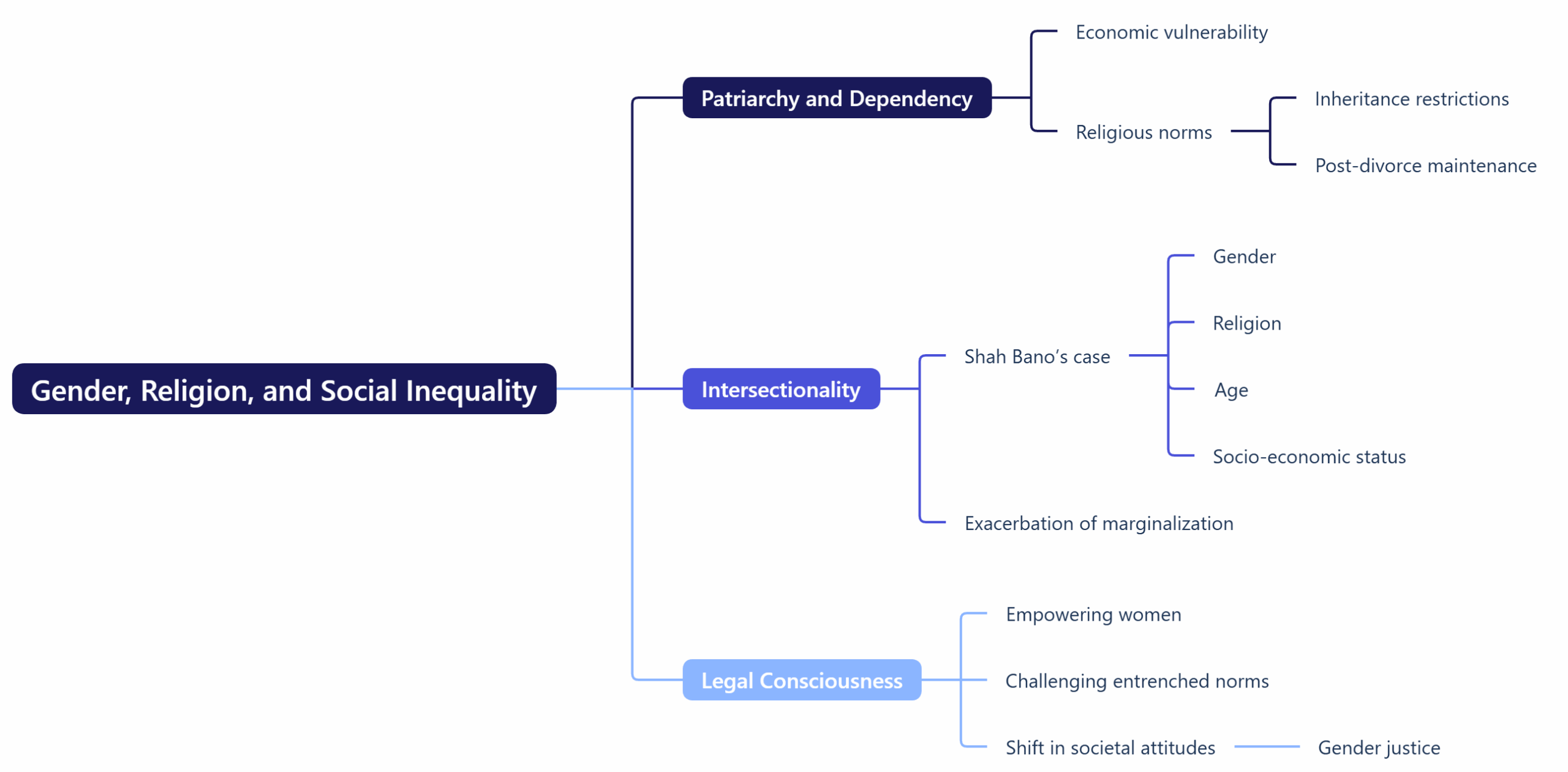
The Shah Bano case, beyond its legal significance, is a sociological lens to understand the structural inequalities faced by Muslim women:
It also illuminates how legal reform can act as a catalyst for cultural transformation, even when resisted by conservative structures. By invoking both secular law and religious texts, the SC demonstrated a nuanced approach to legal pluralism, a hallmark of Indian democracy. Contemporary RelevanceThe Shah Bano case continues to resonate in contemporary debates on gender justice, secularism, and legal reform:
ConclusionThe Shah Bano case is far more than a legal milestone—it is a sociological mirror reflecting the tensions of a plural society. It illustrates the challenges of reconciling personal laws with constitutional guarantees, the complexities of gender and religious politics, and the enduring struggle for social justice in India. Through the lens of sociology, Shah Bano teaches that legal reform cannot succeed in isolation; it must be accompanied by shifts in social norms, political will, and community consciousness. The ongoing debates around the Uniform Civil Code, gender equality, and women’s rights reveal that Indian society is continuously negotiating its path between tradition and modernity, faith and equality, and custom and constitutionalism. In the final analysis, Shah Bano’s courage and the judicial interventions that followed symbolize a critical assertion of women’s agency in Indian society, offering lessons in the intersection of law, religion, and social reform that remain relevant to this day. |
To Read more topics, visit: www.triumphias.com/blogs
Read more Blogs:
India’s Top 1% and the Sociological Dimensions of Wealth Inequality
Generative AI in India: A Sociological Lens on Technology, Power, and Governance
The sociological implications of the Shah Bano case are significant. It not only highlighted the struggles of Muslim women in accessing their rights but also brought into question how personal laws often perpetuate social inequalities that conflict with constitutional ideals.