Slums, Housing Crisis, and Urban Deprivation

Relevant for Sociology Optional Paper 1, Paper 2, and GS Paper I (Indian Society)

Introduction

Urbanization is often regarded as a symbol of development, modernization, and economic opportunity. Cities attract millions of people seeking employment, education, healthcare, and a better quality of life. However, alongside gleaming skyscrapers and expanding infrastructure, many cities continue to witness the rapid growth of slums and informal settlements. The persistence of slums reflects not merely a housing shortage but a deeper sociological problem of urban deprivation, inequality, and exclusion.

Main Body

From a sociological perspective, slums are not accidental spaces; they are products of structural inequalities embedded within the process of urban development. Rapid rural-to-urban migration, coupled with inadequate housing policies and unequal economic growth, creates a situation where the urban poor are unable to access formal housing markets. Consequently, they are compelled to reside in overcrowded settlements characterized by poor sanitation, insecure tenure, and limited access to basic services.

Classical sociologists provide important insights into this phenomenon. Karl Marx viewed urban poverty as a consequence of capitalist development, where economic systems generate wealth for a few while marginalizing large sections of society. The concentration of capital in urban centres often leads to rising land prices and housing costs, pushing low-income populations into informal settlements. Similarly, Friedrich Engels, in his study of the working-class condition, highlighted how industrial cities reproduce inequalities through segregated residential patterns.

The Chicago School of Sociology, particularly scholars such as Robert Park and Ernest Burgess, examined the spatial organization of cities and argued that urban areas develop distinct zones based on competition for resources and land. Slums often emerge in transitional zones where disadvantaged groups are concentrated due to economic constraints. Contemporary urban sociologists further emphasize that urban space is socially produced and reflects power relations within society.

The housing crisis in modern cities is closely linked to the processes of globalization, real-estate speculation, and uneven development. Urban land increasingly functions as a commodity rather than a social necessity. Luxury housing projects often coexist with severe shortages of affordable housing, revealing the contradictions of market-driven urbanization. The sociologist David Harvey argues that cities have become arenas for capital accumulation, resulting in what he terms “accumulation by dispossession,” where marginalized groups are excluded from urban resources and opportunities.

Urban deprivation extends beyond inadequate housing. Residents of slums frequently experience multiple dimensions of exclusion, including limited access to quality education, healthcare, clean drinking water, social security, and political representation. Such deprivation reinforces cycles of poverty and social inequality across generations. The concept of “social exclusion” helps explain how disadvantaged communities remain disconnected from mainstream economic and social institutions despite living within urban centres.

In India, the challenge is particularly significant due to rapid urban growth and demographic pressures. Programs such as the Pradhan Mantri Awas Yojana (PMAY) and initiatives aimed at slum redevelopment seek to address housing shortages. However, sustainable solutions require more than physical infrastructure. Inclusive urban planning, affordable housing policies, secure land tenure, community participation, and equitable access to public services are essential for reducing urban deprivation.

The growth of slums is therefore not merely an urban planning issue but a reflection of broader social and economic inequalities. Sociology helps us understand that housing is not only a physical shelter but also a determinant of dignity, citizenship, and social inclusion. Addressing the housing crisis requires a commitment to creating cities that are not only economically productive but also socially just and inclusive. The future of urban development depends on ensuring that the benefits of urbanization are shared by all sections of society, rather than remaining concentrated among a privileged few.

UPSC Civil Services (Mains) Question

Q. “Slums are manifestations of structural inequalities inherent in urbanization.” Examine this statement with suitable sociological perspectives and contemporary examples. (20 Marks)

To Read more topicsvisit: www.triumphias.com/blogs

Read more Blogs:

Child Labour, Precarity, and Urban Poverty

Has the Non- Alignment Movement(NAM) lost its relevance in a multipolar world – Triumph IAS & Vikash Ranjan Sir


🔥 YOUR FINAL UPSC RANK CAN BE DECIDED BY JUST TWO PAPERS — ESSAY & OPTIONAL!

Most aspirants study hard.
But very few know how to convert knowledge into MARKS.

That’s where Triumph IAS creates the difference. 🚀

✍️ EMTS – Essay Mentorship & Test Series (CSE Mains 2026–27)

Under the mentorship of Vikash Ranjan Sir, master the art of writing structured, philosophical, multidimensional, and topper-level essays.

Scientific Essay Writing Approach
Knowledge Matrix Framework
5 Exclusive Essay Approach Classes
2 Thematic Tests + 4 UPSC Mock Tests
Detailed Model Essay Hints
Flexible Writing & Discussion Sessions
Personal 1-to-1 Mentorship

🏆 Trusted by UPSC Essay Toppers
━━━━━━━━━━━━━━━━━━

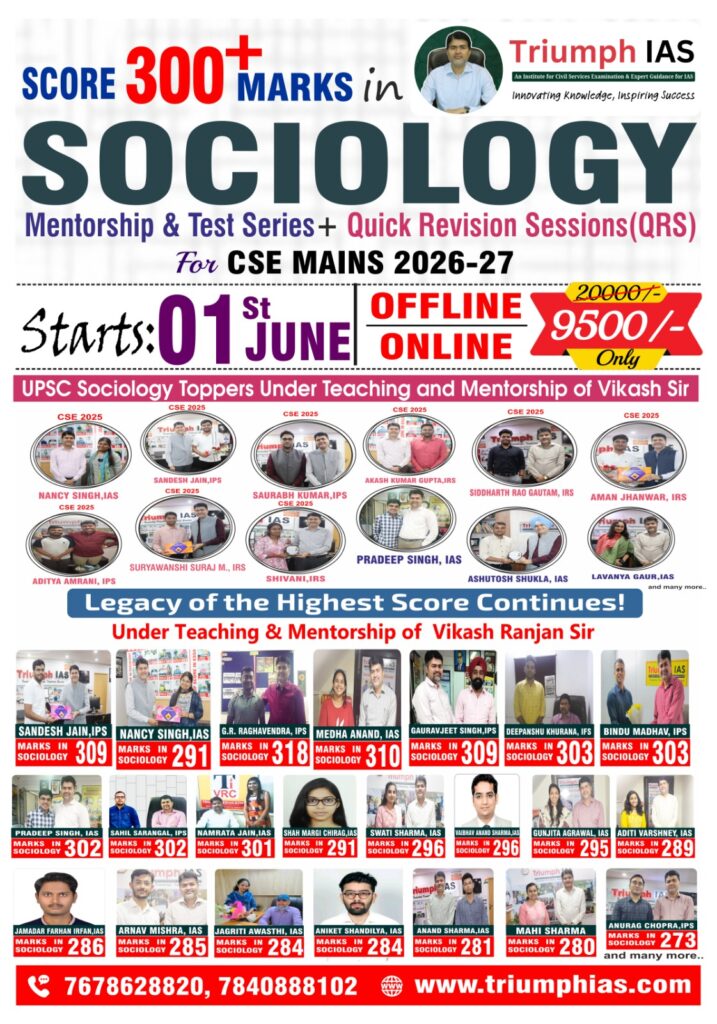
📚 SMTS – Sociology Mentorship & Test Series + Quick Revision Session (QRS)

🎯 SCORE 300+ MARKS IN SOCIOLOGY OPTIONAL

A structured, analytical, and result-oriented mentorship program designed to maximize your Sociology score under the guidance of Vikash Ranjan Sir.

Program Highlights:

26 Full-Length Tests with Detailed Evaluation
PYQ–NYQ Trend Analysis
Quick Revision Sessions on Unconventional Questions
Brainstorming & Concept Enrichment Sessions
1-to-1 Personal Mentorship Discussions
Topic-wise Answer Writing Practice
Current Social Issues Compilation
Home-based Practice Tests with Model Hints
Thinkers Integration & Value Addition Notes
Essay & GS Enrichment through Sociology

  • 🏆 Legacy of High Scores Continues:
  • 🌟 G.R. Raghavendra, IPS – 318
  • 🌟 Medha Anand, IAS – 310
  • 🌟 Sandesh Jain, IPS – 309
  • 🌟 Gauravjeet Singh, IPS – 309
  • 🌟 Deepanshu Khurana, IFS – 303
  • 🌟 Pradeep Singh, IAS – 302
  • 🌟 Swati Sharma, IAS – 296
  • 🌟 Gunjita Agarwal, IAS – 295

…and many more successful aspirants.

━━━━━━━━━━━━━━━━━

Batch Starts: 01 June

  • 📍 Available in OFFLINE & ONLINE Mode
  • 📞 Call/WhatsApp: 7678628820 | 7840888102
  • 🌐 triumphias.com
  • 📍 Triumph IAS
  • 23-B, 3rd Floor, Pusa Road
  • Near Karol Bagh Metro Pillar No. 114, New Delhi
 

Leave a Reply

Your email address will not be published. Required fields are marked *