𝐑𝐞𝐥𝐞𝐯𝐚𝐧𝐭 𝐟𝐨𝐫: Essay for IAS
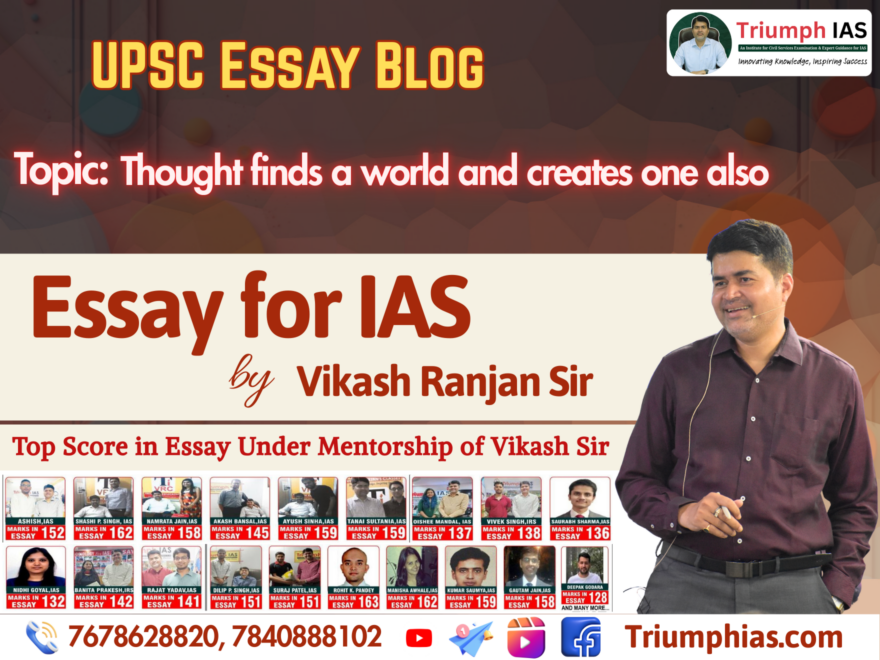
INTRODUCTION:Human civilization is fundamentally a story of thought. Before every invention, institution, revolution, or civilization, there existed an idea. Before a bridge was built, someone imagined crossing a river. Before a constitution was framed, someone envisioned justice. Before humanity reached the moon, someone dared to dream beyond the earth. Thus, thought is not merely a passive reflection of reality; it is an active force that shapes reality itself. The statement, “Thought finds a world and creates one also,” captures this dual character of human consciousness. On the one hand, thought discovers and interprets the world that already exists. It observes nature, understands society, and seeks truth. On the other hand, thought possesses a creative dimension through which it imagines possibilities, constructs meanings, and transforms existing realities into new ones. Human beings are not merely inhabitants of the world; they are creators of worlds through the power of thought. Consequently, every sphere of human existence—philosophy, science, politics, economics, art, religion, and technology—demonstrates how thought simultaneously encounters reality and reconstructs it. The history of humanity is therefore not merely the history of events but also the history of ideas that gave birth to those events. MAIN BODY:At its most basic level, thought serves as an instrument of understanding. Human beings are endowed with the capacity to observe, analyze, compare, and infer. Through thought, they make sense of the world around them. From the earliest times, humans sought answers to fundamental questions: What is the nature of the universe? Why do seasons change? What causes suffering? Such inquiries marked the beginning of philosophy and science. Thought enabled human beings to move beyond superstition and seek rational explanations. Moreover, every scientific discovery represents thought finding a world. When Isaac Newton observed the falling apple, he did not create gravity; rather, he discovered a principle already operating in nature. Similarly, Charles Darwin did not invent evolution but uncovered a process embedded within life itself. Thus, thought first acts as an explorer. It illuminates truths hidden beneath appearances and reveals the underlying order of reality. In this sense, knowledge begins not with creation but with discovery. However, if thought only discovered reality, human civilization would remain static. The uniqueness of human consciousness lies in its ability to imagine what does not yet exist. Unlike other species, human beings can envision alternative futures. They can conceive of a better society, a new technology, or an artistic masterpiece before it materializes. Thought transcends immediate reality and ventures into the realm of possibility. For instance, democracy existed first as an idea before it became a political system. Human rights were philosophical concepts before they became legal principles. Similarly, modern technologies such as airplanes, computers, and artificial intelligence were once products of imagination. Therefore, thought is not merely a mirror reflecting the world; it is also a lamp illuminating new possibilities. It does not simply find reality; it actively participates in creating it. The creative power of thought has fascinated philosophers across civilizations. Ancient Indian philosophy regards the universe itself as emerging from consciousness. The Upanishadic declaration, “Yad Bhavam Tad Bhavati”—as one thinks, so one becomes—highlights the transformative potential of thought. Similarly, the Greek philosopher Plato argued that ideas are more fundamental than material objects. According to him, the visible world is merely a shadow of deeper forms and concepts. Centuries later, the German philosopher Immanuel Kant suggested that human beings do not passively receive reality; rather, the mind actively structures experience. Reality as we know it is shaped by the categories through which we think. Furthermore, Georg Wilhelm Friedrich Hegel viewed history itself as the unfolding of human consciousness. Ideas, according to him, drive historical change and create new social realities. Therefore, philosophical traditions consistently affirm that thought is not merely receptive but also productive. It shapes both individual experience and collective existence. If one examines the rise of civilizations, the central role of thought becomes unmistakable. Civilizations are built not merely by resources or geography but by ideas. The great civilizations of the world emerged from distinctive intellectual traditions. The philosophical inquiry of ancient Greece, the spiritual insights of India, the administrative innovations of China, and the scientific spirit of modern Europe all illustrate the transformative power of thought. Moreover, institutions such as family, state, market, and education are not natural phenomena like mountains or rivers. They are social constructions born of human thought. Laws, constitutions, currencies, and political systems exist because human beings collectively believe in and sustain them. Consequently, society itself can be understood as a world created by thought. What appears natural today was once merely an idea in someone’s mind. Perhaps nowhere is the creative power of thought more visible than in science and technology. Scientific advancement begins with curiosity and imagination. Every major breakthrough was preceded by a thought experiment. Theories often emerge before empirical verification. Scientists imagine possibilities and then test them against reality. For example, Albert Einstein conceived the theory of relativity through imaginative reasoning long before technological advancements confirmed many of its implications. Likewise, space exploration began as a dream before becoming an engineering achievement. Furthermore, technological innovations transform human life precisely because thought creates new realities. The internet, smartphones, and artificial intelligence have not merely changed tools; they have altered communication, work, governance, and culture. Hence, scientific progress exemplifies how thought first finds the laws of nature and then creates unprecedented worlds based on that understanding. While science transforms material conditions, ideas also transform social realities. Many of history’s greatest changes originated in the realm of thought. The abolition of slavery began as a moral idea challenging accepted norms. The struggle for gender equality emerged from new ways of thinking about justice and human dignity. National liberation movements were inspired by ideas of freedom and self-determination. Likewise, social reformers transformed societies by changing minds before changing institutions. Social change often begins when people imagine that existing arrangements are neither natural nor inevitable. Therefore, revolutions are ultimately revolutions of thought before they become revolutions in society. The statement is equally relevant at the individual level. Human beings do not merely live in the external world; they inhabit internal worlds created by their thoughts. Two individuals may face identical circumstances yet experience them differently because of their mental frameworks. Optimism and pessimism, courage and fear, confidence and insecurity often originate in patterns of thought. Modern psychology increasingly emphasizes the role of cognition in shaping behavior and well-being. Thoughts influence emotions, decisions, and actions. Consequently, individuals create personal realities through the meanings they assign to experiences. Moreover, self-belief often becomes self-fulfilling. Those who perceive challenges as opportunities are more likely to succeed than those who view them as insurmountable obstacles. Thus, thought does not merely interpret life; it actively constructs the lens through which life is experienced. The creative dimension of thought reaches its highest expression in art and literature. Artists, poets, and writers create worlds that transcend ordinary reality. Epic narratives, philosophical novels, paintings, and music emerge from the human capacity to imagine. Through artistic thought, humanity explores emotions, aspirations, and possibilities beyond immediate experience. Literature, in particular, demonstrates that ideas can outlive generations. Great works continue to shape societies because they offer alternative visions of reality. Furthermore, art often anticipates social change by imagining futures that do not yet exist. In this sense, artistic thought becomes a laboratory of human possibility. Therefore, culture itself is evidence of humanity’s ability to create worlds through imagination. The twenty-first century provides unprecedented examples of the creative power of thought. Knowledge economies increasingly depend not on physical resources but on ideas and innovation. Digital platforms, virtual environments, and artificial intelligence illustrate how human imagination continuously creates new realms of existence. Entire economic systems now revolve around intangible assets such as information, creativity, and intellectual property. However, this creative power also carries responsibility. The same thought that creates technological progress can create misinformation, polarization, and ethical dilemmas. Ideas can liberate societies, but they can also divide them. Consequently, the quality of thought becomes as important as its power. Humanity must ensure that its creative capacities are guided by wisdom, ethics, and human welfare. Nevertheless, while celebrating the power of thought, one must recognize its limitations. Not every idea corresponds to reality. Human beings can create illusions, prejudices, and destructive ideologies. History contains numerous examples where misguided thoughts produced catastrophic consequences. Extremism, racism, and totalitarianism were also products of ideas. Therefore, thought must remain connected to truth, evidence, and moral responsibility. Moreover, creation without understanding can be dangerous. Thought must first find the world accurately before attempting to recreate it. Wisdom lies in balancing imagination with reality, innovation with ethics, and freedom with responsibility. Hence, the statement implies not only the power of thought but also the obligation to use that power judiciously. CONCLUSION:The statement “Thought finds a world and creates one also” captures one of the most profound truths about human existence. Thought discovers reality through observation, inquiry, and understanding. Simultaneously, it transcends reality through imagination, creativity, and innovation. Human beings are unique because they possess the capacity not only to know the world but also to transform it. From philosophy to science, from social reform to technological progress, from personal growth to artistic expression, every significant human achievement reflects this dual role of thought. Civilizations rise on ideas, institutions are sustained by beliefs, and futures are shaped by imagination. Yet, the power of thought carries corresponding responsibility. Since ideas can build or destroy, liberate or oppress, humanity must cultivate thoughtful wisdom alongside intellectual creativity. Ultimately, the destiny of societies is determined not merely by material resources but by the quality of ideas that guide them. Indeed, every great transformation in history began as a thought in a human mind. Thought finds the world as it is, but more importantly, it creates the world as it ought to be. In that creative journey lies the essence of human progress and the promise of civilization itself. |
Read More Blog:
The supreme art of war is to subdue the enemy without fighting – Triumph IAS & Vikash Ranjan Sir
Best Essay Writing Course for UPSC CSE
If you’re preparing for the UPSC Civil Services Examination (CSE), one paper that can unlock exceptional scores and a top rank is the Essay Paper. While General Studies and Optional Subjects are structured and syllabus-driven, the Essay writing segment is where individuality, critical thinking, and articulation truly shine.
Among various Essay programs available across India, Triumph IAS, under the expert mentorship of Vikash Ranjan Sir, offers the Best Essay writing Course for UPSC CSE. This comprehensive guide explores what makes this program unparalleled and why it should be part of every serious aspirant’s preparation strategy.