
Relevant for Sociology Optional Paper 1, Paper 2, and GS Paper I (Indian Society)
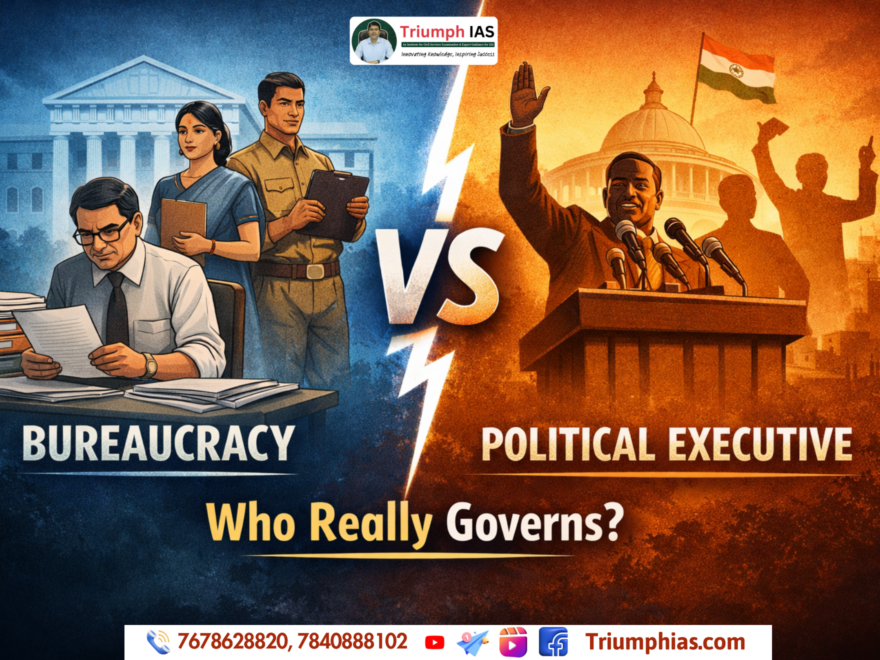
IntroductionModern democratic states operate through a complex relationship between elected political leaders and permanent administrative officials. In India, this relationship often raises a critical question: Who actually governs—the political executive or the bureaucracy? From a sociological perspective, governance is not controlled by a single actor but is the outcome of an ongoing interaction between these two institutions.
DimensionUnderstanding the Political Executive and BureaucracyThe political executive consists of elected representatives such as the Prime Minister, Chief Ministers, and Ministers who formulate policies and represent the democratic will of the people. Their legitimacy stems from electoral mandates and public accountability. The bureaucracy, on the other hand, refers to the permanent administrative machinery of the state. Civil servants implement policies, maintain continuity in governance, and provide technical expertise. Sociologist Max Weber conceptualized bureaucracy as a rational and efficient form of organization characterized by hierarchy, specialization, rules, and merit-based recruitment. In theory, the political executive makes decisions while the bureaucracy implements them. However, in practice, the boundaries between policymaking and policy implementation are often blurred. Bureaucratic Power in GovernanceBureaucrats possess significant influence because of their expertise, institutional memory, and control over administrative processes. Ministers typically rely on civil servants for drafting policies, preparing reports, and advising on technical matters. This reliance can lead to a situation where bureaucrats indirectly shape policy outcomes. Scholars refer to this phenomenon as bureaucratic dominance, where administrators influence decision-making due to their specialized knowledge and procedural control. Moreover, bureaucratic structures often ensure continuity even when political leadership changes. Governments may come and go, but administrative institutions remain stable. This permanence gives the bureaucracy considerable structural power within the state apparatus. Political Control and Democratic AccountabilityDespite bureaucratic influence, the political executive holds formal authority. Ministers are responsible for setting policy priorities, allocating resources, and guiding administrative actions. They also remain accountable to legislatures and ultimately to the electorate. Democratic theory emphasises that bureaucrats should operate under the direction of elected representatives. Political oversight is therefore essential to prevent excessive bureaucratic autonomy. In India, mechanisms such as ministerial responsibility, parliamentary committees, and administrative reforms are designed to ensure that bureaucracy remains accountable to the political leadership. The Indian ContextIndia’s administrative system reflects a legacy of the colonial Indian Civil Service, which was designed to maintain strong bureaucratic authority. After independence, the Indian Administrative Service (IAS) inherited this structure but adapted it to a democratic framework. However, tensions between politicians and bureaucrats frequently emerge. Political leaders may seek greater administrative control to implement electoral promises, while civil servants emphasize procedural rules and institutional norms. Issues such as frequent transfers, political interference, bureaucratic inertia, and accountability deficits often complicate this relationship. Critics argue that excessive politicisation can undermine administrative neutrality, while unchecked bureaucracy may slow policy implementation. Towards Collaborative GovernanceSociologically, governance functions most effectively when there is cooperation rather than competition between the political executive and the bureaucracy. Political leaders provide direction and democratic legitimacy, while bureaucrats contribute professional expertise and continuity. Administrative reforms in India increasingly emphasise collaborative governance, transparency, and citizen-centric service delivery. Digital governance, performance evaluation systems, and institutional accountability mechanisms aim to balance political authority with administrative efficiency. ConclusionThe debate over whether bureaucrats or politicians truly govern reflects the broader dynamics of power within modern states. In reality, governance is a shared process shaped by both democratic leadership and administrative expertise. A healthy democracy requires a balance where political executives guide policy while bureaucrats ensure efficient and impartial implementation. When these roles complement rather than conflict with each other, governance becomes more responsive, effective, and accountable to society. |
UPSC Civil Services (Mains) Question
Q. “The relationship between the political executive and bureaucracy often determines the effectiveness of governance.” Discuss with reference to the Indian administrative system.
To Read more topics, visit: www.triumphias.com/blogs
Read more Blogs:
2 comments