


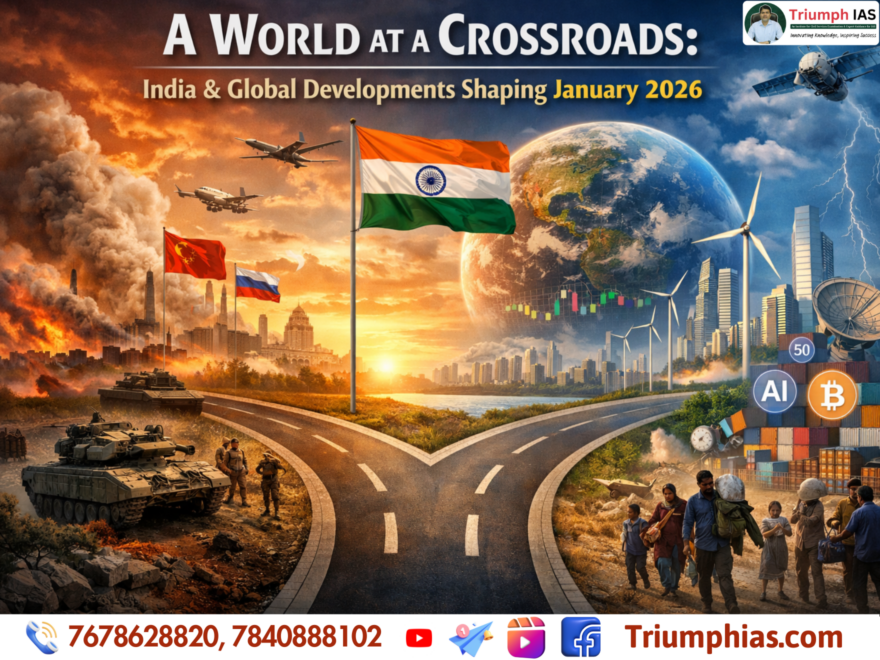
A World at a Crossroads: India and Global Developments Shaping January 2026
(Relevant for Sociology Paper I and II)
India and Global Developments Shaping January 2026The opening weeks of January 2026 reveal a world navigating uncertainty, transformation, and renewed assertions of power. From economic realignments and diplomatic engagements to environmental crises, technological governance, and cultural assertion, current affairs today reflect a complex interplay between national priorities and global challenges. India, positioned as a rising power, finds itself deeply embedded in these shifts—balancing domestic concerns with international responsibilities. This blog offers a comprehensive overview of the most significant current affairs shaping India and the world in January 2026, placing them within a broader political, economic, and sociological context. India’s Global Engagement in a Fragmented World OrderIndia’s Economic Diplomacy and Global ConfidenceIn early 2026, India continues to project confidence in its economic trajectory despite global slowdown concerns. The country’s leadership has emphasized macroeconomic stability, domestic consumption, infrastructure expansion, and digital innovation as key drivers of growth. India’s participation in major global economic dialogues reflects a clear strategy:
This approach is particularly significant at a time when many economies are grappling with inflation, debt distress, and trade fragmentation. Rise of Sub-National DiplomacyAn important trend shaping India’s global outreach is the international visibility of Indian states. Chief Ministers and state delegations are increasingly engaging with global investors and institutions, highlighting region-specific opportunities in infrastructure, tourism, renewable energy, and logistics. This reflects a shift toward competitive federalism, where states act as economic diplomats while aligning with national priorities. Diplomatic Relations and Strategic PartnershipsStrengthening India–West Asia RelationsIndia’s relationship with West Asian nations, particularly the Gulf region, has grown multidimensional. Strategic visits and high-level engagements emphasize cooperation in:
These partnerships are vital as India seeks diversified energy sources and enhanced geopolitical influence beyond South Asia. India–United States EngagementIndia-US relations continue to evolve through regular diplomatic dialogue. Discussions in early 2026 have focused on:
While areas of friction remain, the relationship is increasingly characterized by pragmatic engagement rather than ideological alignment. Domestic Governance and Infrastructure PushInfrastructure as a Developmental PillarInfrastructure remains central to India’s governance strategy in 2026. Major projects across railways, highways, and urban connectivity aim to:
Special emphasis has been placed on the northeastern states, reflecting a broader effort to integrate peripheral regions into India’s economic mainstream. Accountability and Regulatory OversightGovernance in 2026 also reflects a stronger regulatory stance. Recent penalties imposed on major corporations underscore the government’s intent to ensure:
Such actions signal that economic growth is increasingly accompanied by institutional discipline and regulatory enforcement. Environmental Crisis and Public Health ConcernsAir Pollution and Urban VulnerabilityOne of the most pressing challenges in January 2026 remains severe air pollution in urban India, particularly in the National Capital Region. Persistently hazardous air quality has reignited debates on:
Public health experts warn that prolonged exposure disproportionately affects children, elderly populations, and low-income communities, revealing deep environmental inequalities. Climate Variability and Extreme WeatherUnusual winter patterns, including dense fog, cold waves, rainfall, and snowfall in northern regions, highlight the growing unpredictability of climate systems. These changes affect:
Climate adaptation, once a future concern, has become an immediate governance priority. Republic Day 2026: Nationhood, Memory, and PowerReimagining National CelebrationsAs India approaches Republic Day 2026, preparations reflect a blend of tradition and transformation. The celebration emphasizes:
New formats in ceremonial displays underline India’s evolving defence capabilities and strategic outlook. Cultural Nationalism and Collective IdentityThe thematic focus on historical symbols and patriotic expression illustrates how national celebrations serve as instruments of collective identity. Such events reinforce:
They also reflect how culture and politics intersect in shaping modern nationalism. Global Economic Uncertainty and Geopolitical TensionsTrade Conflicts and Financial VolatilityGlobal markets in early 2026 remain sensitive to geopolitical developments. Trade disputes, tariff escalations, and capital flow volatility have affected currencies, bonds, and equity markets worldwide. For emerging economies like India, these conditions pose both risks and opportunities:
Conflict Zones and Global StabilityOngoing conflicts in West Asia, political unrest in parts of Africa, and democratic backsliding in several regions underscore the fragility of global peace. International efforts toward mediation and humanitarian assistance remain constrained by competing geopolitical interests. India’s increasing involvement in peace-building discussions reflects its aspiration to be a responsible global actor. Technology, Artificial Intelligence, and Global GovernanceIndia’s Push for Ethical AI FrameworksAs artificial intelligence becomes integral to governance, healthcare, finance, and security, India has emerged as a strong advocate for global AI standards. Key concerns include:
India’s position reflects the interests of developing nations seeking technological inclusion without exploitation. Technology as Power and InequalityWhile AI promises efficiency and innovation, it also risks deepening social and economic inequalities. Access to digital infrastructure, skills, and data increasingly determines national and individual power. This makes technology governance not merely a technical issue, but a deeply political and ethical one. Society, Culture, and LivelihoodsSupporting Traditional ArtisansCultural initiatives in early 2026 have highlighted the importance of traditional artisans and craftspeople. Government-supported platforms aim to:
These efforts represent a counterbalance to mass industrialization, emphasizing cultural sustainability. Sports as Soft PowerInternational sporting events underway in January 2026—from cricket tournaments to global tennis championships—demonstrate the role of sports in diplomacy, youth engagement, and national pride. Sports function as a unifying force, transcending political and cultural boundaries. Sociological Perspective: Patterns Beneath the HeadlinesFrom a sociological standpoint, today’s current affairs reveal deeper structural trends:
These contradictions are not anomalies but defining features of contemporary society. Understanding them requires moving beyond headlines to analyze power, institutions, and social change. Conclusion: Navigating an Uncertain FutureJanuary 2026 captures a world at a crossroads. India’s expanding global role, domestic governance challenges, environmental crises, and technological transformations all point toward a future shaped by complex choices. The path ahead demands:
Current affairs are not isolated events; they are expressions of deeper historical forces. How societies respond to these moments will determine whether the future is marked by resilience and cooperation—or fragmentation and conflict. |
To Read more topics, visit: www.triumphias.com/blogs
Read more Blogs:
Education Reforms in India: A Sociological Analysis of Change, Inequality, and the Role of the State
India’s 2026 Budget Priorities and Impact: A Comprehensive Analysis
One comment