Relevant for Sociology Optional Paper 1, Paper 2, and GS Paper I (Indian Society)
IntroductionReligion has always been more than a matter of faith. In sociology, it is understood as a powerful social institution that shapes values, collective identity, moral order, and patterns of social interaction. At the same time, religion can also become deeply intertwined with politics, especially in societies marked by diversity, inequality, and competition over power. The relationship between religion, identity politics, and social polarisation has therefore become one of the most significant themes in contemporary sociology. Religion provides individuals with meaning, belonging, and a shared moral universe. Émile Durkheim viewed religion as a source of social solidarity because it binds people together through common beliefs and rituals. Religious symbols and practices create what he called a “collective conscience,” a shared sense of community. In this sense, religion performs an integrative role by generating trust, cohesion, and continuity within society.
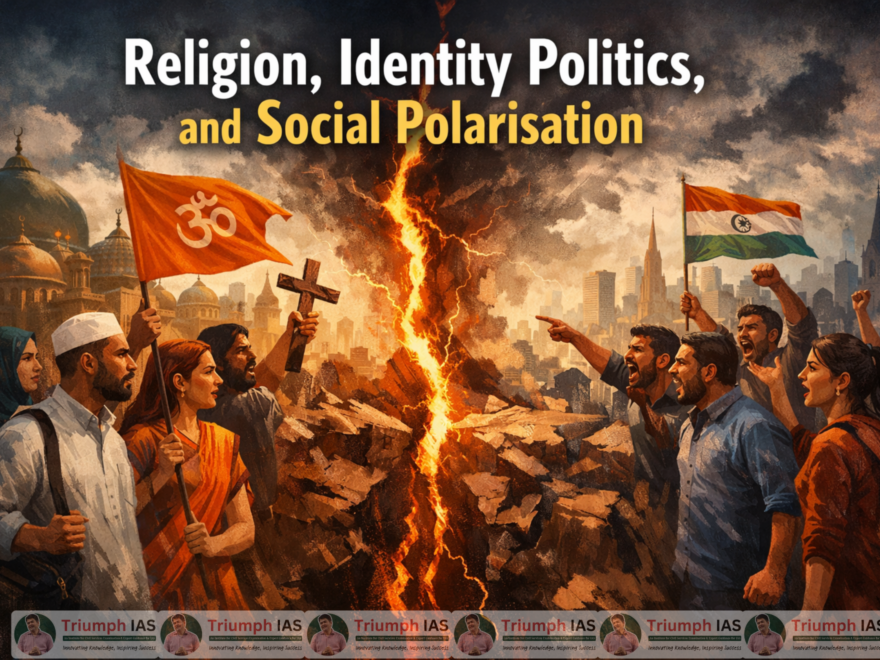
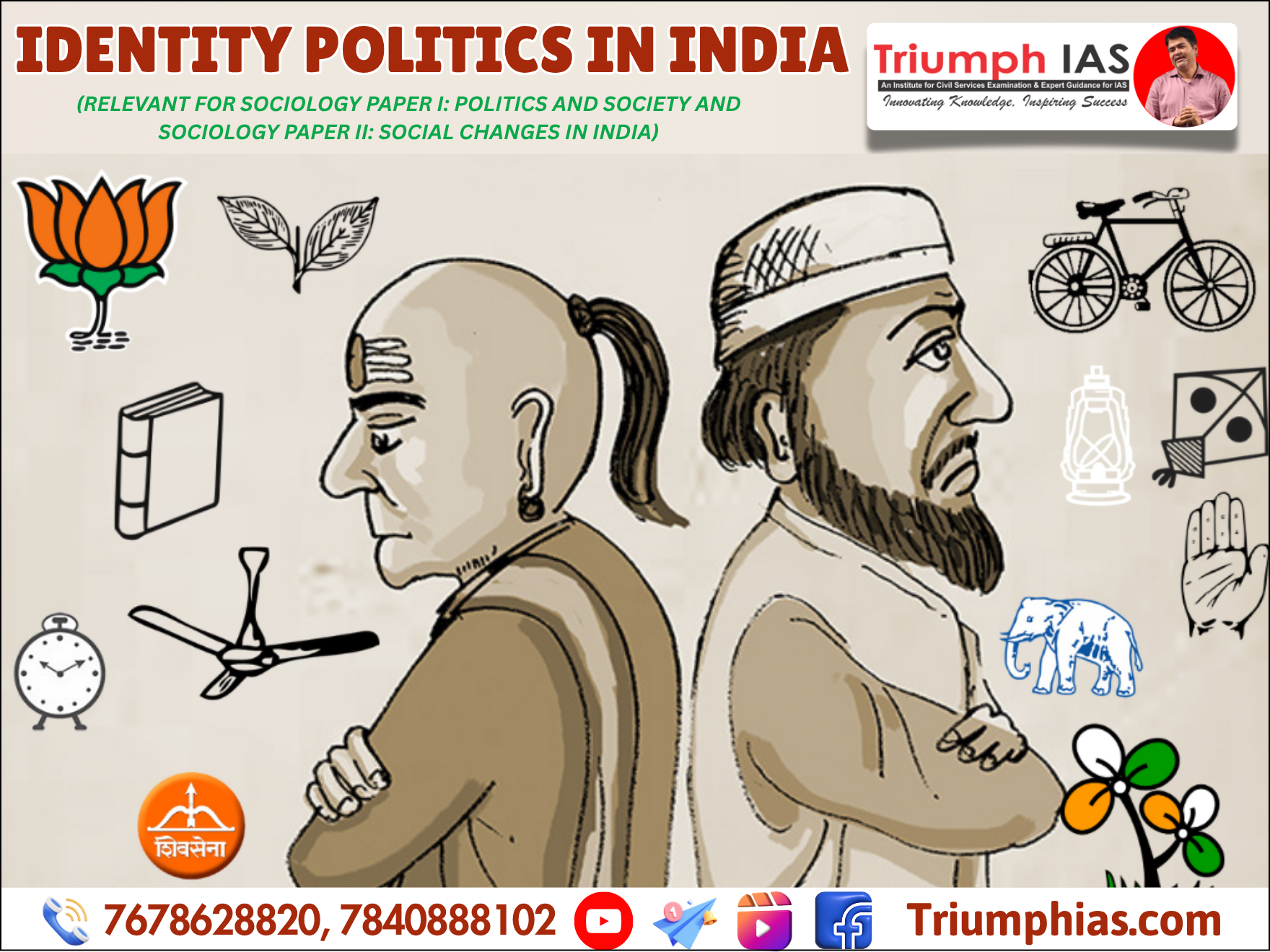
However, religion is not only a source of unity; it can also become a marker of difference. When religion becomes linked with political mobilisation, it often shifts from a spiritual domain to a social and political identity. This is where identity politics enters the picture. Identity politics refers to political action organised around the interests, experiences, and recognition of specific social groups such as those defined by religion, caste, ethnicity, gender, or language. In such situations, religious identity becomes a basis for claims-making, representation, and mobilisation. Sociologically, this transformation is important because it shows how identities are socially constructed and politically activated. A religious community is not always politically conscious, but under certain historical and political conditions, it may become organised as a political bloc. Leaders, parties, and institutions often invoke religious symbols and historical grievances to create a sense of “we” versus “they.” This process strengthens in-group solidarity, but it also sharpens social boundaries. Identity, once politicised, becomes a tool of inclusion for some and exclusion for others. Social polarisation emerges when these boundaries harden and society gets divided into opposing camps. Polarisation is not merely difference of opinion; it is a deepening of mistrust, hostility, and emotional distance between groups. In such contexts, religion may no longer function simply as a cultural resource but as a political weapon. Narratives of victimhood, fear, or superiority are amplified, and public discourse becomes increasingly antagonistic. The sociological concern here is not religion itself, but the way it is instrumentalised in social and political conflicts. This phenomenon can be better understood through conflict theory. From a conflict perspective, religion may be used by dominant groups to preserve power or by marginalised groups to resist domination. Political elites may strategically mobilise religious identities to divert attention from economic inequality, unemployment, or governance failures. By shifting public debate from material issues to symbolic and emotional issues, identity politics can fragment class-based solidarities and create new social tensions. Thus, religion becomes embedded in struggles over power, legitimacy, and resources. The role of media and digital communication has further intensified this process. Social media platforms often circulate selective narratives, stereotypes, and misinformation that reinforce prejudice. Echo chambers and algorithmic amplification deepen divisions by constantly exposing people to content that confirms their existing beliefs. In this way, social polarisation is not only ideological but also technologically mediated. Sociology therefore must examine how institutions, communication networks, and political structures shape religious identities in the public sphere. Yet it would be simplistic to treat religion only as a source of conflict. Religion can also inspire peace, ethical conduct, social reform, and inter-community solidarity. Many religious traditions contain values of compassion, justice, and coexistence. The challenge for plural societies is to prevent the politicisation of religious difference from overpowering these humane possibilities. Democratic institutions, constitutional values, secular citizenship, and civil society dialogue play a crucial role in reducing polarisation and sustaining social cohesion. In conclusion, religion, identity politics, and social polarisation are deeply interconnected sociological processes. Religion becomes politically potent when it is transformed into an instrument of collective identity and mobilisation. This can strengthen solidarity within groups, but it can also intensify division across society. A sociological analysis helps us move beyond moral panic and understand the structural, political, and cultural dynamics behind this phenomenon. In an increasingly diverse and contested world, the task of sociology is to explain how identities are formed, mobilised, and mediated—and how societies can preserve unity without erasing difference. |
UPSC Civil Services (Mains) Question
Q. “Religion as a source of social solidarity can also become a basis of identity politics and social polarisation.” Critically examine. (250 words)
To Read more topics, visit: www.triumphias.com/blogs
Read more Blogs:
Best lessons are learnt through bitter experiences – Triumph IAS & Vikash Ranjan Sir
 SANDESH JAIN [B.Tech] SOCIOLOGY STRATEGY #UPSC CSE 2025
 𝐖𝐡𝐚𝐭 𝐦𝐚𝐤𝐞𝐬 𝐭𝐡𝐢𝐬 𝐚𝐜𝐡𝐢𝐞𝐯𝐞𝐦𝐞𝐧𝐭 𝐞𝐱𝐭𝐫𝐚𝐨𝐫𝐝𝐢𝐧𝐚𝐫𝐲 𝐢𝐬 𝐡𝐢𝐬 𝐒𝐨𝐜𝐢𝐨𝐥𝐨𝐠𝐲 𝐎𝐩𝐭𝐢𝐨𝐧𝐚𝐥 𝐬𝐜𝐨𝐫𝐞:
 𝐓𝐎𝐓𝐀𝐋 𝐒𝐎𝐂𝐈𝐎𝐋𝐎𝐆𝐘 𝐌𝐀𝐑𝐊𝐒: 𝟑𝟎𝟗
 𝐏𝐚𝐩𝐞𝐫 𝟏 – 173 Marks 𝐏𝐚𝐩𝐞𝐫 𝟐 – 136 Marks
 Single Source Preparation- Only #Vikash #Ranjan Sir’s Sociology Foundation Class Notes, Discussions, Application Strategies & Answer Writing Practice. No multiple books or Scattered Materials, No PDFs, No Free YouTube Time Wastes, No other Essentials.
 Offline Classroom Program
 Live Online Classes
 Tablet Course (Learn Anytime)