

Relevant for Sociology Optional Paper 1, Paper 2, and GS Paper I (Indian Society)
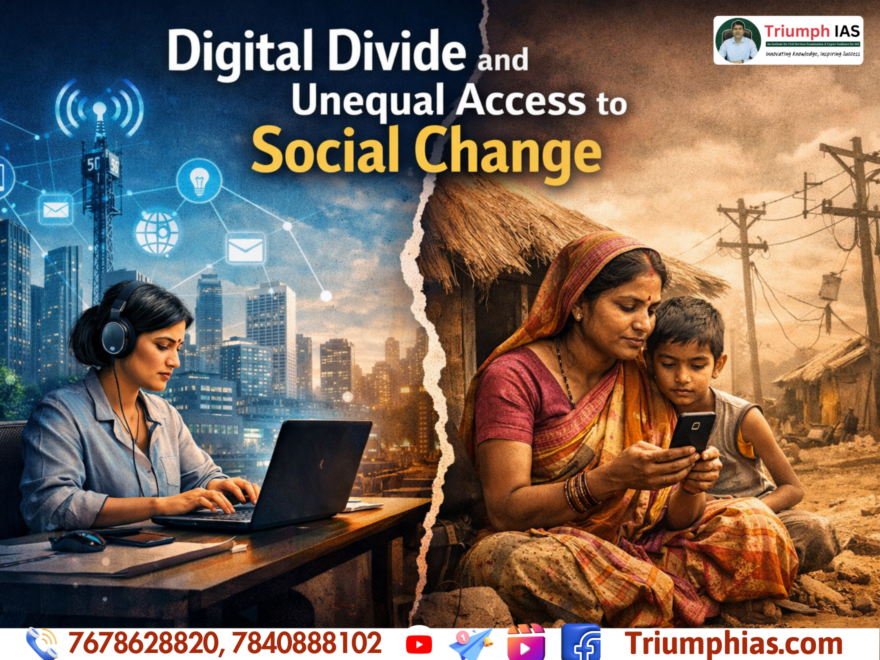
IntroductionThe rapid expansion of digital technologies has been widely celebrated as a transformative force capable of accelerating social change, enhancing participation, and democratizing access to knowledge. However, this transformation is far from uniform. The concept of the digital divide highlights persistent inequalities in access to, use of, and benefits derived from digital technologies. In sociological terms, the digital divide is not merely a technological gap but a reflection of deeper structural inequalities embedded within society. DimensionAt its core, the digital divide operates across three dimensions: access, capability, and outcomes. The first level concerns physical access to devices and internet connectivity. Despite significant progress, large sections of rural populations, economically weaker groups, and marginalized communities remain excluded. In India, for instance, disparities between urban and rural internet penetration illustrate how infrastructure limitations intersect with socio-economic hierarchies. The second level of the divide relates to digital literacy and skills. Merely providing access does not guarantee meaningful participation. Individuals require the cognitive and technical ability to navigate digital spaces, critically evaluate information, and utilize platforms effectively. This dimension often correlates with education levels, gender, and caste-based inequalities. Women, particularly in patriarchal settings, frequently face restricted access to digital tools, reinforcing existing gender disparities. The third and most significant level concerns outcomes—the extent to which digital engagement translates into tangible social, economic, and political benefits. Those with higher social capital are better positioned to leverage digital technologies for upward mobility, employment, and influence. Conversely, marginalized groups often remain passive consumers rather than active producers of digital content, limiting their role in shaping narratives and social change. From a theoretical perspective, the digital divide can be analyzed through the lens of Pierre Bourdieu’s concept of capital—economic, cultural, and social. Access to digital technologies represents a form of digital capital, which interacts with existing forms of capital to reproduce inequality. Similarly, Manuel Castells’ network society thesis underscores how power in contemporary society is organized through networks, making exclusion from digital networks a form of structural marginalization. The implications of the digital divide for social change are profound. While digital platforms have enabled movements such as online activism, e-governance, and digital entrepreneurship, these benefits are unevenly distributed. The promise of inclusive development through initiatives like Digital India remains constrained by ground-level disparities. Thus, instead of acting as a great equalizer, digital technology often amplifies pre-existing inequalities. Furthermore, the digital divide has significant implications for democratic participation. Access to information and the ability to engage in public discourse are essential for an informed citizenry. When sections of society are excluded from digital spaces, their voices are marginalized, leading to a skewed representation of interests and concerns. This raises critical questions about the inclusiveness of digital democracy. Addressing the digital divide requires a multi-dimensional approach. Infrastructure development must be complemented by investments in digital literacy, especially among marginalized communities. Policy interventions should focus on affordability, accessibility, and inclusivity, ensuring that digital transformation does not exacerbate social stratification. Community-based initiatives, public-private partnerships, and targeted schemes for women and disadvantaged groups can play a crucial role in bridging the gap. ConclusionIn conclusion, the digital divide is a critical sociological issue that reflects and reinforces broader patterns of inequality. While digital technologies hold immense potential for facilitating social change, their benefits remain unevenly distributed. A nuanced understanding of the digital divide is essential for designing inclusive policies that ensure equitable access to the opportunities of the digital age. Without such interventions, the digital revolution risks becoming another axis of exclusion rather than a pathway to inclusive development. |
UPSC Civil Services (Mains) Question
Q.“The digital divide is not merely a technological issue but a manifestation of deeper social inequalities.” Discuss in the context of contemporary India. (250 words)
To Read more topics, visit: www.triumphias.com/blogs
Read more Blogs: