Standardized tests have long occupied a central position in modern education systems. Designed to assess learning outcomes through uniform questions, evaluation criteria, and scoring methods, they promise objectivity, comparability, and efficiency. From school-level board examinations to competitive entrance tests for higher education and public services, standardized assessments have become gatekeepers of opportunity.
However, their growing dominance has also provoked persistent debate. Do standardized tests truly measure academic ability and intellectual growth, or do they merely quantify limited forms of performance under artificial conditions? In a world where learning is increasingly multidimensional and lifelong, the question assumes critical importance. While standardized tests offer certain measurable advantages, their capacity to capture the full spectrum of academic ability and genuine progress remains deeply contested.
MAIN BODY:
Before evaluating standardized tests, it is necessary to clarify what is meant by academic ability and progress. Academic ability encompasses not only cognitive skills such as comprehension, reasoning, and analysis, but also creativity, curiosity, adaptability, and the capacity to apply knowledge in diverse contexts. Academic progress, meanwhile, refers to intellectual growth over time—how learners deepen understanding, refine skills, and develop independent thinking.
However, standardized tests tend to operationalize ability in narrow, quantifiable terms. They prioritise what can be easily measured—accuracy, speed, and recall—often at the expense of depth, originality, and reflective thinking. Consequently, a conceptual mismatch emerges between the richness of learning and the rigidity of its measurement.
Despite criticism, standardized tests offer certain undeniable advantages. First, they provide a common metric for comparison. In large and diverse societies, such as India, standardized assessments help ensure uniform evaluation across regions, institutions, and social backgrounds. Without them, subjective biases and arbitrary judgments could dominate educational decision-making.
Second, standardized tests introduce a degree of accountability. They compel institutions and educators to align teaching with measurable outcomes, thereby discouraging complacency. From a policy perspective, aggregate test data can highlight systemic gaps, regional disparities, and trends in educational performance.
Third, standardized tests reward discipline and consistency. Preparing for such assessments requires sustained effort, time management, and familiarity with core concepts. In this sense, they do measure certain academically relevant traits, particularly perseverance and foundational knowledge.
Thus, it would be simplistic to dismiss standardized tests as entirely irrelevant. Their value lies in their efficiency and comparability, especially in mass education systems.
However, the core criticism lies in what standardized tests fail to measure. Academic ability is not a static trait but a dynamic and contextual process. Standardized tests, by design, flatten this complexity. They capture performance at a single moment rather than intellectual growth over time.
Moreover, such tests often privilege convergent thinking—arriving at one correct answer—while undervaluing divergent thinking, which generates multiple possibilities. Yet, innovation, research, and problem-solving in real life demand precisely this kind of open-ended reasoning. Consequently, students adept at critical inquiry may perform poorly on standardized tests, while rote learners may excel.
Howard Gardner’s theory of multiple intelligences further challenges the assumption that a single test can assess human capability. Linguistic and logical-mathematical skills dominate standardized assessments, while spatial, musical, interpersonal, and ethical intelligences remain largely invisible. As a result, standardized tests risk equating narrow cognitive proficiency with overall academic merit.
Furthermore, standardized tests are often criticised for reproducing social inequalities. Although presented as neutral tools, they are embedded in unequal social contexts. Access to quality schooling, coaching, parental support, and learning resources significantly influences test outcomes. Consequently, test performance often reflects socio-economic advantage as much as academic ability.
Pierre Bourdieu’s concept of cultural capital is particularly relevant here. Students from privileged backgrounds possess linguistic styles, confidence, and familiarity with test-oriented norms that align with standardized assessments. Conversely, first-generation learners may struggle despite intellectual potential. In such cases, standardized tests measure social conditioning rather than genuine academic progress.
Thus, while standardized tests claim meritocracy, they frequently mask structural inequalities under the guise of objectivity.
Another significant concern is the impact of standardized testing on pedagogy. When test scores become the primary indicator of success, teaching inevitably narrows to what is tested. This phenomenon, often described as “teaching to the test,” reduces education to examination preparation.
As a result, classrooms prioritise memorisation, predictable formats, and short-term performance over deep understanding and long-term intellectual development. Subjects that are difficult to standardize—such as ethics, creativity, and civic engagement—are marginalised. Consequently, standardized tests shape not only assessment but also the very nature of learning, often impoverishing it.
John Dewey warned that education divorced from experience becomes mechanical. When standardized tests dominate, learning risks becoming instrumental rather than transformative.
A crucial distinction must be made between measuring progress and ranking individuals. Standardized tests excel at ranking but perform poorly at capturing growth. They compare students against each other rather than against their own developmental trajectories.
Academic progress, however, is inherently personal. A learner overcoming foundational gaps may demonstrate significant growth yet still score lower than peers. Standardized tests fail to recognise such improvement, thereby discouraging effort among those who start from disadvantaged positions.
Moreover, progress involves qualitative changes—greater curiosity, ethical sensitivity, or independent thinking—that resist numerical representation. By reducing learning to scores, standardized tests risk confusing measurement with meaning.
Additionally, excessive reliance on standardized tests has psychological consequences. High-stakes testing environments generate stress, anxiety, and fear of failure. When academic worth becomes synonymous with test scores, learners internalise narrow definitions of success and self-worth.
Ethically, this raises concerns about fairness and human dignity. Education, at its core, should nurture confidence and curiosity, not anxiety and conformity. When standardized tests dominate educational narratives, they risk undermining education’s humanistic purpose.
At a deeper philosophical level, the debate reflects differing conceptions of knowledge. Standardized tests align with positivist assumptions—that knowledge is objective, discrete, and measurable. However, contemporary epistemology recognises knowledge as contextual, interpretive, and evolving.
Thinkers such as Tagore and Gandhi emphasised education as self-realisation and moral growth, dimensions that defy standardised measurement. If education is reduced to what can be tested, vast realms of human understanding remain unacknowledged.
Therefore, the limitations of standardized tests are not merely technical but philosophical.
Nevertheless, rejecting standardized tests entirely would be impractical. Large-scale systems require some common benchmarks. The challenge lies in rebalancing assessment rather than abolishing it.
A more holistic approach would combine standardized tests with formative assessments, project work, portfolios, peer evaluation, and experiential learning. Such plural methods can capture both outcomes and processes, both competence and growth.
Moreover, standardized tests themselves can be redesigned to emphasise analytical reasoning, application-based questions, and interdisciplinary thinking. When used as diagnostic tools rather than absolute judgments, they can contribute meaningfully to educational improvement.
CONCLUSION:
In conclusion, standardized tests are at best an incomplete measure of academic ability and progress. While they offer efficiency, comparability, and administrative convenience, they fall short in capturing the depth, diversity, and dynamism of learning. By privileging narrow cognitive skills and momentary performance, they risk distorting educational priorities and reinforcing social inequalities.
Academic ability is multifaceted, and academic progress is longitudinal. No single test can encapsulate either fully. Therefore, standardized tests should be viewed as tools, not truths—useful indicators rather than definitive judgments. A mature education system must look beyond scores to recognise growth, creativity, and ethical development.
Ultimately, the true measure of education lies not in standardised rankings, but in the capacity of individuals to think critically, act responsibly, and continue learning throughout life. Only when assessment aligns with this broader vision can education fulfil its transformative promise.
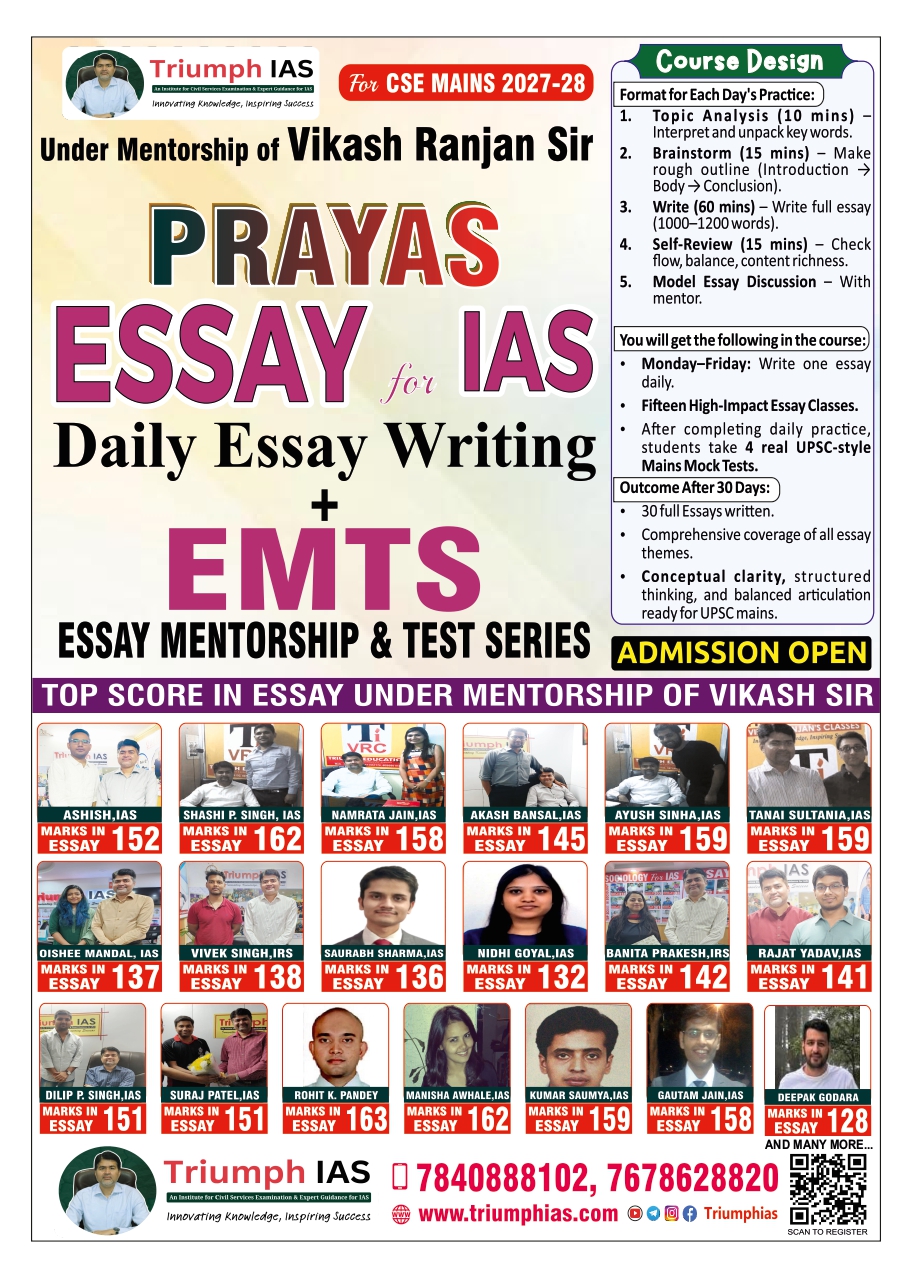
If you’re preparing for the UPSC Civil Services Examination (CSE), one paper that can unlock exceptional scores and a top rank is the Essay Paper. While General Studies and Optional Subjects are structured and syllabus-driven, the Essay writing segment is where individuality, critical thinking, and articulation truly shine.
Among various Essay programs available across India, Triumph IAS, under the expert mentorship of Vikash Ranjan Sir, offers the Best Essay writing Course for UPSC CSE. This comprehensive guide explores what makes this program unparalleled and why it should be part of every serious aspirant’s preparation strategy.


One comment