
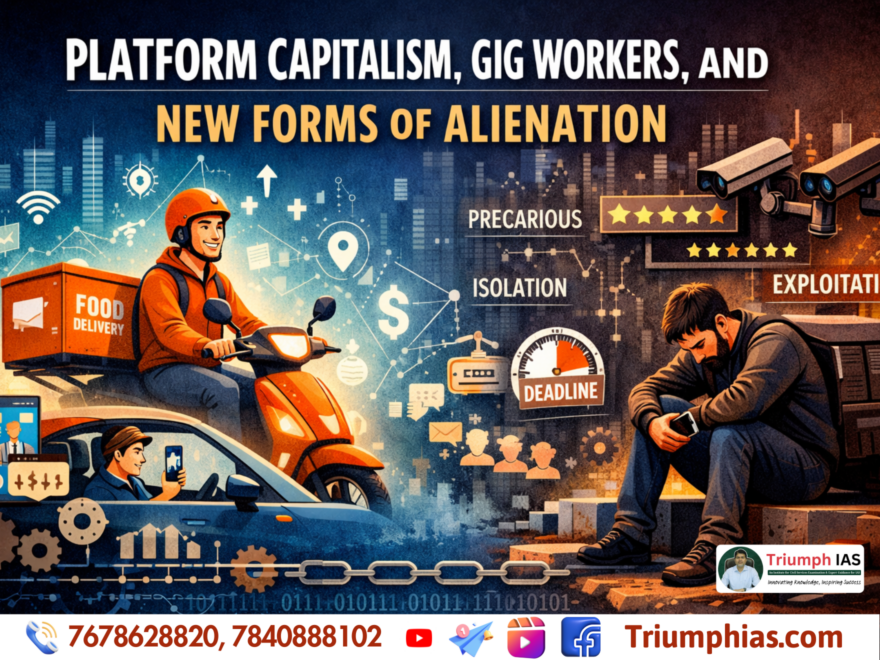
Platform Capitalism, Gig Workers, and New Forms of Alienation
(Relevant for Sociology Paper 1 and GS Society )
IntroductionThe rise of platform capitalism marks a decisive transformation in the organisation of work under late capitalism. Digital platforms such as ride-hailing apps, food delivery services, and freelance marketplaces have restructured labour relations by mediating work through algorithms rather than traditional employers. While often projected as flexible and empowering, platform-based work has generated new forms of alienation, particularly for gig workers who occupy a precarious position in the contemporary political economy. From a sociological perspective, platform capitalism represents an advanced stage of capitalist accumulation where data, algorithms, and digital infrastructure become key means of production. Unlike classical industrial capitalism, control is exercised not through factory supervision but through algorithmic management—ratings, incentives, penalties, and opaque performance metrics. This has fundamentally altered the labour process while intensifying worker vulnerability. Dimension:Gig Work and the Illusion of Flexibility
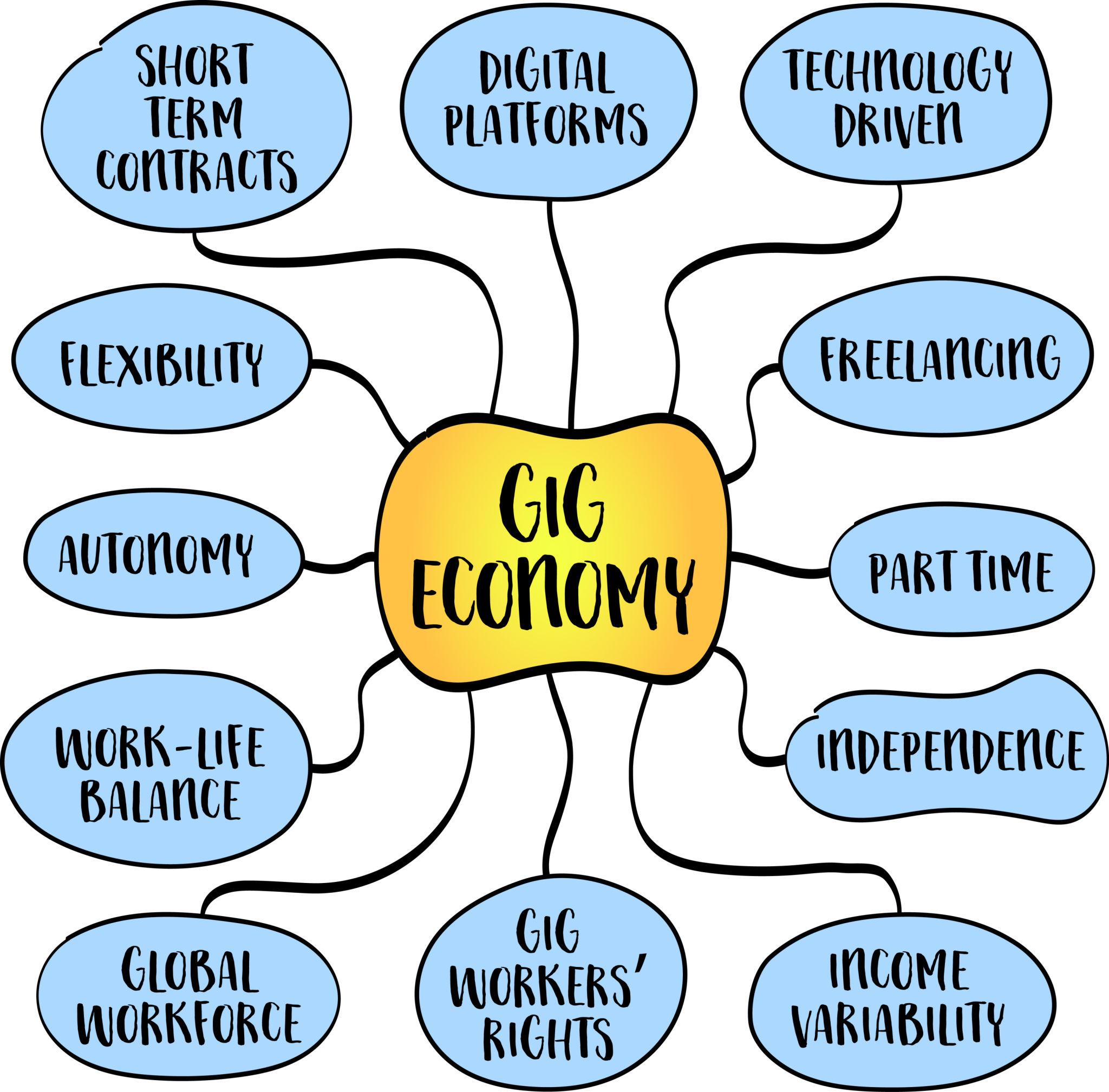
Gig workers are formally classified as “independent contractors,” which exempts platforms from providing job security, social protection, or collective bargaining rights. While flexibility in working hours is highlighted, sociological studies reveal that this autonomy is largely illusory. Workers are compelled to align their availability with peak demand hours, surge pricing, and platform incentives to earn a subsistence income. This condition reflects what sociologists describe as precarisation of labour, where employment becomes uncertain, informal, and individualised. Risk is systematically shifted from capital to labour. The platform extracts value without assuming responsibility for workers’ welfare, thereby deepening structural inequality. New Forms of Alienation
The concept of alienation, classically articulated by Karl Marx, remains analytically relevant but requires reinterpretation in the digital age. Under platform capitalism, alienation manifests in multiple, novel ways:
Unlike factory workers who could identify an employer, gig workers face “faceless capital”, where accountability is diffused behind technology. This leads to psychological stress, insecurity, and a sense of powerlessness—hallmarks of alienation in contemporary capitalism. Sociological ImplicationsPlatform capitalism challenges established sociological categories such as formal–informal labour, employer–employee relations, and industrial class struggle. It reinforces individualisation, a key feature of late modernity, while simultaneously intensifying exploitation. From a conflict perspective, platforms represent a new bourgeoisie that controls digital capital, while gig workers form a fragmented and weakly organised proletariat. From a Weberian lens, algorithmic rationality exemplifies instrumental rationality, where efficiency overrides ethical and social considerations. Feminist sociology further highlights how platform work often reproduces gendered inequalities, with women concentrated in low-paid, care-related digital gigs. Conclusion:Platform capitalism does not signal the end of exploitation but its technological reconfiguration. Gig workers experience freedom without security and autonomy without power. Understanding these new forms of alienation is crucial for sociology, especially in the context of labour reforms, welfare policy, and digital governance. As work becomes increasingly platform-mediated, sociological analysis must remain attentive to how technology reshapes inequality, power, and human dignity. |

UPSC Civil Services Mains – Sociology Optional Question
“Platform capitalism has transformed labour relations without eliminating alienation.”
Critically examine this statement in the context of gig work in contemporary society.
(250 words)
To Read more topics, visit: www.triumphias.com/blogs
Read more Blogs:
Non-Positivist Methods and Lived Experiences of Marginalised Groups
11 comments