Introduction
As India charts its path to becoming a Viksit Bharat (Developed India) by 2047, manufacturing is set to become a key pillar. Equally emphasized is the role of ‘nari shakti’ (women empowerment). However, a glaring contradiction emerges—women remain missing from India’s factory floors. This gender gap in the formal manufacturing sector raises serious concerns about gender inequality in labor markets, informalization of work, and the persistence of patriarchal structures—all of which are core concerns in the Sociology syllabus.
The Data Story: Women in Manufacturing
Recent data reveals:
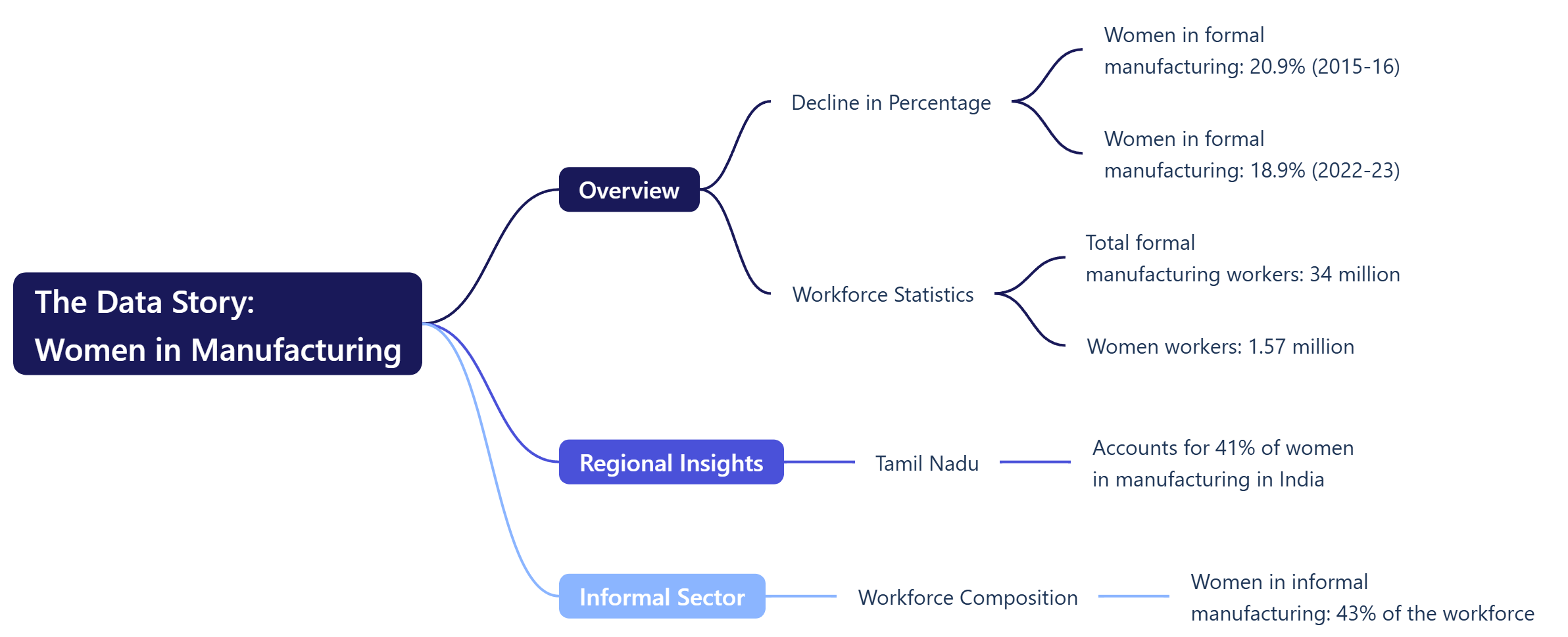
- The share of women in India’s formal manufacturing sector fell from 20.9% (2015-16) to 18.9% (2022-23).
- Out of 34 million formal manufacturing workers, only 1.57 million are women.
- Tamil Nadu alone accounts for 41% of all women employed in manufacturing across India.
- In informal manufacturing, however, women constitute 43% of the workforce.
This discrepancy tells a powerful story—not that women aren’t working, but that they are confined to low-paying, insecure, informal jobs.
Sociological Analysis
- Gender Division of Labour –Sociologists like Ann Oakley and Sylvia Walby have emphasized how patriarchal norms determine what constitutes “women’s work.” In India’s case, factory jobs—especially in formal manufacturing—are seen as male-dominated due to physical labor expectations, rigid work hours, and mobility constraints for women.
- Feminization of Labour and Informal Sector: As highlighted in the sociology of work, the feminization of labour refers to the increasing participation of women in low-paid, precarious, and unregulated jobs. This is visible in India’s manufacturing industry, where informal jobs dominate women’s employment, reflecting labor market segmentation and gendered occupational segregation.
- Social Institutions and Patriarchy – In Indian society, patriarchal family structures restrict women’s mobility, decision-making, and aspirations. Cultural norms around ‘women’s honor’, household responsibilities, and unsafe public transport act as barriers to their participation in industrial jobs.
Case Study: Tamil Nadu’s Industrial Belt
Tamil Nadu offers a model worth studying. It accounts for 41% of all women in manufacturing—especially in textile and electronics sectors—thanks to relatively better social indicators, hostel facilities, and targeted skill-training programs. However, even here, women are concentrated in semi-skilled and low-wage roles.
Way Forward
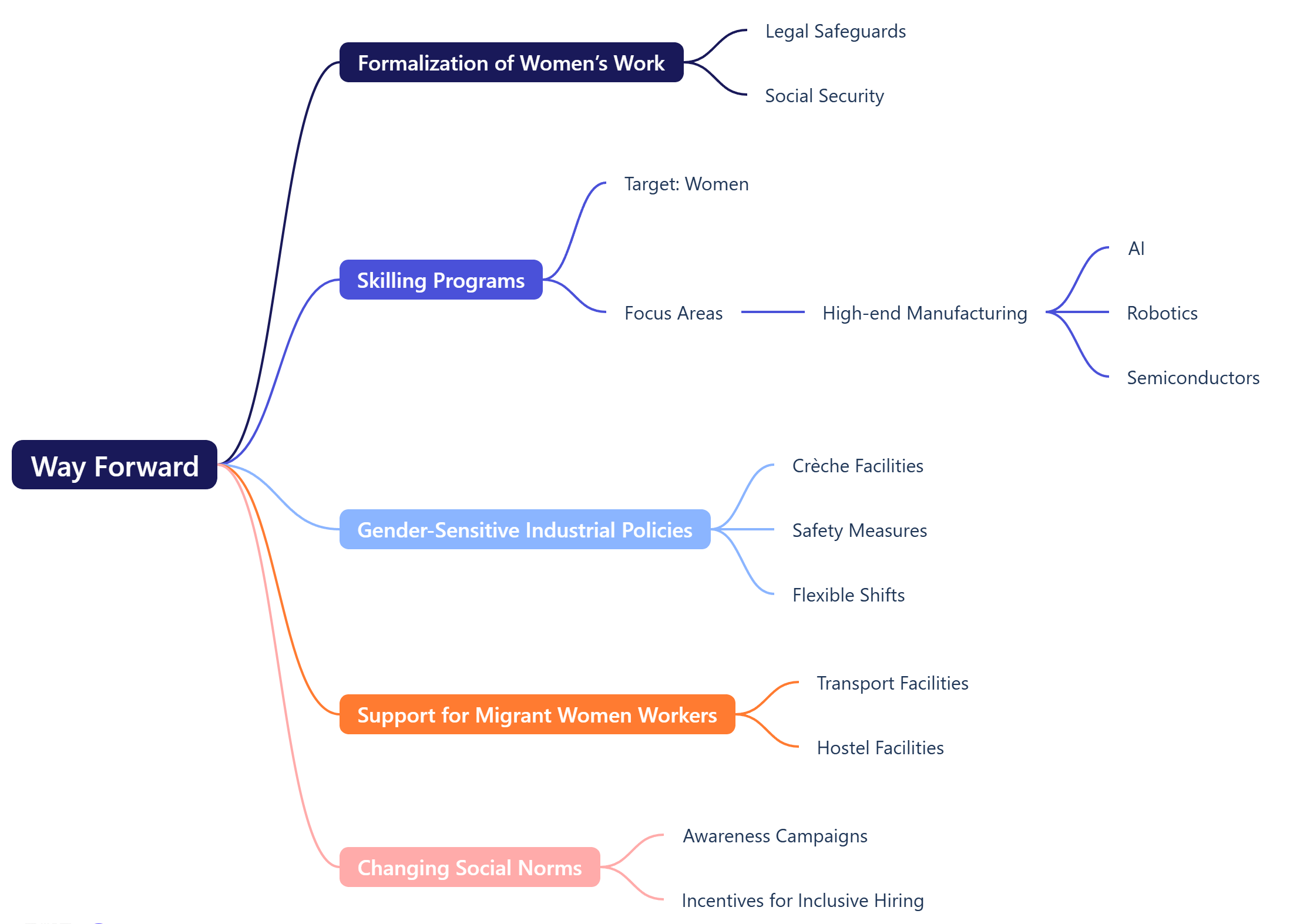
- Formalization of Women’s Work through legal safeguards and social security.
- Skilling Programs targeting women for high-end manufacturing jobs (AI, robotics, semiconductors).
- Gender-Sensitive Industrial Policies with crèche facilities, safety, flexible shifts.
- Transport and Hostel Facilities for migrant women workers.
- Changing Social Norms through awareness campaigns and incentives for inclusive hiring.
Conclusion
The missing women from India’s factory floors are not a result of lack of willingness or skill, but a complex interplay of social, economic, and cultural factors. For India to truly harness the power of its demographic dividend, gender equality in the formal labor market must become a non-negotiable priority.
PYQs
Paper I
- How do social constraints affect the working of women in the informal sector in India? (2013)
- Distinguish between sex and gender. Examine the role of socialization in determining gender roles. (2014)
- Explain the concept of ‘feminization of labour’. What are its socio-economic consequences? (2015)
- Examine how the concept of patriarchy affects the sexual division of labour in society. (2016)
- Discuss the gender dimension in work and economic life in contemporary India. (2017)
- How does the process of social mobility impact gender relations in India? (2018)
- Analyse how inequality in the workplace is perpetuated through social norms and institutions. (2019)
- Discuss Sylvia Walby’s analysis of patriarchy and explain its relevance in understanding gender inequality. (2020)
- Explain how Ann Oakley’s views on gender socialization help in understanding gender-based occupational segregation. (2021)
- How does globalization impact gender roles in the work domain in developing countries like India? (2022)
Paper II
- Discuss the role of patriarchy in the Indian family and its implications for women’s participation in the workforce. (2013)
- Explain the factors responsible for the low work participation rate of women in India. (2014)
- Examine the impact of industrialization and urbanization on women’s employment in India. (2015)
- Critically assess the feminization of labour in the informal sector in India. (2016)
- What are the structural and cultural constraints faced by Indian women in the formal labor market? (2017)
- Discuss the impact of globalization and economic liberalization on the employment of women in India. (2018)
- Describe how caste and gender intersect in shaping women’s access to employment opportunities. (2019)
- Critically evaluate government policies aimed at improving women’s participation in economic activities in India. (2020)
|