
Understanding the South Indian Kinship System
(Relevant for Sociology Paper I: Systems of Kinship and Sociology Paper II: Systems of Kinship in India)
Introduction
South Indian kinship system represents a distinctive and structurally complex pattern of social organization in India. Unlike its North Indian counterpart, which is often governed by exogamous patrilineal systems, the South Indian system is known for its matrilateral cross-cousin marriages, strong lineage ties, and localized practices influenced by language, caste, and regional identities. Studying this kinship structure is crucial, especially under topics like Kinship, Family and Marriage, Caste and Class, and Indian Social Institutions.
What is Kinship?
Kinship refers to a system of social relationships based on blood (consanguinity) and marriage (affinity). It forms the foundation of social institutions like the family, marriage, inheritance, and lineage.
In the Indian context, kinship structures are broadly divided into North Indian (Indo-Aryan) and South Indian (Dravidian) systems. The Dravidian kinship system, dominant in Tamil Nadu, Karnataka, Andhra Pradesh, Kerala, and Telangana, is of special sociological interest.
Features of the South Indian Kinship System
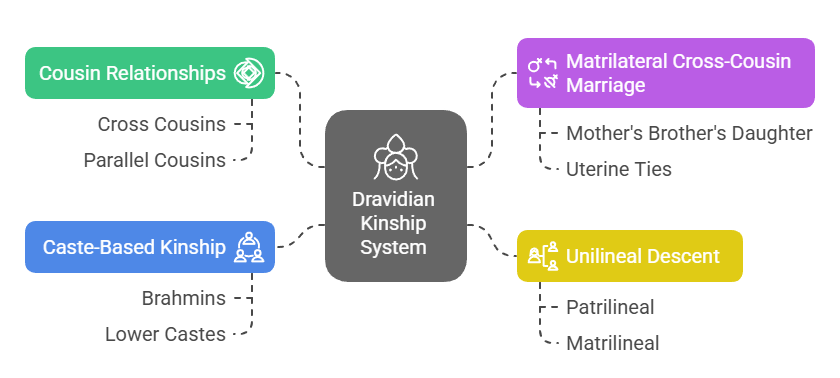
Dravidian Kinship Terminology
The South Indian kinship system is based on Dravidian terminology, which distinguishes between cross-cousins and parallel cousins, unlike in the North where all cousins are usually treated similarly.
- Parallel cousins (father’s brother’s children or mother’s sister’s children) are treated as siblings.
- Cross cousins (mother’s brother’s children or father’s sister’s children) are preferred for marriage.
Matrilateral Cross-Cousin Marriage
This is a hallmark of the system:
- Marriage between a man and his mother’s brother’s daughter (MBD) is preferred.
- It strengthens uterine ties, maintaining alliances within the maternal line.
- The practice is linked to concepts of endogamy within specific caste groups.
Unilineal Descent with Local Variations
Though the patrilineal system dominates (descent traced through the father), matrilineal communities like the Nairs in Kerala display unique kinship structures, where property and lineage are traced through women.
Hierarchy and Caste-Based Kinship
The kinship system is also influenced by caste dynamics:
- Brahmins (e.g., Iyers and Iyengars) follow strict lineage and gotra rules.
- Lower castes may follow more flexible kinship arrangements.
Sociological Analysis

- Louis Dumont (Structural Indology): Dumont, in Homo Hierarchicus, suggested that purity and pollution underlie caste-based kinship rules. South Indian kinship, though different in marital rules, also reflects hierarchical logic.
- Irawati Karve (Descriptive Approach): Karve classified Indian kinship into four zones and emphasized the distinction between North and South Indian kinship. She introduced the term Dravidian kinship zone.
- McKim Marriott: Marriott highlighted cultural continuity through universalization and parochialization.
- M.N. Srinivas: Srinivas, in his study of Rampura, identified kinship ties as integral to social mobility, especially via Sanskritization.
Kinship and Marriage in South India
- Marriage is often arranged between matrilateral cross-cousins, promoting clan cohesion.
- Hypergamy and hypogamy are less common than in North India.
- Marriages consolidate alliances within caste and lineage
- Dowry is less pronounced in some areas, replaced by bride price or shared inheritance.
Role of Kinship in Social Organization

Inheritance
- In patrilineal groups: Property passes through the male line.
- In matrilineal groups: Women have usufruct rights but the control often lies with maternal uncles.
Residence
- Virilocal (bride moves to husband’s house) in most groups.
- Matrilocal or avunculocal in matrilineal societies like Nairs (bride stays in maternal home or maternal uncle’s home).
Authority and Power
- Kinship influences decision-making, ritual authority, and social status.
- Women gain symbolic power in matrilineal setups, but often lack real decision-making authority.
Kinship and Gender Dynamics
- Though South Indian kinship allows closer bonds between maternal kin, gender inequalities persist.
- Male dominance is seen in inheritance and rituals.
- Women’s roles are defined in relation to kinship positions (daughter, wife, sister).
Contemporary Changes and Challenges
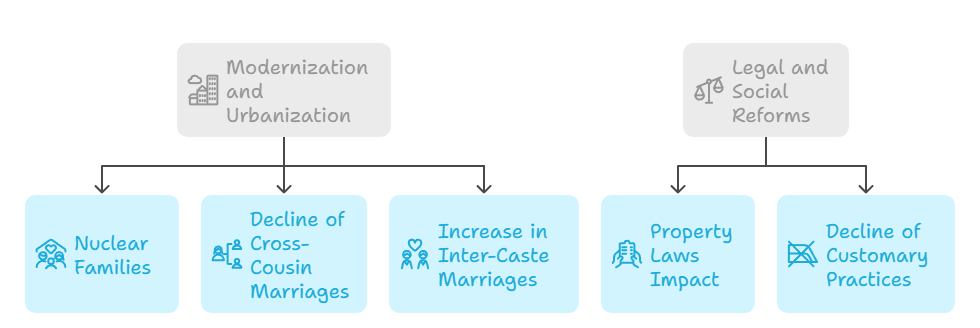
Modernization and Urbanization
- Nuclear families are replacing joint families.
- Cross-cousin marriages are declining in urban educated classes.
- Inter-caste and inter-regional marriages are slowly increasing.
Legal and Social Reforms
- Property laws (like the Hindu Succession Act, 2005 amendment) have impacted women’s rights in kinship.
- Decline of customary practices due to state laws and feminist movements.
North vs. South Indian Kinship
| Aspect | North India (Aryan) | South India (Dravidian) |
| Cousin Marriage | Avoided | Preferred (especially cross-cousin) |
| Gotra Rule | Strict exogamy | Not prevalent |
| Residence | Virilocal | Virilocal / Matrilocal / Avunculocal |
| Descent | Patrilineal | Patrilineal and Matrilineal (in Kerala) |
| Terminology | General | Cross vs Parallel cousin distinction |
Conclusion
The South Indian kinship system reflects a rich tapestry of social, cultural, and symbolic structures, where tradition and modernity co-exist. It is essential for UPSC aspirants to understand this system not just in anthropological terms but through critical sociological lenses. From cross-cousin marriage to matrilineal lineages, and from ritual purity to changing family forms, the South Indian kinship structure offers fertile ground for academic and civil services exploration.
PYQs
Paper I
- Distinguish between classificatory and descriptive systems of kinship. (2014)
- Discuss the concept of descent and alliance in kinship theory. (2015)
- Explain the relevance of Lévi-Strauss’s alliance theory in understanding South Indian kinship practices. (2017)
- Discuss the role of kinship in the social organization of South Indian society. (2018)
- How do rules of endogamy and exogamy influence kinship and marriage in Indian society? (2020)
- Explain the concept of ‘kinship usage’ with examples from Indian society. (2021)
- Discuss the typology of kinship in the context of Dravidian kinship systems. (2022)
- Discuss the contemporary changes in kinship and family structures in India. (2023)
Paper II
- Discuss the differences between North Indian and South Indian kinship systems with sociological examples. (2014)
- Explain the implications of matrilineal kinship on the status of women with reference to Kerala. (2015)
- Examine the role of kinship in maintaining caste endogamy in South India. (2016)
- Describe the impact of modernization on kinship and family in South Indian states. (2017)
- Analyze the institution of cross-cousin marriage and its significance in South Indian society. (2018)
- Highlight the changes in the institution of marriage in India with examples from South India. (2019)
- Discuss the persistence of traditional kinship patterns in urban South India. (2020)
- How has the Hindu Succession Act amendment influenced kinship and property rights in South India? (2021)
- Discuss the role of kinship in social mobility and caste alliances in Southern India. (2022)
To Read more topics, visit: www.triumphias.com/blogs
Read more Blogs:
Dalit Weddings: Celebrations Turned into Sites of Caste Resistance
One comment