Fiscal Federal Relations
India’s federal structure, as enshrined in the Constitution, is characterized by a strong center but also a growing emphasis on cooperative and competitive federalism. Fiscal federalism refers to the financial relations between different levels of government—primarily the Centre and the States. In a vast and diverse country like India, where states differ widely in economic strength, population, and needs, maintaining a balanced fiscal relationship is critical to ensure equitable development.
Constitutional Framework of Fiscal Federalism
The Seventh Schedule of the Constitution divides powers between the Union and States through three lists—Union, State, and Concurrent. Financial powers are distributed such that major taxation powers rest with the Centre, while the States are responsible for implementing most public welfare and development programs.
- Article 268-293 deals with the distribution of revenues.
- Article 280 provides for the constitution of the Finance Commission every five years to recommend the distribution of tax revenue between Centre and States.
Vertical and Horizontal Imbalance
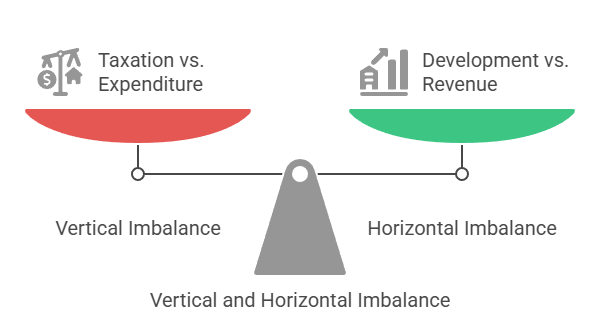
India’s fiscal federalism suffers from two types of imbalances:
- Vertical imbalance: arises because the Centre has more taxation powers while the States have higher expenditure responsibilities.
- Horizontal imbalance: results from differing levels of development and revenue capacities among states.
To address these issues, institutions like the Finance Commission, GST Council, and NITI Aayog play critical roles.
Role of the Finance Commission
The 15th Finance Commission (2020-25), chaired by N.K. Singh, made significant recommendations:
- 41% of the divisible pool of central taxes to be devolved to states (down from 42% in the 14th FC due to the creation of Jammu and Kashmir as a Union Territory).
- A new incentive-based grant structure linked to reforms in power sector, urban local bodies, and health.
- Grants-in-aid for local governments totaling ₹4.36 lakh crore.
This commission emphasized performance-based devolution and the need for states to increase own revenues, especially post-COVID-19.
GST and Fiscal Federalism
The introduction of Goods and Services Tax (GST) in 2017 marked a paradigm shift in Indian fiscal federalism:
- It subsumed 17 taxes and 13 cesses, creating a common national market.
- The GST Council—comprising representatives from the Centre and all States—was created under Article 279A to ensure consensus-based decision-making.
While GST improved tax compliance and revenue in the long term, initial implementation issues and delay in compensation payments to states exposed challenges in cooperative federalism.
GST Compensation Issue (2017-2022):
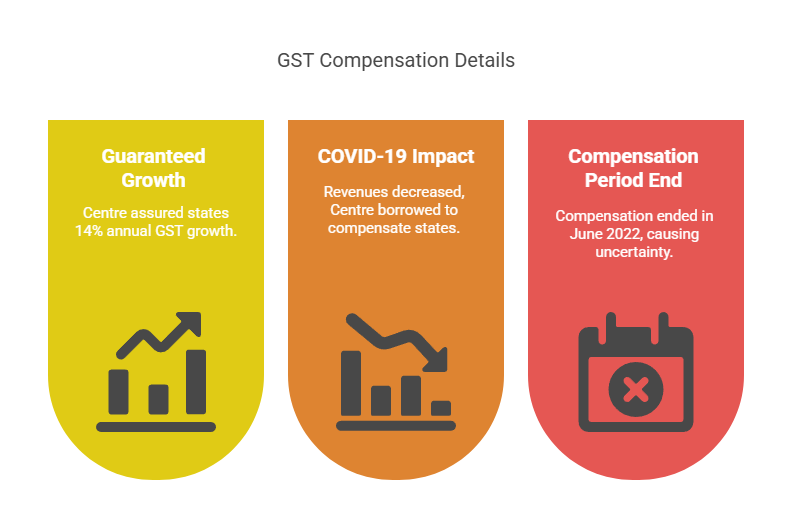
- The Centre guaranteed a 14% annual growth in GST revenue to states for five years.
- Due to COVID-19, revenues fell short, and the Centre had to borrow ₹1.1 lakh crore in FY21 and ₹1.59 lakh crore in FY22 to compensate states.
- The compensation period ended in June 2022, creating uncertainty for revenue-deficit states like Punjab, Kerala, and Chhattisgarh.
Central Schemes and Conditionalities
The Centre often introduces Centrally Sponsored Schemes (CSS) and Central Sector Schemes, which account for a significant portion of public spending in sectors like health, education, and agriculture.
- States often complain that these schemes have rigid guidelines and do not reflect local priorities.
- Example: The PM Awas Yojana, PM KISAN, and Jal Jeevan Mission are centrally funded but implemented by states, leading to friction in cost-sharing.
To address such concerns, NITI Aayog has recommended rationalizing CSSs, providing more flexibility to states, and ensuring Outcome-Based Budgeting.
Emergence of Competitive Federalism
The shift from a top-down planning model (as followed by the Planning Commission) to a cooperative and competitive federalism model under NITI Aayog is a transformative change.
- States are ranked based on performance in sectors like education, health, SDGs, and infrastructure.
- This has encouraged healthy competition among states and led to reforms in governance and service delivery.
Recent Developments (2023-24 & 2024-25)
- Capital Expenditure Incentives to States
- In Budget 2024-25, the Centre announced ₹1.3 lakh crore for 50-year interest-free loans to states for capital expenditure.
- This promotes fiscal discipline and investment in infrastructure.
- Devolution of Taxes to States
- According to the Ministry of Finance, ₹12.21 lakh crore is estimated to be devolved to states in FY 2024-25—an increase from ₹11.48 lakh crore in FY 2023-24.
- CAG Reports and State Finances
- Recent CAG reports indicate rising fiscal deficits and debt-to-GSDP ratios in many states, crossing the FRBM threshold of 3%.
- States like Punjab, West Bengal, and Kerala are under scrutiny for high committed expenditure (salaries, pensions, and interest payments).
Challenges in India’s Fiscal Federalism
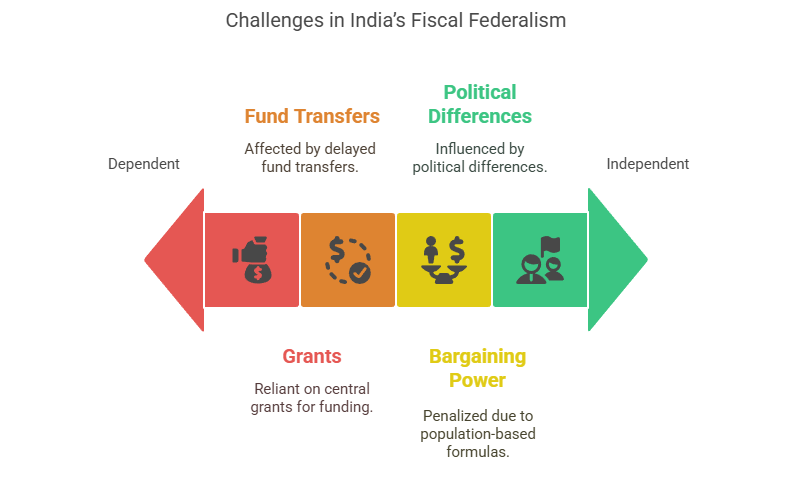
- Delayed fund transfers from the Centre affect state planning and implementation.
- Unequal bargaining power—richer states like Maharashtra and Tamil Nadu often feel penalized in devolution due to population-based formulas.
- Dependence on the Centre for grants reduces fiscal autonomy of states.
- Political differences between Centre and States influence fiscal relations, especially with opposition-ruled states.
Way Forward
- Strengthen GST Council as a true federal forum with better dispute resolution mechanisms.
- Empower States with more untied grants and reduce conditionalities in CSS.
- Review Finance Commission formula periodically to account for performance and not just needs.
- Encourage states to expand their tax base, especially property tax and user charges.
- Promote cooperative federalism in fiscal decision-making, especially in crises like pandemics or climate-related disasters.
Conclusion
The dynamics of India’s fiscal federalism continue to evolve, shaped by constitutional mandates, political realities, and economic challenges. As India moves towards becoming a $5 trillion economy, ensuring fiscal responsibility, transparency, and balanced Centre-State relations is essential for inclusive and sustainable development. For aspirants of civil services, understanding these intricacies is key to appreciating the functioning of the Indian polity and governance system.
|


One comment