
𝐑𝐞𝐥𝐞𝐯𝐚𝐧𝐭 𝐟𝐨𝐫: Essay for IAS
INTRODUCTIONThe rapid rise of Artificial Intelligence (AI) marks a defining moment in the evolution of human society, comparable to earlier technological revolutions such as mechanization and digitization. By enabling machines to learn, reason, and make decisions, AI is transforming production systems, services, and governance. Yet, this transformation has revived a persistent anxiety: will intelligent machines render human labor obsolete, leading to a jobless future? Or will AI, by augmenting human capability, generate new and better employment opportunities through reskilling and upskilling? This debate is not merely economic; it is social, ethical, and philosophical, touching upon the meaning of work, human dignity, and the future of social organization. A balanced assessment reveals that while AI poses significant disruption to existing jobs, it also creates unprecedented opportunities—provided societies proactively invest in skills, institutions, and inclusive adaptation. MAIN BODY:Historically technological revolutions have followed a recurring pattern: short-term disruption accompanied by long-term transformation. The Industrial Revolution displaced artisanal labor but created factory employment and new professions. Similarly, the digital revolution automated clerical tasks while generating jobs in information technology, communication, and services. In each case, fears of mass unemployment were eventually mitigated by the emergence of new economic activities. AI, however, differs in scale and scope. Unlike earlier technologies that primarily replaced physical labor, AI encroaches upon cognitive tasks such as data analysis, pattern recognition, and decision-making. Consequently, professions once considered secure—accounting, legal research, diagnostics, and even creative industries—are experiencing automation. This breadth intensifies concerns about structural unemployment and social inequality. Those who foresee a jobless future argue that AI’s capacity for continuous learning and efficiency will reduce the demand for human labor across sectors. Automated systems can operate around the clock, minimize errors, and lower costs, incentivizing firms to substitute machines for workers. In manufacturing, robotics and AI-driven quality control reduce labor intensity. In services, chatbots, virtual assistants, and automated customer support replace entry-level jobs. Moreover, the pace of AI adoption risks outstripping the capacity of labor markets to absorb displaced workers. Low- and middle-skilled jobs are particularly vulnerable, raising fears of job polarization and widening inequality. If economic gains from AI accrue disproportionately to capital owners and highly skilled professionals, societies may witness a concentration of wealth and a decline in inclusive growth. From this perspective, AI threatens not only employment but also the social contract that links work with income and dignity. Conversely, a more optimistic perspective emphasizes AI’s potential to generate new forms of employment. AI systems require design, development, maintenance, oversight, and ethical governance, all of which create demand for skilled human labor. New roles such as data scientists, AI trainers, ethicists, cybersecurity experts, and human–machine interaction designers are already emerging. Furthermore, AI can augment rather than replace human capabilities. In healthcare, AI assists doctors by analyzing medical images and patient data, enabling faster and more accurate diagnosis while preserving the human role in judgment and empathy. In education, AI-powered tools personalize learning, allowing teachers to focus on mentorship and critical thinking. In this sense, AI complements human skills, enhancing productivity and job quality. Importantly, AI also lowers entry barriers for entrepreneurship by automating routine tasks and providing analytical insights. Small businesses and startups can leverage AI to compete with larger firms, potentially creating decentralized and inclusive employment opportunities. The decisive factor determining whether AI leads to joblessness or opportunity is the capacity for reskilling and upskilling. As job roles evolve, workers must acquire new competencies that align with AI-driven economies. Skills such as critical thinking, problem-solving, creativity, emotional intelligence, and interdisciplinary knowledge become increasingly valuable, as they are less susceptible to automation. Technical skills related to AI—data literacy, programming, and digital fluency—are also essential. However, reskilling is not merely about learning new tools; it involves lifelong learning and adaptability. Educational institutions, employers, and governments must collaborate to create flexible learning ecosystems that enable continuous skill development. For countries like India, with a large and young workforce, this transition presents both a challenge and an opportunity. If reskilling initiatives are inclusive and accessible, AI can become a catalyst for demographic dividend rather than a source of mass unemployment. Beyond economics, the AI-driven transformation of work raises deeper philosophical questions. Work has traditionally been a source of identity, purpose, and social integration. A future where machines perform most tasks challenges the moral foundations of work-centered societies. From a humanistic perspective, AI should be evaluated not solely by efficiency but by its impact on human well-being. If automation liberates humans from drudgery and enables engagement in creative, caring, and civic activities, it can enhance quality of life. However, this outcome requires deliberate policy choices, such as social protection, fair distribution of productivity gains, and recognition of non-market contributions. Ethically, the responsibility lies in ensuring that AI serves human ends rather than subordinating humans to technological imperatives. This aligns with the Kantian principle that humans must be treated as ends in themselves, not merely as inputs in production systems. The transition to an AI-driven economy necessitates proactive governance. Labor market policies must support worker mobility, income security, and skill development. Social safety nets, such as unemployment insurance and targeted income support, can cushion transitional shocks. Moreover, education systems must shift from rote learning to competency-based models that foster adaptability. Public–private partnerships can facilitate industry-relevant training, while digital platforms can scale reskilling initiatives. At the same time, ethical regulation of AI is essential to ensure transparency, accountability, and fairness in automated decision-making. International cooperation also plays a role, as AI’s impacts transcend borders. Sharing best practices and aligning norms can help mitigate global inequalities arising from uneven technological adoption. In India, AI adoption intersects with structural challenges such as informality, skill mismatches, and regional disparities. While AI can enhance productivity and governance, it also risks excluding workers without access to education and digital infrastructure. Therefore, inclusive AI strategies must prioritize skilling at scale, particularly for vulnerable groups. Initiatives focused on digital literacy, vocational training, and industry-aligned curricula can enable India to harness AI for employment generation. Additionally, India’s strengths in IT services and innovation position it to become a global hub for AI-driven solutions, creating high-value jobs domestically. CONCLUSION:The rise of Artificial Intelligence does not predetermine a jobless future, nor does it automatically guarantee better employment opportunities. Rather, it presents a crossroads. AI has the potential to displace certain jobs while creating new ones, to exacerbate inequality or to enhance human capability. The outcome depends on how societies respond through reskilling, upskilling, and inclusive governance. Ultimately, the challenge is not technological but moral and institutional. If guided by foresight, equity, and human-centered values, AI can become a force for dignified work and shared prosperity. By investing in skills, adaptability, and ethical frameworks, societies can ensure that the rise of AI leads not to the redundancy of human labor, but to its reinvention in more meaningful and fulfilling forms. |
Read more blog:
Best Essay Writing Course for UPSC CSE
If you’re preparing for the UPSC Civil Services Examination (CSE), one paper that can unlock exceptional scores and a top rank is the Essay Paper. While General Studies and Optional Subjects are structured and syllabus-driven, the Essay writing segment is where individuality, critical thinking, and articulation truly shine.
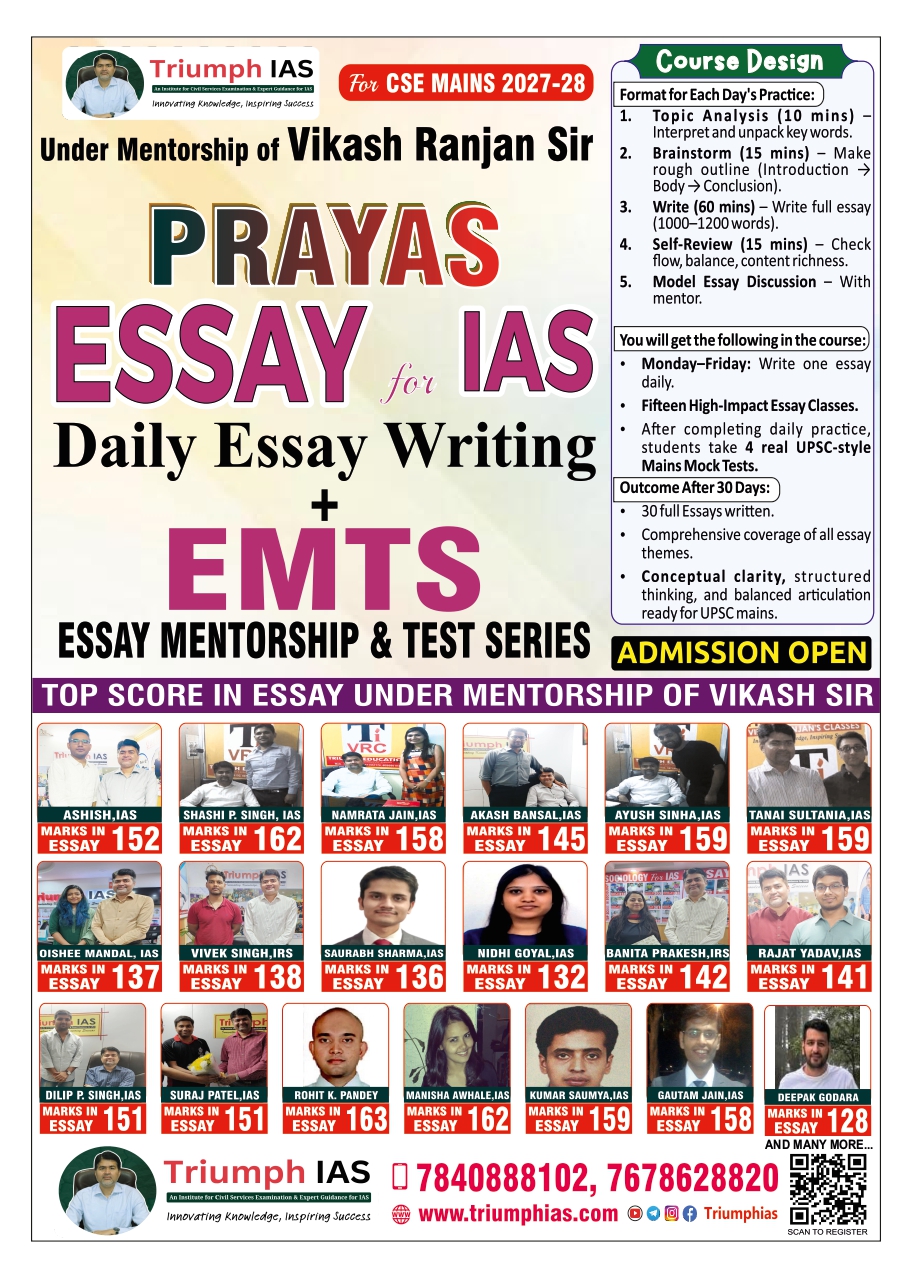
Among various Essay programs available across India, Triumph IAS, under the expert mentorship of Vikash Ranjan Sir, offers the Best Essay writing Course for UPSC CSE. This comprehensive guide explores what makes this program unparalleled and why it should be part of every serious aspirant’s preparation strategy.


3 comments