Introduction:
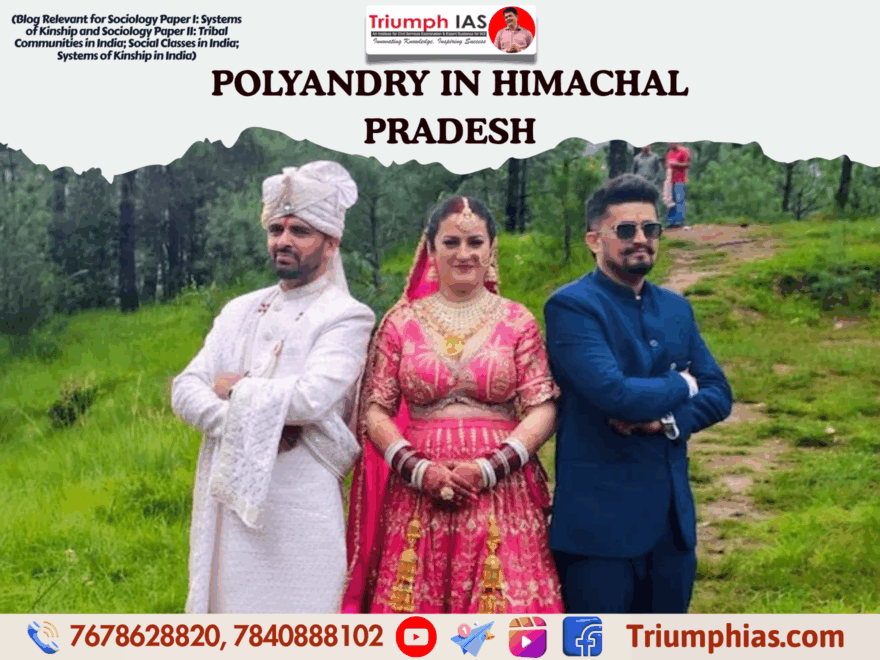
Recently, a wedding in Kunhat village of Sirmaur district, Himachal Pradesh, attracted national attention. A young woman married two biological brothers. This revival of the centuries-old custom of polyandry (a woman having multiple husbands) has rekindled public and academic interest in this unique social practice, particularly among tribal communities like the Hatti tribe. With the growing debates on tribal rights, gender, marriage patterns, and social change, polyandry is no longer a mere anthropological curiosity but a contemporary issue with profound sociological relevance.
What is Polyandry?
Polyandry is a form of marriage where one woman marries two or more men. It is less common globally than polygyny (one man with multiple wives) but has been historically practiced in parts of Tibet, Nepal, Bhutan, and specific Indian regions like Himachal Pradesh and Ladakh. In India, polyandry exists in two primary forms:
- Fraternal Polyandry – where brothers share one wife.
- Non-Fraternal Polyandry – where the husbands are not related.
The recent case in Himachal falls under fraternal polyandry and is deeply rooted in the customs of the Hatti community of the Sirmaur district.
Historical Roots of Polyandry in Himachal Pradesh
Polyandry in Himachal is not a new phenomenon. It has been prevalent in:
- Sirmaur district (Giri Par region) – particularly among the Hatti tribe.
- Kinnaur – where Buddhist and Bon cultural influences contributed to the practice.
- Lahaul and Spiti – known for their Tibetan-influenced traditions.
This tradition historically aimed to:
- Maintain family unity.
- Prevent division of ancestral land.
- Ensure socio-economic stability in agrarian, mountainous communities.
Notably, Dr. Y.S. Parmar, the first Chief Minister of Himachal Pradesh, completed his PhD on “The Social and Economic Background of Polyandry in the Himalayan Regions,” bringing academic legitimacy to the study of this institution.
Legal Recognition of Polyandry in Himachal Pradesh
What sets this tradition apart is its legal and social legitimacy in tribal regions:
- Under customary law, particularly applicable to Scheduled Tribes like the Hattis, polyandrous marriages are not deemed illegal.
- The Hatti community was recently granted Scheduled Tribe (ST) status, making the understanding of their customs even more critical for policy and law.
Sociological Analysis
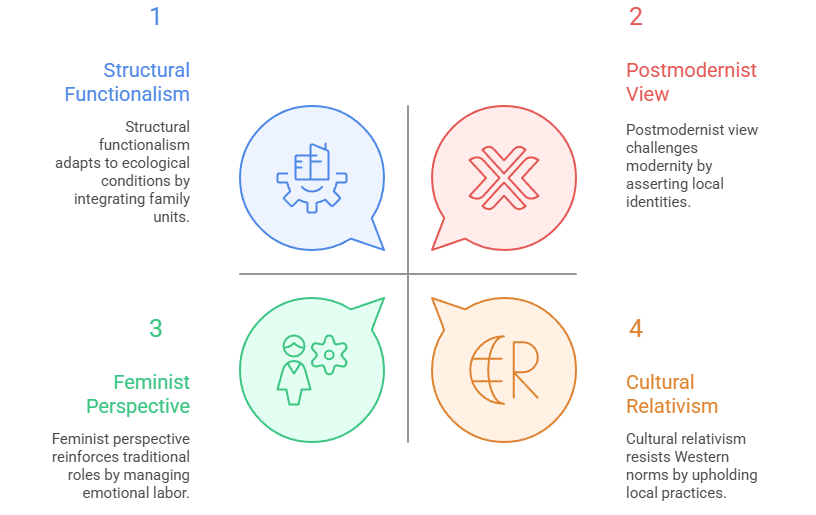
From a sociological lens, polyandry must be viewed through the lens of structural functionalism, cultural relativism, and gender roles in tribal societies.
- Structural Functionalism: According to Parsons’ AGIL framework, polyandry served as a functional response to the ecological and economic conditions of the Himalayan region. It helped in adapting to land scarcity by preventing its fragmentation, integrating the family unit through shared marital bonds, and maintaining cultural continuity through traditional norms.
- Cultural Relativism (Franz Boas): From a cultural relativist lens, polyandry cannot be judged by Western norms of monogamy. Instead, it must be understood within the specific ecological and cultural context of Himachal’s tribal societies, where it was historically viewed as a dignified and rational practice, not a deviance.
- Feminist Perspective: While polyandry may seem to offer women control over multiple husbands, feminist scholars caution that it often reinforces traditional gender roles. Women are expected to manage emotional labor and domestic harmony, while still being viewed primarily as reproducers of lineage and caretakers of household unity.
- Postmodernist View: Postmodern sociology sees the persistence or revival of polyandry as a resistance to dominant narratives of homogenized modernity. It reflects the assertion of local identities and cultural pluralism in an era of rapid globalization and legal standardization.
Why Is Polyandry Declining?
Despite cultural acceptance, polyandry is on the decline in Himachal. Some key factors include:
- Increased literacy and exposure to mainstream values.
- Economic mobility, especially migration to cities or abroad.
- Nuclear family preference in a modernized setting.
- Changing aspirations of younger generations.
Yet, instances like the Sirmaur wedding reflect a conscious cultural assertion by younger individuals who do not see tradition and modernity as opposites.
Implications and Current Relevance
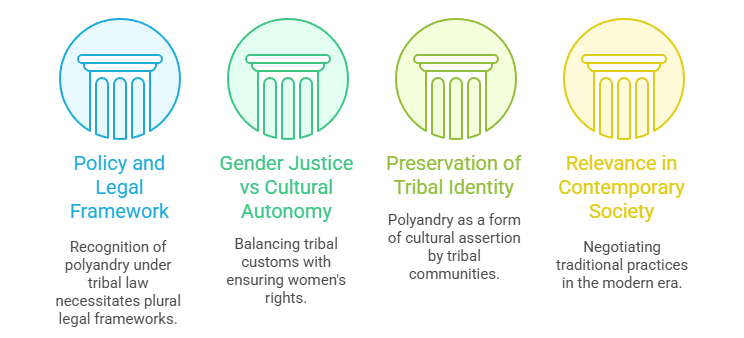
- Policy and Legal Framework: The recognition of polyandry under customary tribal law brings attention to the need for plural legal frameworks in India. In the debate around the Uniform Civil Code (UCC), practices like polyandry raise important questions about how to reconcile tribal autonomy with constitutional values.
- Gender Justice vs Cultural Autonomy: There is a fine balance between preserving tribal customs and ensuring gender justice. While polyandry reflects cultural heritage, it must be evaluated to ensure that women’s rights are not compromised under the garb of tradition.
- Preservation of Tribal Identity: The continuation of polyandry serves as a form of cultural assertion by tribal communities such as the Hattis. It helps preserve their unique heritage, especially after their recognition as Scheduled Tribes, reinforcing their distinct identity within the national framework.
- Relevance in Contemporary Society: The recent wedding in Sirmaur involving two brothers and one bride illustrates how traditional practices are being negotiated in the modern era. It invites a rethinking of what constitutes modernity, showing that tradition and modern aspirations can coexist in hybrid forms.
Conclusion
The revival and media attention to a polyandrous wedding in Himachal’s Hatti community is more than a cultural anecdote — it’s a window into how tradition, identity, law, and modernity interact in India’s plural society. As India debates issues like the Uniform Civil Code, women’s rights, and tribal autonomy, such practices compel a deeper understanding rooted in sociology. Rather than dismissing them as outdated, scholars, policymakers, and citizens must engage with such traditions empathetically and analytically.
Previous Year Questions
Paper I
- What are the implications of cultural pluralism in Indian society? (2016)
Paper II
- Discuss the various forms of marriage prevalent in tribal India. (2017)
- How does modernization affect the institution of marriage in tribal societies? (2020)
- Examine the role of customary laws in protecting the identity of tribal communities. (2022)
|

One comment