

Modernising India Higher Education Framework
(Relevant for GS paper-2, Education)
India Higher Education FrameworkIndia higher education system, one of the largest in the world with over 1,100 universities and 43,000 colleges, plays a pivotal role in shaping the nation’s socio-economic development. However, with the rapidly changing global landscape and India’s aspirations to become a knowledge superpower, there is a pressing need to rethink and reform the higher education model. The introduction of the National Education Policy (NEP) 2020 is a significant step in this direction, but challenges persist. This blog analyses the current status, key reforms, recent developments, and the way forward for India Higher Education. Current Landscape of Higher Education in IndiaAs per the All India Survey on Higher Education (AISHE) 2021-22:
Key Reforms Under NEP 2020NEP 2020 aims to overhaul India’s higher education system through several transformative changes:
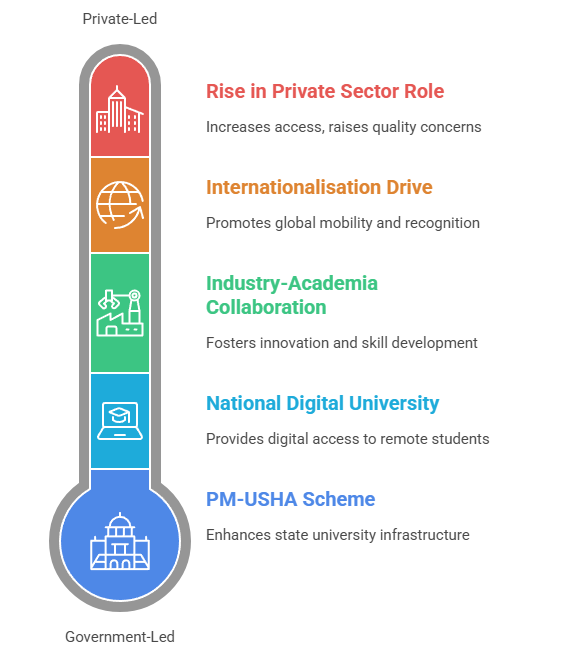
Recent Developments and Initiatives
Announced in Budget 2022-23, NDU aims to provide access to world-class education to students in remote areas via digital platforms, leveraging partnerships with top universities.
Launched in 2023, the Pradhan Mantri Uchchatar Shiksha Abhiyan (PM-USHA) focuses on enhancing infrastructure and research capacity in state universities.
India has signed mutual recognition agreements for academic qualifications with countries like Australia, the UK, and the UAE, promoting student and faculty mobility.
Private universities, constituting over 77% of institutions, are playing an increasing role in providing higher education, though concerns of commercialization and quality assurance persist.
Schemes like the National Research Foundation (NRF) and AI-based initiatives are encouraging collaboration between industry and academia to foster innovation and skill development. Major Challenges
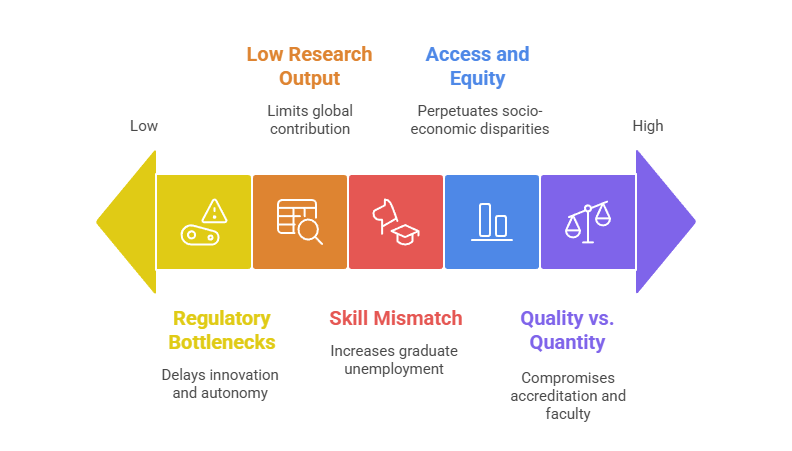
Despite these reforms, several systemic issues continue to hinder India’s higher education progress:
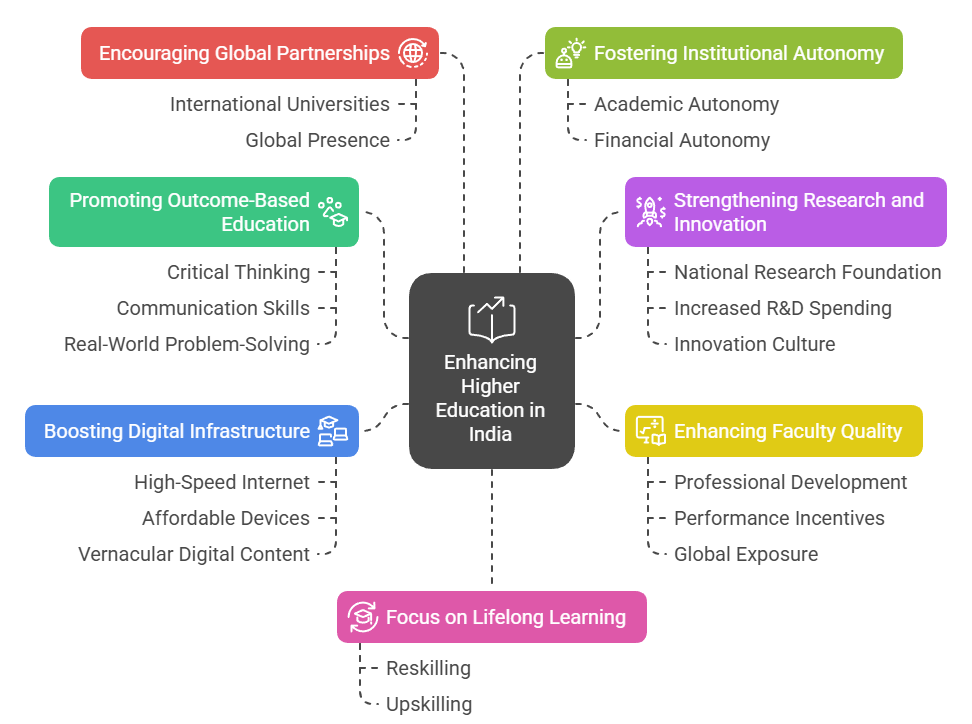
The Road Ahead: Reimagining Higher Education
Curriculum should focus on critical thinking, communication skills, and real-world problem-solving to enhance employability.
Accelerating the establishment of the National Research Foundation (NRF), increasing R&D spending, and fostering a culture of innovation are crucial.
Continuous professional development programs, performance-linked incentives, and global exposure for faculty are necessary to uplift teaching standards.
Expanding high-speed internet, affordable devices, and vernacular digital content will bridge rural-urban divides and promote inclusive education.
Attracting top international universities to set up campuses in India (per UGC guidelines 2023) and enabling Indian institutions to establish global presence will help improve academic standards.
Granting academic and financial autonomy to universities can nurture innovation and reduce bureaucratic red tape.
Given the rapidly evolving job market, universities must promote reskilling and upskilling through flexible, modular, and short-term courses. ConclusionIndia’s higher education sector stands at a critical juncture. The ambitious goals of NEP 2020, combined with recent initiatives like the National Digital University, PM-USHA, and global collaborations, offer a promising roadmap. However, to truly transform into a global knowledge hub, India must focus on quality, equity, employability, and innovation. A reformed higher education model, aligned with India’s demographic dividend and global aspirations, can catalyse socio-economic transformation and establish India as a Vishwa Guru (global leader) in the 21st century. |
To Read more topics, visit: www.triumphias.com/blogs
The phrase “Modernising India Higher Education Framework” really stood out to me, as it’s a crucial aspect of our nation’s growth. As someone who’s worked in education marketing, I’ve seen firsthand how important it is to adapt to changing times. One concrete idea that comes to mind is the need for universities to focus on interdisciplinary approaches, much like the National Institutional Ranking Framework (NIRF) emphasizes. In my experience, this can lead to more well-rounded graduates. The parallel between the NEP 2020’s emphasis on holistic education and the need for universities to have a strong online presence is something I’ve been thinking about because it highlights the importance of accessibility in modern education. I wonder, how do you think universities can balance the pursuit of excellence, as measured by rankings, with the need to innovate and modernize their approach to education?
The idea of “Modernising India Higher Education Framework” really stood out to me, particularly the emphasis on transforming the current landscape of higher education. As someone who’s passionate about education and has seen the impact of innovative approaches, I think it’s essential to consider the role of extracurricular activities in shaping students’ skills and perspectives. In my experience, sports like padel, which require strategy, teamwork, and adaptability, can be incredibly effective in developing these skills. The parallel between the need for flexible, adaptive learning pathways in education and the dynamic, fast-paced nature of racket sports is something I’ve been thinking about because it highlights the importance of fostering a growth mindset and embracing new challenges. I wonder, how do you think institutions can better integrate such activities into their frameworks to support students’ holistic development?
The idea of “Modernising India Higher Education Framework” really caught my attention, particularly the section on “Key Reforms Under NEP 2020”. As someone who’s worked in edtech, I’ve seen how crucial it is to strike a balance between organic and paid marketing strategies to reach students. One concrete tip I’d add is to consider allocating a specific percentage of the marketing budget to SEO, as it can have a significant impact on reaching the target audience. The parallel between reforming education systems and learning new skills, like a sport, is something I’ve been thinking about because, in my experience as a padel player, adapting to new rules or techniques can be challenging, yet rewarding. I wonder, how do you think the reforms under NEP 2020 will impact the way students approach learning and skill-building in the long run?
The phrase “Modernising India Higher Education Framework” resonates with me, particularly in the context of reforms under the new education policy. As someone who has worked in education administration, I think it’s essential to focus on practical implementation strategies, such as teacher training programs and infrastructure development, to support these reforms. For instance, allocating a specific percentage, say 20%, of the institution’s budget towards faculty development could be a step in the right direction. The parallel between restructuring educational institutions and building a strong foundation in sports, like the one I’ve observed in my experience with racket sports, is something I have been thinking about because it highlights the importance of a well-planned framework in achieving success. I wonder if the author has considered exploring the potential benefits of incorporating sports and physical activity into the educational framework, as a means to enhance overall student development.