

Max Weber: Architect of Modern Sociology
(Relevant for Sociology paper 1: Sociological Thinkers)
IntroductionMax Weber (1864–1920) was a German sociologist, economist, historian, and political theorist whose ideas profoundly shaped the foundations of modern sociology. While Karl Marx focused on economic determinism and Émile Durkheim on social facts, Weber introduced a multidimensional perspective by integrating culture, ideas, religion, and individual agency into the study of society. His work is crucial for understanding the dynamics of modern social life, bureaucratic organizations, authority, and the interplay between religion, economy, and rationalization. Weber’s contributions remain highly relevant in contemporary sociological analysis, particularly in the Indian context where modernization, bureaucracy, and globalization are reshaping social structures. Early Life and Intellectual ContextMax Weber was born in Erfurt, Prussia, into a politically and academically active family. His father, a conservative politician, and his mother, a devout Calvinist, influenced Weber’s dual interest in politics and religion. Weber studied law, economics, and history at the universities of Heidelberg, Berlin, and Göttingen. A pivotal moment in his life was his mental breakdown in 1897, after which he withdrew from academic work for several years. During this period, Weber produced his landmark work, The Protestant Ethic and the Spirit of Capitalism, which would later redefine sociology’s understanding of the interplay between culture and economic behavior. Weber lived during a time of rapid industrialization, political upheaval, and the rise of bureaucratic institutions in Europe. His insights were deeply shaped by these socio-political contexts, making his analysis both historical and theoretical. Key Concepts and Contributions
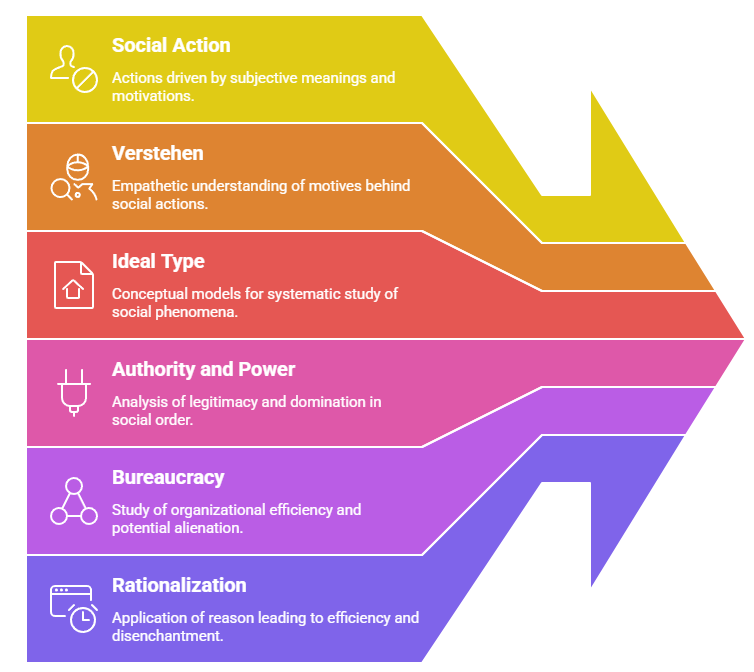
1. Social ActionWeber’s most fundamental contribution is the concept of social action. He argued that sociology should focus on understanding the subjective meanings that individuals attach to their actions. He distinguished four types of social action:
This typology allows sociologists to interpret human behavior beyond observable patterns, emphasizing motivations, beliefs, and social norms. 2. Verstehen (Interpretive Understanding)Weber introduced Verstehen, or empathetic understanding, as a methodological tool. Unlike positivist approaches that focus on objective facts, Verstehen emphasizes interpreting the subjective meanings and motives behind social actions. For instance, to understand why individuals participate in protests, a Weberian approach seeks to uncover their beliefs, goals, and social pressures rather than merely counting the number of participants. This approach remains central to qualitative research and interpretive sociology. 3. Ideal TypeWeber developed the concept of the ideal type to systematically study social phenomena. An ideal type is a conceptual model highlighting essential features of a phenomenon, not necessarily reflecting reality perfectly, but serving as a standard of comparison. For example, Weber’s “ideal type of bureaucracy” emphasizes hierarchy, specialization, formal rules, and impersonality. Real-world organizations may not perfectly match this type, but it provides a benchmark for analysis. 4. Authority and PowerWeber’s analysis of authority is foundational in political sociology. He distinguished three pure types of authority:
He also distinguished power as the ability to achieve one’s will even against resistance, highlighting how domination and legitimacy shape social order. 5. BureaucracyWeber’s study of bureaucracy remains relevant to understanding modern governance and organizations. Key features of bureaucracy include:
While Weber acknowledged bureaucracy’s efficiency, he warned of the “iron cage” of rationality, where individuals become trapped in rigid systems, losing freedom and creativity. 6. RationalizationWeber argued that Western society is characterized by rationalization—the application of reason, efficiency, and calculability in all spheres of life. Examples include modern capitalism, bureaucratic administration, legal systems, and scientific management. Rationalization, while increasing efficiency, can lead to disenchantment (Entzauberung) and a sense of alienation, where life is governed by rules and technical processes rather than human values. 7. The Protestant Ethic and the Spirit of CapitalismWeber’s landmark work connected culture, religion, and economic behavior. He argued that Calvinist ethics, emphasizing discipline, frugality, and a sense of vocational calling, contributed to the rise of capitalism in Western Europe. This challenged Marxian economic determinism, showing that ideas and cultural values can shape economic systems. Weber highlighted the significance of ideology, ethics, and beliefs in shaping material realities. Weber’s Methodology: AntipositivismWeber advocated antipositivism, arguing that social sciences should not imitate natural sciences. Social phenomena are subjective, historically contingent, and laden with meaning. Understanding requires interpretive methods, contextual analysis, and comparative approaches. Key methodological contributions include:
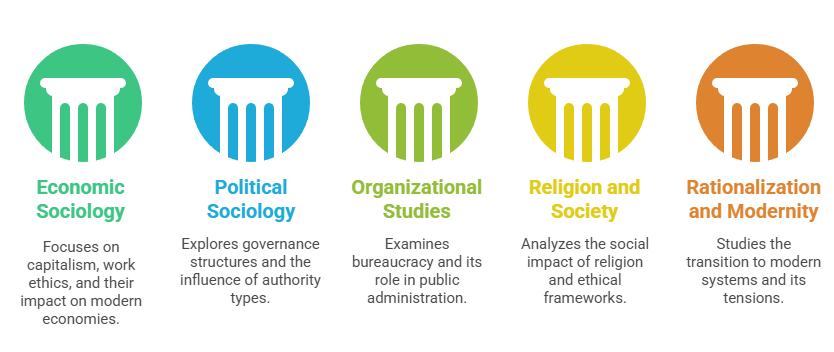
Relevance to Modern Sociology and Indian Context
Critiques of WeberWhile Weber’s work is influential, scholars have noted limitations:
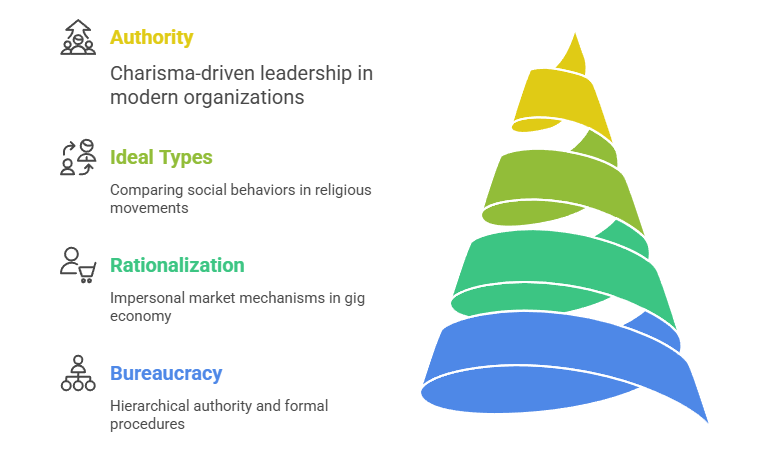
Despite critiques, Weber’s ideas remain a cornerstone of sociology, bridging economics, politics, culture, and history. Case Studies and Applications
ConclusionMax Weber’s sociological vision remains profoundly relevant. He emphasized the interplay between ideas, culture, and social structures while highlighting the importance of individual agency and interpretation. Weber’s contributions—social action, Verstehen, ideal types, authority, rationalization, and bureaucracy—offer analytical tools to understand modern societies, governance, religion, and economic behavior. For UPSC Sociology Optional aspirants, Weber’s ideas are indispensable for topics ranging from organizational theory and political sociology to religion and modernity. By integrating Weberian analysis, one can critically examine contemporary Indian society, from bureaucratic functioning and political leadership to labor markets and religious practices, bridging classical sociology with current social phenomena. |
To Read more topics, visit: www.triumphias.com/blogs
2 comments