

India’s Juvenile Justice System: A Sociological Reflection on Critical Gaps Identified by the India Justice Report (IJR)
(Relevant for Sociology Paper 1: Stratification and Mobility and Politics and Society and Sociology Paper 2: Population Dynamics and Challenges of Social Transformation)
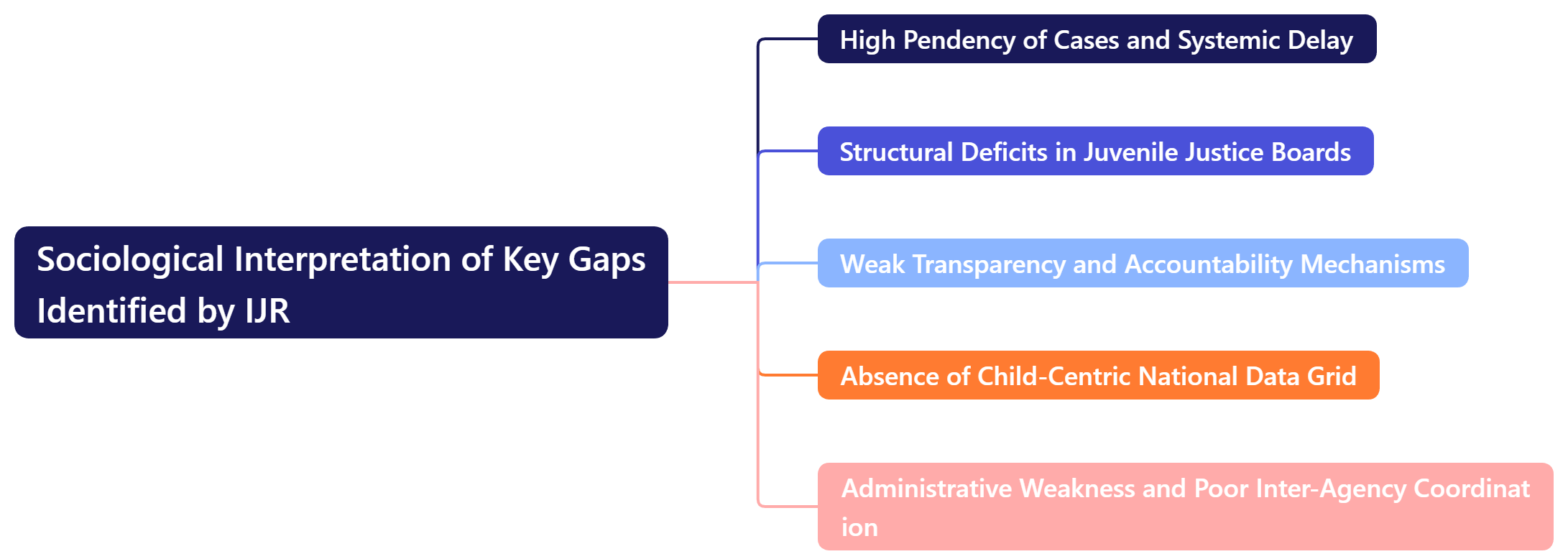
Introduction: Juvenile Justice SystemThe India Justice Report (IJR) 2024, in its first-ever study on “Juvenile Justice and Children in Conflict with the Law,” exposes deep structural and systemic weaknesses that undermine the child-centred foundation of the Juvenile Justice (Care & Protection of Children) Act, 2015. While constitutionally guaranteed rights (Art. 21, 39e-f, 45) and global frameworks such as the UN Convention on the Rights of the Child (UNCRC) envision a system grounded in rehabilitation rather than retribution, the empirical data reveal high pendency, infrastructural deficits and weak transparency that compromise children’s access to justice. These failings are sociologically significant because they reflect how societies treat their most vulnerable members and how institutions function in reproducing or mitigating inequality. Sociological Interpretation of Key Gaps Identified by IJR
From Émile Durkheim’s perspective, judicial institutions play a role in maintaining social solidarity. When institutional delays occur, trust in collective order collapses and anomic conditions arise for children who may feel detached from societal norms. Delay also hinders psychological rehabilitation, producing secondary deviance. Robert Merton’s strain theory explains that when legitimate institutional pathways break down, marginalised children may pursue illegitimate opportunities—reinforcing cycles of deviance.
This represents institutional dysfunction within Talcott Parsons’ AGIL framework—the system fails at Goal Attainment and Integration, weakening the purpose of JJ as a rehabilitative framework. Pierre Bourdieu’s concept of structural inequality shows how children from marginalised socio-economic backgrounds—Dalits, tribals, street-connected children—suffer disproportionately when institutions malfunction because they lack cultural and social capital (legal literacy, representation, family support networks).
This reflects the failure of what Upendra Baxi calls “social action justice”, where legal institutions should empower the powerless. Instead, opacity protects bureaucratic inertia and weakens public oversight. Foucault’s theory of disciplinary power applies here: instead of surveillance ensuring accountability, the state actually escapes scrutiny and children become invisible subjects of institutional neglect.
Lack of integrated data flow between:
This violates Anthony Giddens’ Structuration Theory, demonstrating how structural systems collapse when information flows fail, preventing coordinated action and producing fragmented justice.
The decentralised design of the JJ Act requires collaborative governance. However, administrative fragmentation prevents coordinated rehabilitation. Erving Goffman, in Asylums, describes institutions turning into “total institutions” where children are processed rather than understood, leading to identity erosion and institutionalisation syndrome. Sociological Critique of Juveniles Tried as Adults
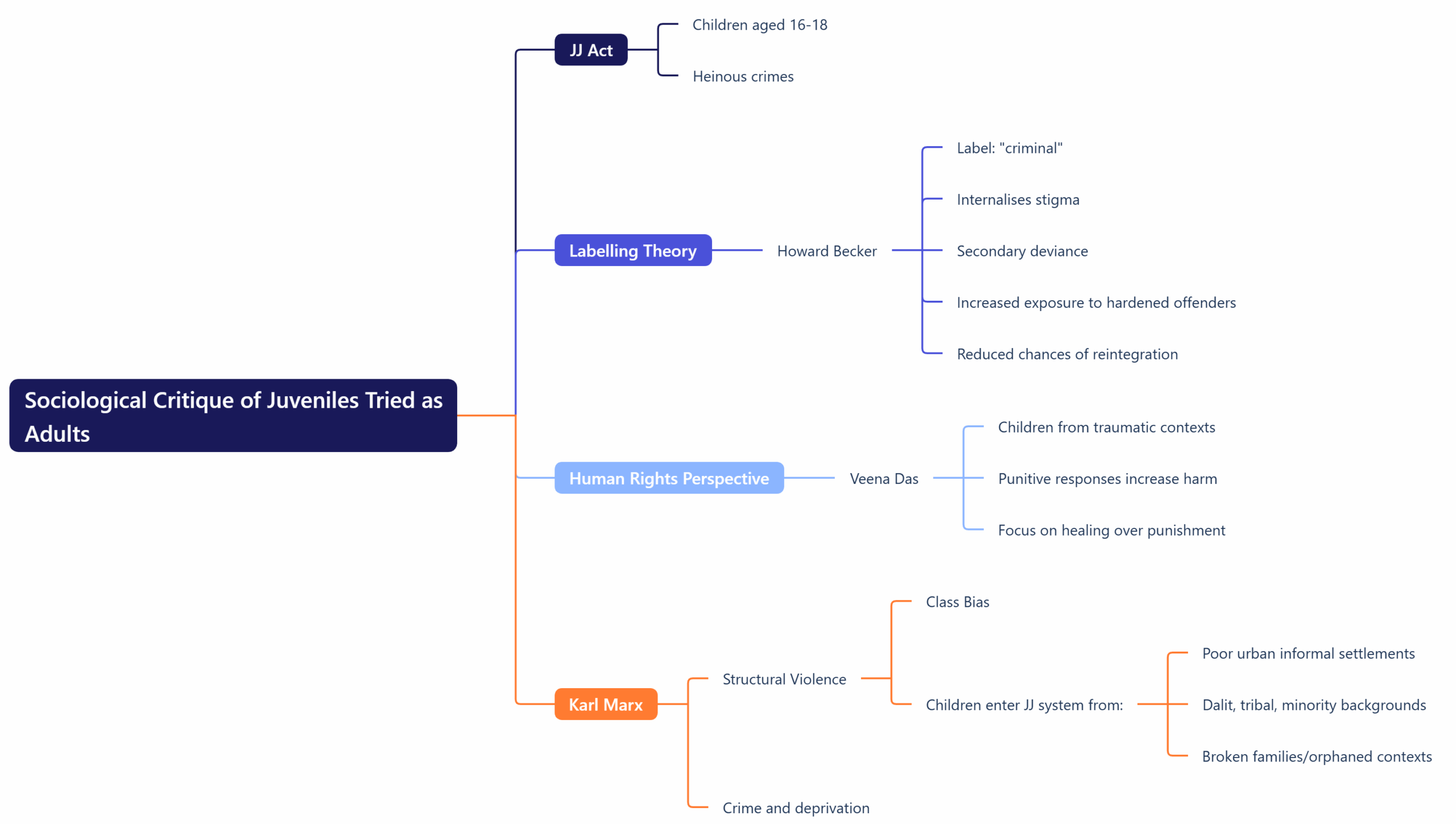
The JJ Act allows children aged 16–18 years to be tried as adults for heinous crimes.
Once labelled a “criminal”, a child internalises stigma and undergoes secondary deviance. Adult courts increase exposure to hardened offenders and reduce chances of reintegration.
Children involved in violence often emerge from contexts of trauma; punitive responses deepen psychological harm rather than healing.
Most children entering the JJ system come from:
Thus, crime is often a response to deprivation, not free will—reflecting structural violence and inequality. Implications on Rehabilitation and ReintegrationThe spirit of the JJ Act is rooted in restorative justice, but weak infrastructure produces custodial and punitive experiences, contrary to:
Guy Standing’s PrecariatChildren leaving CCIs or after legal processes face:
Measures Needed: A Sociological Reform Lens
Use community-based treatment instead of custodial care; involve counsellors, psychologists, and trained social workers.
Reduce stigma of “criminal child” → shift to “child in conflict with law”, promoting dignity and social identity. ConclusionA decade after the JJ Act 2015 promised a rights-based, child-centric and rehabilitative justice system, the India Justice Report reveals serious systemic failures—high pendency, institutional vacancies, poor transparency and weak inter-agency coordination. These structural gaps reproduce inequality, marginalisation and criminalisation of vulnerable children, contradicting the Act’s foundational commitment to reform and reintegration. To achieve its vision, India must shift from punitive frameworks to restorative, rehabilitative, psychologically informed and rights-based justice, supported by strong institutional governance and accountability. |
To Read more topics, visit: www.triumphias.com/blogs
Read more Blogs:
The Sigachi Blast and the Crisis of Labour: A Sociological Examination of Industrial Safety in India
2 comments