Towards Cleaner Skies: India’s Journey to Sustainable Air Quality

Towards Cleaner Skies: India’s Journey to Sustainable Air Quality

Towards Cleaner Skies: India’s Journey to Sustainable Air Quality

(Relevant for GS paper-3, Environmental Conservation)

Introduction

Air pollution is one of the most pressing environmental challenges in India today. According to the 2024 World Air Quality Report by IQAir, 9 of the world’s 10 most polluted cities are in India, with Begusarai, Bihar, topping the list. Chronic exposure to air pollution not only undermines public health but also affects economic productivity and environmental sustainability. India’s journey towards sustainable air quality is, therefore, both a public health necessity and a developmental imperative.

Understanding the Air Pollution Crisis

Understanding the Air Pollution Crisis

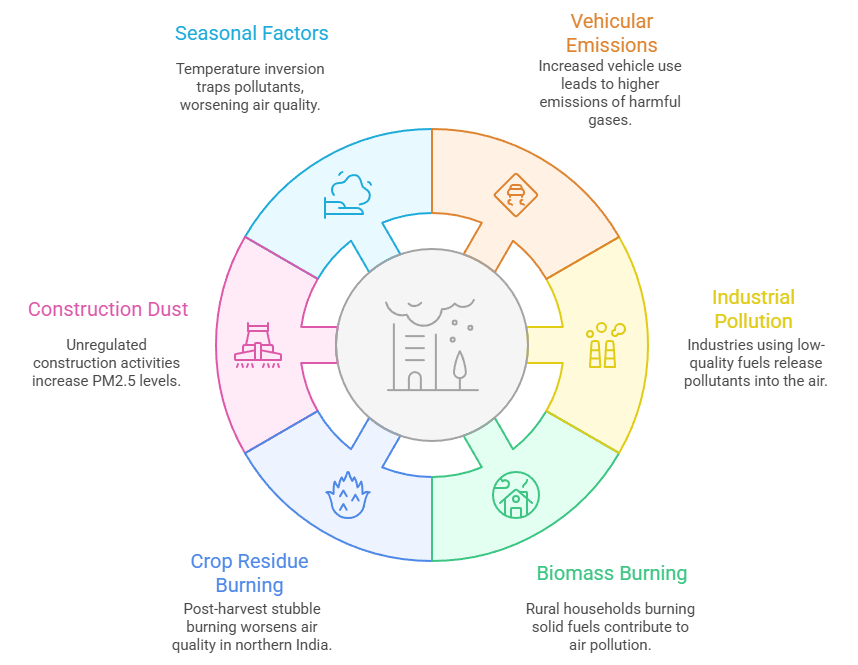
India’s air pollution problem stems from multiple sources:

  • Vehicular Emissions: Rapid urbanisation and rising vehicle ownership have led to increased emissions of nitrogen oxides and particulate matter.
  • Industrial Pollution: Thermal power plants, brick kilns, and small-scale industries often rely on low-quality fuels.
  • Biomass Burning: Over 50% of rural households still use solid fuels like firewood and dung cakes for cooking.
  • Crop Residue Burning: Particularly in Punjab, Haryana, and western Uttar Pradesh, post-harvest stubble burning during October–November severely impacts air quality in northern India.
  • Construction Dust: Unregulated construction activities contribute significantly to PM2.5 levels.
  • Seasonal Factors: Winters trap pollutants closer to the surface due to temperature inversion.

The Health Effects Institute (HEI) reported in 2024 that exposure to air pollution caused 1.6 million premature deaths in India in 2022 alone, with children and elderly populations most vulnerable.

India’s Institutional Framework and Policy Response

India’s Institutional Framework and Policy Response

Over the years, India has developed a multi-pronged strategy to improve air quality:

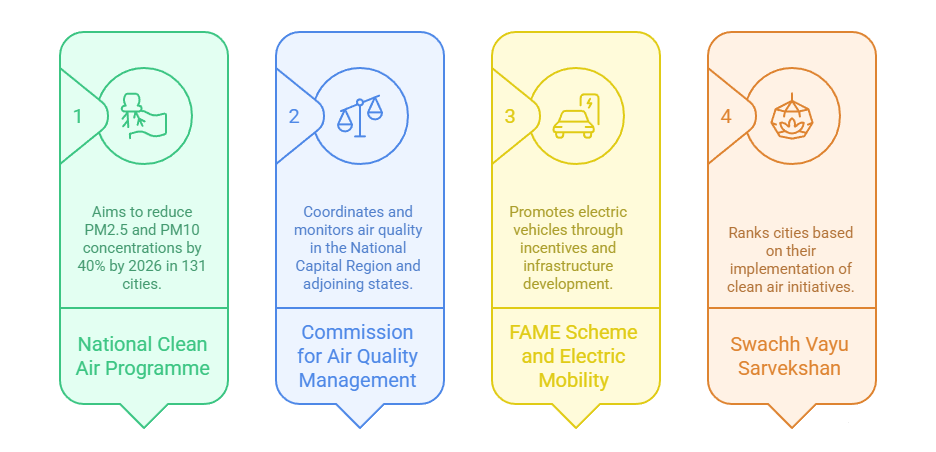
  1. National Clean Air Programme (NCAP)

Launched in 2019 and updated in 2023, NCAP aims to reduce PM2.5 and PM10 concentrations by 40% by 2026 (revised target) in 131 non-attainment cities. Key features include:

  • Preparation of city-specific action plans
  • Air quality monitoring network expansion
  • Public awareness campaigns
  • Source apportionment studies

In July 2024, the MoEFCC reported that 95 cities showed improvement in PM10 levels over a 3-year average.

  1. Commission for Air Quality Management (CAQM)

Established in 2021, CAQM has legal powers to coordinate and monitor air quality in the National Capital Region (NCR) and adjoining states. It has enforced bans on diesel generators, promoted smog towers, and implemented GRAP (Graded Response Action Plan) during severe air pollution events.

  1. FAME Scheme and Electric Mobility

Under the FAME-II (Faster Adoption and Manufacturing of Hybrid and Electric Vehicles) scheme, the government has provided over ₹10,000 crore in incentives, promoting electric two-wheelers, buses, and cars.

In Budget 2025–26, an additional ₹5,000 crore was allocated to bolster EV infrastructure in Tier-2 and Tier-3 cities.

  1. Swachh Vayu Sarvekshan

Launched in 2023, it ranks cities based on their implementation of clean air initiatives. Indore, Surat, and Bhopal topped the rankings in the 2024 edition among million-plus cities.

Technological and Sectoral Interventions

Technological and Sectoral Interventions

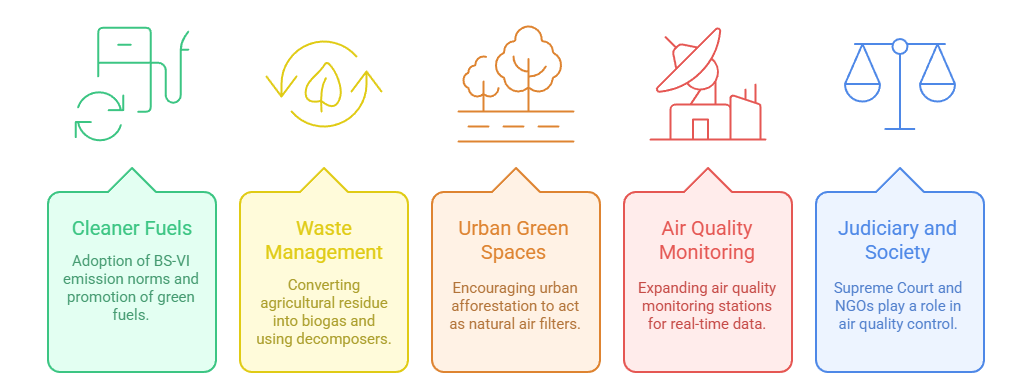
Cleaner Fuels and Vehicles

  • India has adopted BS-VI emission norms since April 2020.
  • Expansion of CNG and electric buses in cities like Delhi, Mumbai, and Ahmedabad.
  • Promotion of green hydrogen and ethanol blending (E20 fuel) under the National Green Hydrogen Mission.

Waste and Biomass Management

  • National Bio-Energy Mission aims to convert agricultural residue into compressed biogas (CBG) and biofuels.
  • Pusa Decomposer’ developed by ICAR helps in-situ decomposition of stubble.

Urban Green Spaces and Carbon Sinks

Programs like Nagar Van Yojana encourage urban afforestation to act as natural air filters. Over 600 Nagar Vans have been sanctioned since 2020.

Air Quality Monitoring

India has expanded its Continuous Ambient Air Quality Monitoring Stations (CAAQMS) to over 500 stations nationwide, enabling real-time data analysis.

Role of Judiciary and Civil Society

  • The Supreme Court and National Green Tribunal (NGT) have been instrumental in banning firecrackers, regulating construction activities, and monitoring state compliance.
  • NGOs and citizen groups like SAFAR, Help Delhi Breathe, and Greenpeace India have created public awareness and conducted independent research.

Challenges Ahead

Despite efforts, several challenges persist:

  • Enforcement gaps: Many city action plans remain poorly implemented.
  • Data accuracy: Discrepancies exist between official and independent air quality readings.
  • Interstate coordination: Pollution knows no boundaries, yet policies remain fragmented across states.
  • Climate–Pollution Nexus: Rising temperatures and erratic weather patterns can worsen air quality episodes.

Way Forward: Towards Sustainable Air Quality

  1. Integrated Urban Planning: Promoting compact cities, public transport, and non-motorised transit.
  2. Legal Framework: Enacting a comprehensive Clean Air Act to consolidate existing regulations and improve compliance.
  3. Incentive-based Mechanisms: Expanding carbon credit trading and pollution taxes for industries.
  4. Technology Transfer: Adoption of AI, IoT, and satellite-based air pollution tracking tools.
  5. Community Participation: Incentivising citizen reporting of polluting activities and involving Resident Welfare Associations in awareness drives.

Conclusion

India’s fight for cleaner air is not only a technical and administrative challenge but also a moral one. Sustainable air quality is essential for public health, climate resilience, and overall quality of life. While government schemes and judicial actions are steps in the right direction, lasting change will require a whole-of-society approach — involving citizens, industries, scientists, and policy-makers. By aligning environmental goals with developmental priorities, India can indeed pave the path to breathable skies and healthier futures.

To Read more topicsvisit: www.triumphias.com/blogs

Read more Blogs:

Kidfluencers | Sociology Optional Coaching | Vikash Ranjan Classes | Triumph IAS | UPSC Sociology Optional

Women’s Reservation in legislatures | Sociology Optional Coaching | Vikash Ranjan Classes | Triumph IAS | UPSC Sociology Optional

One comment

Leave a Reply

Your email address will not be published. Required fields are marked *