Introduction
India is undergoing a remarkable demographic transformation, as evidenced by the latest Sample Registration System (SRS) Statistical Report 2023. The report highlights key shifts in fertility, mortality, and population structure, marking a critical juncture in India’s demographic journey. Simultaneously, the Human Development Report (HDR) 2025, released by the United Nations Development Programme (UNDP), evaluates India’s performance in health, education, income, and inequality—offering a broader human development context.
Together, these reports allow for a holistic understanding of India’s socio-demographic evolution, its implications for population policy, and the challenges of inclusive development in the age of Artificial Intelligence (AI).
Section 1: India Demographic Transition – Insights from SRS 2023

1.1. Total Fertility Rate (TFR) Falls Below Replacement Level
- India’s TFR has declined to 1.9 in 2023, below the replacement level fertility of 2.1.
- This trend signifies that India’s population will begin to stabilize and potentially decline over the next few decades.
- Regional Variation:
- Highest TFR: Bihar (2.8)
- Lowest TFR: Delhi (1.2)
Sociological Significance:
- Reflects the Second Demographic Transition, characterized by delayed marriage, decline in fertility, and individual autonomy in reproductive choices.
- Indicative of rising female literacy, urbanization, and economic aspirations.
1.2. Crude Birth Rate (CBR) and Death Rate (CDR)
- CBR fell from 19.1 (2022) to 18.4 (2023).
- CDR stood at 6.4 per 1000 people in 2023.
- Declining birth and death rates show India moving into Stage 4 of the Demographic Transition Model, marked by low fertility and mortality.
1.3. Infant Mortality Rate (IMR)
- IMR has declined to 25 in 2023, reflecting improved maternal and child healthcare services.
- However, disparities remain:
- Urban IMR is lower than rural,
- IMR is highest among marginalized communities due to limited access to nutrition and healthcare.
1.4. Sex Ratio at Birth (SRB): A Persistent Concern
- SRB stands at 917 girls per 1,000 boys, still significantly skewed.
- Best performing state: Chhattisgarh (974)
- Worst performing: Uttarakhand (868)
Sociological Implications:
- Despite legal reforms (like the PCPNDT Act), son preference persists due to deep-rooted patriarchy, dowry norms, and economic dependence of women.
- Reinforces Amartya Sen’s notion of “missing women”—a structural gender bias embedded in society.
Section 2: Human Development in India – Insights from HDR 2025
2.1. India’s Human Development Index (HDI) Rank and Progress
- India ranked 130th out of 193 countries.
- HDI improved from 0.676 (2022) to 0.685 (2023).
- India remains in the “medium human development” category but is approaching the “high” threshold (≥0.700).
Key Contributors:
- Life expectancy: Improved to 72 years (from 58.6 in 1990).
- Education: Expected years of schooling rose to 13 years.
- Gross National Income per capita (PPP): Quadrupled since 1990.
2.2. Comparison with Neighbours
| Country |
HDI Rank |
| China |
78 |
| Sri Lanka |
89 |
| Bhutan |
125 |
| India |
130 |
| Bangladesh |
130 |
| Nepal |
145 |
| Pakistan |
168 |
Despite progress, inequality-adjusted HDI shows a 30.7% loss, highlighting how caste, class, and gender inequalities continue to undermine development.
Section 3: Demographic Shifts and Development – Sociological Analysis
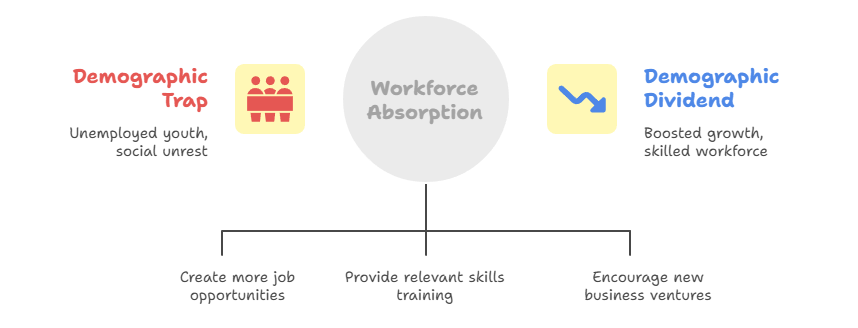
3.1. Demographic Dividend or Demographic Trap?
- With fertility below replacement level, India’s working-age population (15–64) is at a peak.
- Potential Dividend: If harnessed through employment, skilling, and entrepreneurship, this cohort can boost growth.
- Risk of Trap: If not absorbed into the workforce, it may lead to youth unemployment, social unrest, and urban slums.
3.2. Gender Dimensions of Development
- Female labour force participation is 41.7%, but most women remain in informal, unpaid, or precarious jobs.
- Political representation has seen a potential boost via the 106th Constitutional Amendment, reserving 1/3rd of seats in legislatures for women.
Sociological Lens:
- Sylvia Walby’s theory of public and private patriarchy explains how women are exploited both at home and in the labour market.
- A gender-just HDI must focus on capability expansion, not just basic needs.
Section 4: AI and the Future of Human Development
4.1. AI as a Development Tool
The 2025 HDR theme – “A Matter of Choice: People and Possibilities in the Age of AI” – reflects the transformative power of AI.
Benefits:
- Healthcare: AI improves diagnosis, personalized treatment, and healthcare access in rural India.
- Education: Enables adaptive learning, language translation, and real-time feedback.
- Governance: Fraud detection, welfare targeting, and multilingual communication through Bhashini and MuleHunter.AI.
- Job Creation: Google estimates AI could add ₹33.8 lakh crore to India’s GDP by 2030.
Risks:
- Displacement of jobs without adequate skilling.
- Widening digital divide and algorithmic bias, exacerbating social inequalities.
4.2. India’s Role in the Global AI Ecosystem
- India has the highest self-reported AI skills penetration globally.
- 20% of Indian AI researchers are now staying back in India, up from near-zero in 2019.
Sociological Insight:
- Technological determinism must be balanced with human-centric governance.
- Inclusive AI must consider intersectionality—how caste, gender, rural/urban location affect access.
Section 5: Addressing India Human Development Challenges

5.1. Inequality Reduction
- Inequality has eroded 30.7% of India’s HDI.
- Measures:
- Strengthen MGNREGA, PMEGP, Jan Dhan Yojana.
- Focus on land reforms, urban housing, and rural asset creation.
5.2. Improving Education and Health
- Expand Poshan Abhiyaan, Ayushman Bharat, One Stop Centres, and nutrition access.
- Reforms under NEP 2020, enhanced teacher training, and digital classrooms are essential.
5.3. Promoting Gender Equality
- Legal: Stronger enforcement of laws on child marriage, gender-based violence, and workplace harassment.
- Economic: Support for women entrepreneurs, creches, skilling in STEM.
- Political: Full implementation of 106th Amendment.
5.4. AI for Inclusion
- Ethical AI guidelines needed to avoid biases.
- Use AI in agriculture (weather alerts), e-health (telemedicine), and education (adaptive learning).
- Ensure access through Digital India, UPI, Jan Dhan, and Bhashini.
Conclusion: A Sociological Synthesis
India’s demographic and human development trends reflect progress, paradoxes, and possibilities. Falling fertility rates and rising life expectancy indicate success in public health, but gender inequality, digital divides, and social exclusion remain critical concerns.
From a sociological standpoint, India must move beyond quantitative growth metrics to focus on qualitative development rooted in social justice, capability expansion, and equitable opportunity.
As the HDR 2025 emphasizes, inclusion is not optional—it is essential. Only by addressing structural inequalities and leveraging technology ethically can India convert its demographic transition into a developmental transformation.
|

One comment