The Non-Aligned Movement (NAM) emerged in the mid-twentieth century as a collective response of newly decolonized nations to the rigid bipolarity of the Cold War. Conceived by visionary leaders such as Jawaharlal Nehru, Josip Broz Tito, Gamal Abdel Nasser, Sukarno, and Kwame Nkrumah, NAM sought to preserve strategic autonomy, resist military alliances, and promote peaceful coexistence in a world polarized between the United States and the Soviet Union. At its core, non-alignment was not neutrality in the passive sense, but an active assertion of independence in foreign policy and a moral critique of power politics.
However, with the end of the Cold War and the dissolution of the bipolar order, the international system has undergone profound transformation. The contemporary world is increasingly multipolar, marked by shifting power centers, economic interdependence, and complex transnational challenges. In this altered context, questions have arisen regarding the continued relevance of NAM. Does a movement born in an era of ideological confrontation still have meaning in a world defined by fluid alignments and pragmatic partnerships? This essay examines whether NAM has lost its relevance or whether it requires conceptual and institutional redefinition to remain meaningful in a multipolar world.
MAIN BODY:
To assess NAM’s relevance today, it is essential to revisit its original purpose. NAM was formally institutionalized in 1961 at the Belgrade Conference, at a time when decolonization was reshaping global politics. Newly independent states, wary of neo-colonial domination and superpower rivalry, sought to safeguard their sovereignty by refusing to align with military blocs.
The movement emphasized principles such as respect for sovereignty, non-interference, peaceful resolution of disputes, and opposition to imperialism and racism. Importantly, NAM also aimed to amplify the collective voice of the Global South in international forums, challenging the dominance of great powers. Thus, NAM was as much a political strategy as it was a moral vision of international relations.
The collapse of the Soviet Union in 1991 fundamentally altered the global order. The disappearance of one pole seemed to undermine the very rationale of non-alignment. In a unipolar moment dominated by the United States, many argued that NAM had become redundant, reduced to a forum for rhetoric without strategic relevance.
Moreover, several NAM members began forging close economic, political, and military ties with major powers. Strategic partnerships, defense cooperation agreements, and participation in global trade regimes appeared to contradict the ethos of non-alignment. Consequently, critics contended that NAM had lost coherence, as its members pursued divergent national interests rather than a shared collective agenda.
However, this apparent crisis also revealed a deeper question: was NAM merely a response to bipolarity, or was it a broader philosophy of autonomy and equity in international relations?
The contemporary international system is neither bipolar nor strictly unipolar. Instead, it is characterized by multipolarity, with the rise of China, India, the European Union, Russia, and influential middle powers. Economic power is more diffused, and global governance increasingly involves multiple stakeholders.
In such a world, rigid alliances are less dominant, and strategic flexibility has become a necessity. Ironically, this fluidity aligns with the original spirit of non-alignment. Rather than binding states to permanent alliances, the current order encourages issue-based cooperation and diversified partnerships.
Therefore, while the context has changed, the underlying need for strategic autonomy has arguably intensified. Smaller and developing countries, in particular, face the challenge of navigating great-power competition without becoming instruments of rivalries. In this sense, the principles of NAM remain relevant, even if the institutional form appears outdated.
Strategic autonomy—the ability of a state to pursue its national interests without undue external pressure—has re-emerged as a central concept in foreign policy discourse. Countries today seek to engage with multiple power centers while avoiding excessive dependence on any single actor.
This approach resonates strongly with NAM’s foundational ethos. For example:- India’s contemporary foreign policy, often described as “multi-alignment,” reflects a pragmatic adaptation of non-alignment. India engages with diverse groupings such as the Quad, BRICS, SCO, and G20, while retaining independent decision-making.
Thus, while non-alignment in its classical form may appear obsolete, its underlying logic has evolved into more flexible strategies suited to a multipolar world. NAM, therefore, has not lost relevance in principle, but requires reinterpretation in practice.
One of NAM’s most enduring contributions has been providing a platform for the Global South to articulate shared concerns. Issues such as development, economic inequality, climate justice, and reform of global institutions remain highly relevant today.
Despite globalization, structural inequalities persist in international trade, finance, and governance. Institutions such as the United Nations Security Council, IMF, and World Bank continue to reflect historical power imbalances. In this context, NAM’s advocacy for a more equitable international order retains moral and political significance.
However, NAM has often struggled to translate collective declarations into concrete outcomes. Internal diversity, lack of cohesion, and varying national priorities weaken its effectiveness. Therefore, while the need for a collective Southern voice remains, NAM must strengthen institutional coordination and focus on actionable agendas.
The twenty-first century has introduced challenges that transcend traditional geopolitical divisions. Climate change, pandemics, cyber security, terrorism, and technological disruption require collective action beyond ideological alignments.
NAM’s response to these issues has been limited and largely rhetorical. The movement has yet to articulate a coherent framework for addressing such global challenges. This inability to adapt substantively fuels perceptions of irrelevance.
Philosophically, this reflects the danger of institutional stagnation. As Herbert Spencer noted, survival depends not on strength alone, but on adaptability. For NAM to remain relevant, it must evolve from a forum of political symbolism into a platform for practical cooperation on global commons.
NAM has always embodied a tension between moral idealism and political realism. Its commitment to peace, sovereignty, and justice offered a normative alternative to power politics. Yet, in practice, many member states have prioritized national interests, sometimes aligning with major powers when expedient.
This gap between ideals and practice has eroded NAM’s credibility. However, in an era where realpolitik often dominates global affairs, moral frameworks remain essential. As history demonstrates, power without ethics breeds instability.
NAM’s enduring relevance, therefore, lies not in its ability to compete with power blocs, but in its capacity to remind the international community of ethical principles that transcend immediate interests.
CONCLUSION:
The Non-Aligned Movement has not lost its relevance in a multipolar world; rather, it has lost clarity of purpose and adaptability. While the bipolar context that gave birth to NAM no longer exists, the fundamental challenges it sought to address—inequality, domination, loss of autonomy, and marginalization of the Global South—persist in new forms.
In a world characterized by shifting power balances, strategic competition, and global interdependence, the need for autonomy, inclusivity, and ethical engagement is greater than ever. However, for NAM to remain meaningful, it must undergo intellectual and institutional renewal. This includes redefining non-alignment as strategic autonomy, strengthening internal coherence, and focusing on contemporary global challenges.
Ultimately, NAM’s relevance should not be measured by its ability to influence great powers, but by its capacity to offer an alternative vision of international relations—one rooted in cooperation rather than confrontation, equity rather than dominance, and autonomy rather than subordination. In this sense, NAM remains not a relic of the Cold War, but a reminder that even in a multipolar world, independence of judgment and moral purpose remain indispensable to global order.
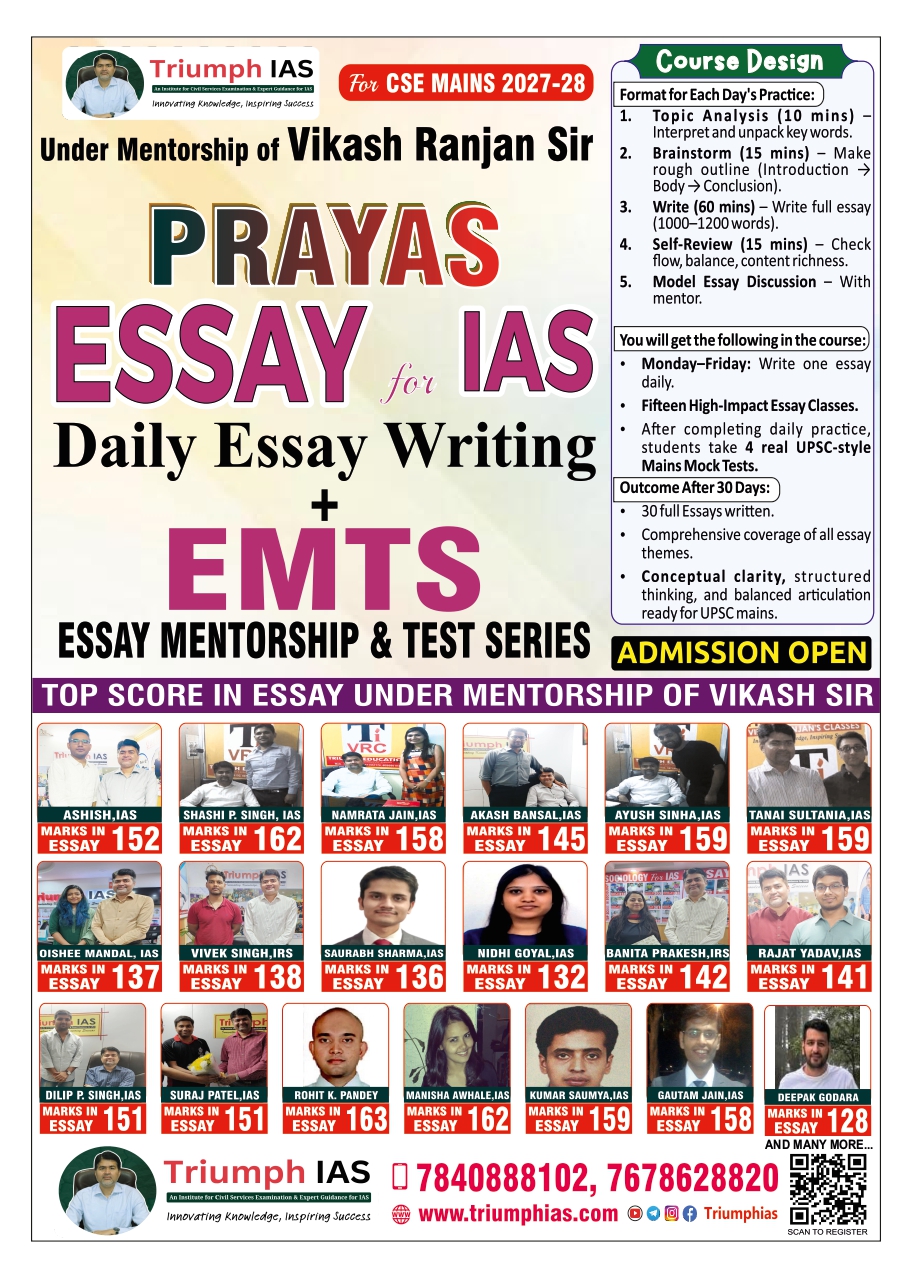
If you’re preparing for the UPSC Civil Services Examination (CSE), one paper that can unlock exceptional scores and a top rank is the Essay Paper. While General Studies and Optional Subjects are structured and syllabus-driven, the Essay writing segment is where individuality, critical thinking, and articulation truly shine.
Among various Essay programs available across India, Triumph IAS, under the expert mentorship of Vikash Ranjan Sir, offers the Best Essay writing Course for UPSC CSE. This comprehensive guide explores what makes this program unparalleled and why it should be part of every serious aspirant’s preparation strategy.


2 comments