
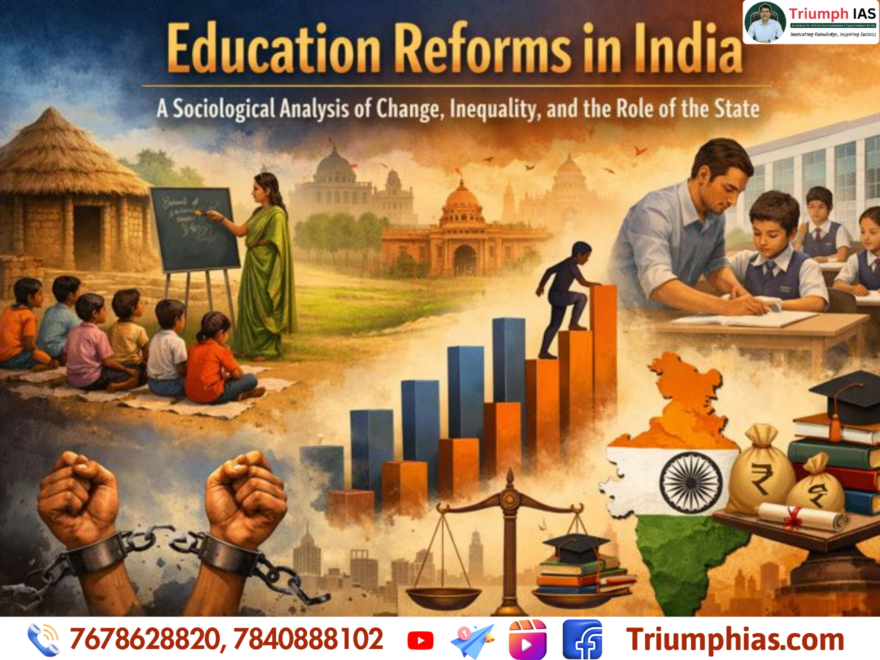
Education Reforms in India: A Sociological Analysis of Change, Inequality, and the Role of the State
(Relevant for Sociology Paper 2: Visions of Social Change in India)
IntroductionEducation has long been regarded as one of the most powerful instruments of social transformation in India. From the colonial introduction of modern education to post-independence planning and recent digital reforms, education has remained central to debates on development, equality, citizenship, and nation-building. In recent years, education reforms in India have gained renewed attention due to structural changes such as curriculum restructuring, digital learning expansion, skill-oriented education, and the implementation of the National Education Policy (NEP). Education reforms today are not merely administrative or technical adjustments; they reflect deeper sociological processes involving power, class, caste, gender, regional disparities, and the changing role of the state in a globalized economy. This blog analyses education reforms in India through a sociological lens, focusing on their objectives, impacts, contradictions, and future challenges. Historical Context of Education Reforms in IndiaColonial LegacyColonial education introduced Western knowledge systems primarily to serve administrative needs. It created:
This legacy continues to shape debates around curriculum, language, and social exclusion. Post-Independence ReformsAfter independence, education was seen as a tool for:
Planning commissions emphasized universal primary education, expansion of higher education, and affirmative action to address historical disadvantages. Contemporary Education Reforms in India1. Structural Reforms in School EducationRecent reforms aim to:
Sociological Significance: 2. Higher Education ReformsKey trends include:
Impact:
Education increasingly reflects class reproduction, as access to elite institutions remains uneven. 3. Digitalization of EducationThe expansion of online learning platforms and digital classrooms is a major reform dimension. Positive outcomes:
Sociological challenges:
4. Skill Development and EmployabilityEducation reforms increasingly align with labour market needs:
Sociological critique: 5. Equity, Inclusion, and Social JusticePolicies emphasize:
However, structural barriers persist due to:
Education reforms must address social context, not just institutional design. Education and Social ChangeEducation acts as both:
While reforms promise equal opportunity, sociological research shows that:
Thus, education reforms may unintentionally widen inequalities unless accompanied by strong welfare and support systems. Role of the State in Education ReformsThe Indian state plays multiple roles:
Recent reforms indicate a shift from welfare-oriented provisioning to regulatory and facilitative governance, reflecting broader changes in the political economy of education. This raises critical questions:
Education, Citizenship, and DemocracyEducation reforms shape:
Curriculum content, language policies, and institutional autonomy influence how citizens perceive:
Thus, education is deeply intertwined with politics and ideology. Challenges and ContradictionsDespite ambitious reforms, challenges remain:
Education reforms risk becoming symbolic unless supported by:
ConclusionEducation reforms in India represent a crucial site where state policy, social structure, and cultural values intersect. While contemporary reforms aim to modernize education and align it with global standards, their sociological impact depends on how effectively they address inequality, access, and inclusion. For education to truly act as an engine of social change, reforms must go beyond structural redesign and engage with the lived realities of Indian society. Only then can education fulfill its promise as a tool for empowerment, citizenship, and social justice. |
To Read more topics, visit: www.triumphias.com/blogs
Read more Blogs:
World Inequality Report 2026: A Sociological Reading of Global and Indian Inequalities
One comment