
Constitutional Morality and the Soul of the Republic: A Sociological Reading of India’s Democratic Ethos
(Relevant for Sociology Paper 1: Politics and Society)
|
In the constitutional imagination of India, law was never meant to be a mere instrument of order—it was to be the moral grammar of democracy. Yet, seven decades after independence, India’s courts and citizens find themselves repeatedly asking: what sustains democracy when majoritarian passions rise, institutions weaken, and morality becomes contested terrain? The recent judicial revival of the concept of “constitutional morality” offers an answer rooted not in sentiment, but in social ethics and civic restraint. The Origins: From Grote to AmbedkarThe idea of constitutional morality traces back to George Grote’s History of Greece (1846), where he described it as a “paramount reverence for the forms of the constitution”—a commitment to the spirit and structure of governance rather than transient passions. Grote emphasized three civic virtues: adherence to constitutional procedure, respect for institutions, and self-restraint guided by public reason. Dr. B.R. Ambedkar carried this idea into India’s Constituent Assembly. His warning that “democracy in India is only a top-dressing on an undemocratic soil” was not a pessimistic prophecy but a sociological diagnosis. Ambedkar understood that political democracy cannot survive without social morality—that the formal mechanisms of elections and rights must be sustained by internalized norms of equality, fraternity, and reason. In this sense, constitutional morality is not mere legality—it is ethical citizenship. It requires individuals and institutions to act with restraint, respect diversity, and prioritize constitutional values over popular impulses or political convenience. Constitutional Morality vs. Public Morality: The Sociological Faultline
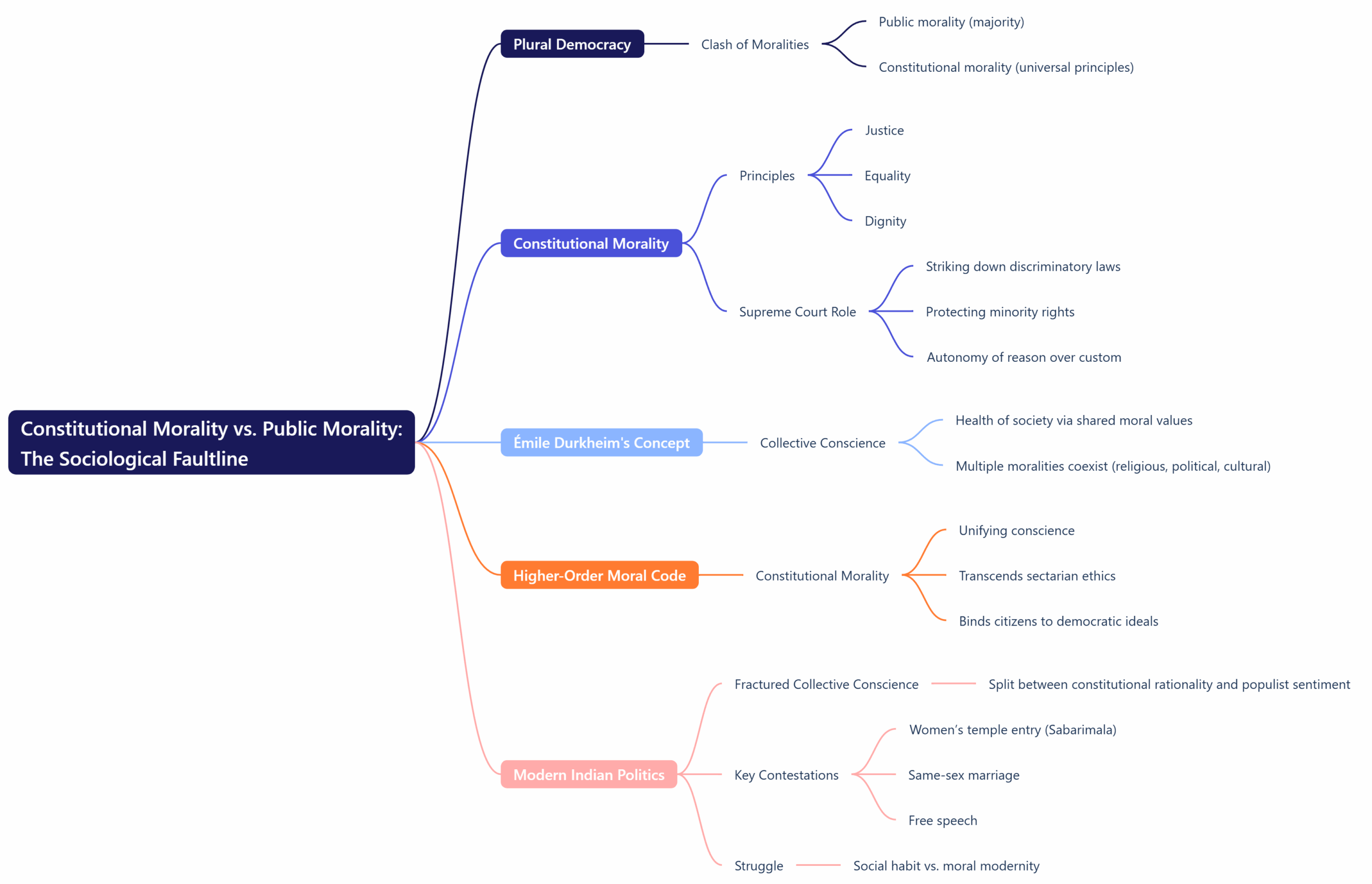
In a plural democracy, public morality—the morality of the majority—can often clash with constitutional morality, which embodies the universal principles of justice, equality, and dignity. When the Supreme Court invokes constitutional morality to strike down discriminatory laws or to protect minority rights, it is essentially asserting the autonomy of reason over custom. Here, Émile Durkheim’s concept of collective conscience becomes relevant. For Durkheim, the health of a society depends on its shared moral values. But in complex, modern societies, multiple moralities coexist—religious, political, cultural—often in conflict. Constitutional morality serves as a higher-order moral code, a unifying conscience that transcends sectarian ethics and binds citizens to shared democratic ideals. Yet, unlike Durkheim’s stable moral order, India’s collective conscience is fractured—split between constitutional rationality and populist sentiment. This tension defines much of modern Indian politics: from debates on women’s temple entry (Sabarimala) to same-sex marriage and free speech. Each contestation reveals the struggle between social habit and moral modernity. From Ambedkar to the Judiciary: The Rebirth of an IdeaFor decades after 1950, the term “constitutional morality” lay dormant in judicial reasoning. Its revival came in the 2010s, as India’s higher judiciary faced unprecedented challenges to institutional autonomy and liberal values. In Manoj Narula v. Union of India (2014), the Supreme Court invoked constitutional morality to urge ethical restraint among political leaders, asserting that adherence to constitutional norms is a moral duty, not just a legal one. The Justice K.S. Puttaswamy (Retd.) v. Union of India (2017) verdict, affirming privacy as a fundamental right, described constitutional morality as the “balancing soul” of the Constitution—a compass ensuring that liberty and dignity prevail even when law is silent. Most famously, in the Sabarimala judgment (Indian Young Lawyers Association v. State of Kerala, 2018), the Court equated “public morality” under Article 25 with “constitutional morality.” Chief Justice Dipak Misra declared that faith cannot override the Constitution—a profound statement on the hierarchy of values in a secular democracy. Yet, critics warn of judicial overreach. Without a clear framework, constitutional morality risks becoming a judicialized morality, where unelected judges determine the ethical trajectory of society. This tension between judicial activism and democratic restraint is itself a moral question: Who decides what the Constitution’s morality demands—the people, their representatives, or the courts? The Sociological Anatomy of Constitutional Morality
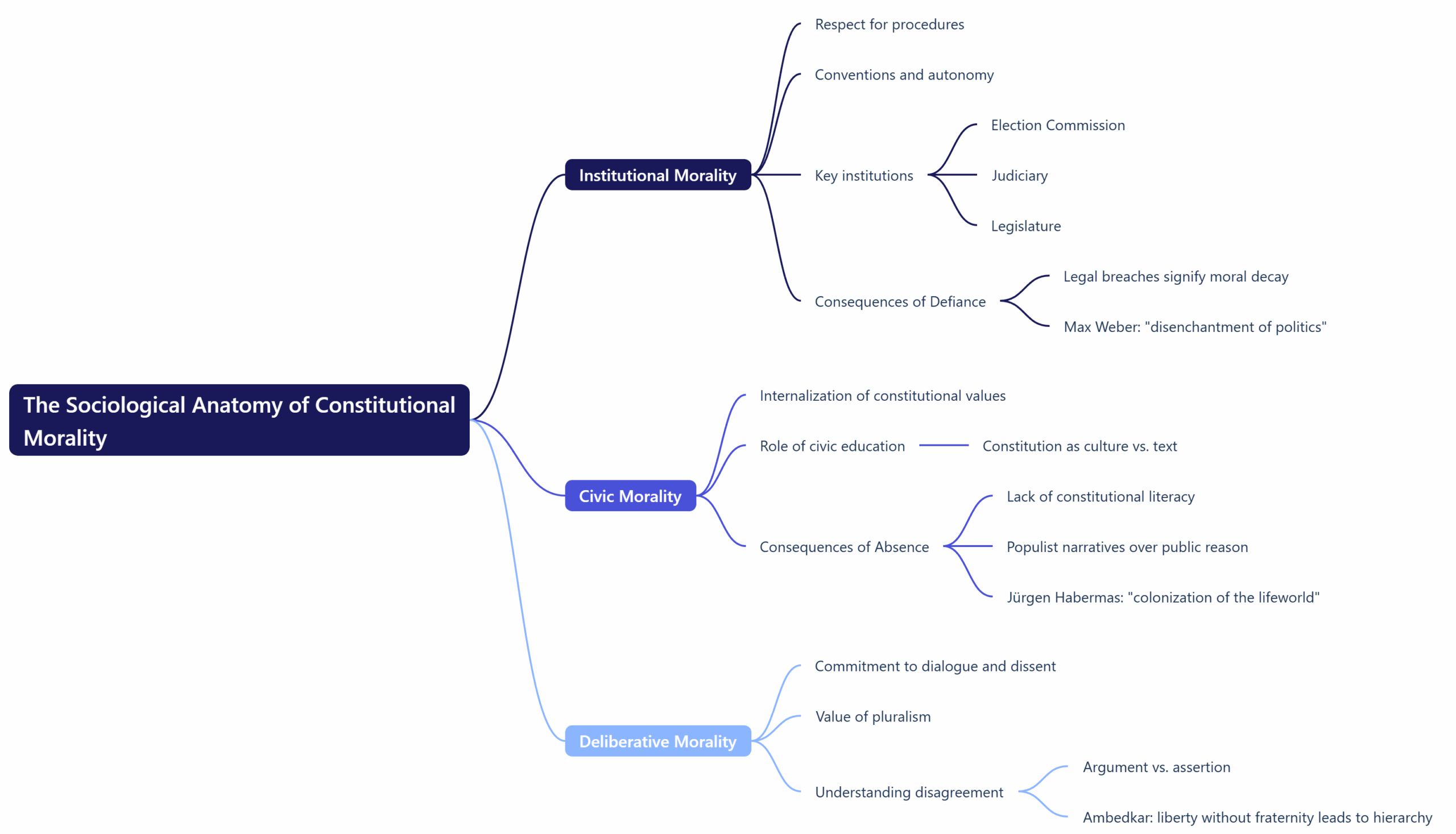
To grasp constitutional morality sociologically, one must see it as both a cultural code and a political practice. It operates at three interconnected levels:
Law, Morality, and the Sociological DebateThe tension between law and morality is as old as jurisprudence itself. The Hart–Devlin controversy of the 1960s captured it perfectly. Lord Devlin argued that the law must enforce common morality to preserve social cohesion, while H.L.A. Hart countered that legal coercion should not dictate moral uniformity. In India, this debate resonates deeply: should law reform social behavior (as in the abolition of untouchability or criminalization of marital rape), or should it follow society’s moral evolution? Historically, Indian law has often led morality—as with the constitutional abolition of untouchability, which preceded social acceptance. At other times, law has followed morality, as seen in growing recognition of LGBTQ+ rights. The dialectic between the two shapes India’s moral modernity: a dynamic process where the Constitution acts both as mirror and motor of social change. Power, Hegemony, and the Moral StateAntonio Gramsci’s idea of hegemony—the dominance of one worldview through cultural consent rather than coercion—helps explain the political stakes of constitutional morality. When the state invokes constitutional morality selectively, it risks turning into an instrument of moral hegemony. Conversely, when citizens internalize constitutional ethics voluntarily, the Constitution becomes not an instrument of power but of emancipation. Similarly, Foucault’s notion of governmentality—the art of governing through moral and administrative norms—illuminates how power in modern democracies operates not by repression but by shaping conduct. Constitutional morality thus represents both a form of resistance (against authoritarian tendencies) and a technology of governance (disciplining political behavior through moral expectations). The Present Challenge: From Law to CultureDespite its judicial revival, constitutional morality faces several sociological impediments. Institutional weakness, politicization of oversight bodies, and the decline of civic education have created a moral vacuum. Citizens often see the Constitution as a remote text rather than a shared covenant. The result is what Durkheim called anomie—a condition of moral disorientation where rules lose their binding power. When constitutional conventions are flouted and public discourse turns sectarian, democracy risks sliding from constitutionalism to populism. To counter this, constitutional morality must become a lived civic ethic, taught in schools, practiced in public life, and demanded of political leaders. As Ambedkar envisioned, the Constitution must not only regulate power—it must cultivate virtue. Conclusion: The Moral RepublicConstitutional morality is not blind reverence—it is disciplined fidelity. It reminds us that allegiance to the Constitution lies not in what it delivers, but in how faithfully we uphold its spirit amid conflict. In times of polarization, it asks of citizens and leaders alike a rare virtue—self-restraint in the pursuit of power. In this, it bridges the moral and the political: the Constitution as a living text of reason, and the Republic as a moral community sustained by that reason. India’s future, as Ambedkar foresaw, depends not merely on the wisdom of its laws, but on the morality of its citizens. When that morality wanes, no amount of legal scaffolding can save the democratic edifice. To sustain the Republic, therefore, we must treat constitutional morality not as a doctrine for judges, but as a civic religion for the people—a shared faith that the Constitution, above all, is our collective conscience. |
To Read more topics, visit: www.triumphias.com/blogs
Read more Blogs:
Bringing Global Education Home: A Sociological Analysis of Foreign University Campuses in India
Reimagining Equality: The Sociology of Reservation beyond the 50% Cap
5 comments