
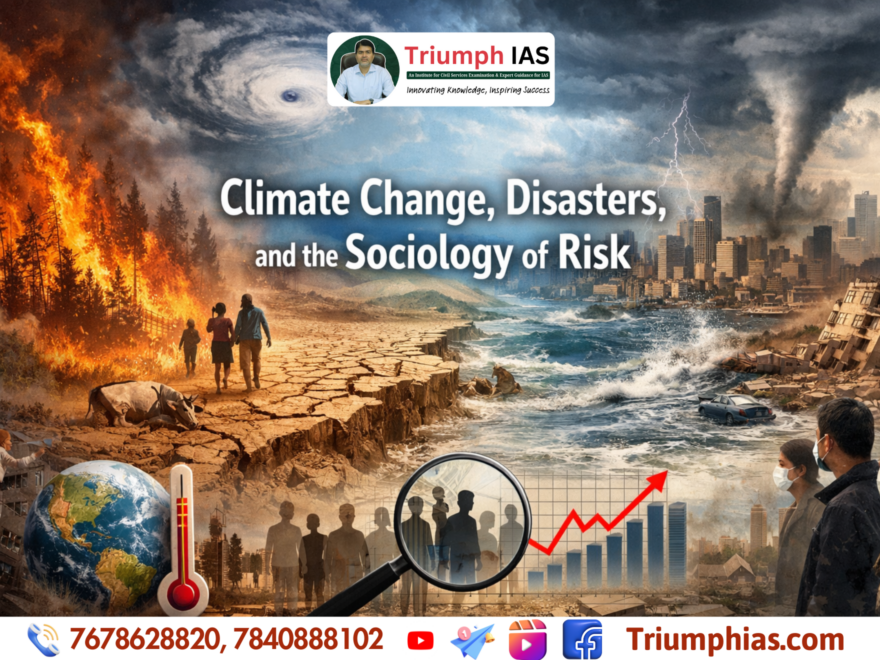
Climate Change, Disasters, and the Sociology of Risk
(Relevant for Sociology Paper 1)
IntroductionClimate change has moved from being an environmental concern to becoming one of the most pressing social issues of the 21st century. In 2024–25, extreme weather events—heatwaves, floods, cyclones, wildfires, and water crises—have intensified across the world, including India. These developments have sparked debates on climate justice, sustainable development, disaster governance, and environmental inequality. While climate change is often framed as a scientific or policy problem, sociology views it as a socially produced risk, deeply embedded in patterns of industrialisation, capitalism, consumption, and power relations. This blog analyses climate change and disasters using Sociology Optional Paper 1 concepts, demonstrating how classical and contemporary sociological theories help us understand the changing relationship between society, nature, and risk. Environment and Society: A Sociological PerspectiveEarly sociology largely focused on social institutions, often treating nature as an external backdrop. However, contemporary sociology recognises that:
Climate change challenges the idea that modern societies can fully control nature. Instead, it exposes the limits of technological rationality, a theme central to sociological theory. Industrialisation, Capitalism, and Environmental DegradationMarx and the Metabolic RiftKarl Marx provided one of the earliest sociological insights into environmental degradation through the concept of the metabolic rift. He argued that capitalist production disrupts the natural metabolism between humans and nature by prioritising profit over ecological balance. In contemporary capitalism:
have intensified climate change. The environmental crisis is therefore not accidental but structurally embedded in the logic of capitalist accumulation. Alienation from NatureMarx’s concept of alienation can be extended to human–nature relations. Modern individuals are:
This alienation contributes to environmental apathy and delayed collective action. Max Weber: Rationalisation and Environmental CrisisInstrumental Rationality and NatureMax Weber’s concept of rationalisation helps explain why modern societies continue environmentally destructive practices despite knowing their consequences. Industrial societies prioritise:
Nature is treated as a resource to be managed, not as a moral concern. Environmental costs are externalised, reflecting what Weber would describe as dominance of instrumental rationality over value rationality (Wertrationalität). The Ecological Iron CageWeber’s “iron cage” can be extended to environmental governance:
As a result, societies become trapped in systems that acknowledge climate risks but fail to transform underlying values. Émile Durkheim: Environmental Anomie and Moral RegulationClimate Change as a Moral CrisisDurkheim emphasised that social order depends on moral regulation. Climate change represents a moral crisis, where:
This creates a form of environmental anomie, where societies lack clear moral guidelines regarding ecological responsibility. Collective Responsibility and SolidarityDurkheim would argue that effective climate action requires:
The failure to generate global solidarity around climate action reflects weak moral integration at both national and international levels. Ulrich Beck: Risk Society and Manufactured RisksClimate Change as a Manufactured RiskUlrich Beck’s concept of risk society is central to understanding climate change. Unlike traditional risks (famine, disease), climate change is:
Modern societies now face manufactured risks produced by industrial success itself. Social Distribution of RiskBeck argued that while risks are global, their impacts are socially unequal. Climate change disproportionately affects:
This reveals a paradox of modernity: those who contribute least to environmental damage often suffer the most. Anthony Giddens: Modernity, Time-Space, and Climate InactionAnthony Giddens highlighted how modernity separates time and space, making abstract risks difficult to perceive. The Giddens ParadoxClimate change exemplifies the Giddens Paradox:
This sociological insight explains why societies struggle to mobilise collective action despite scientific warnings. Disasters, Vulnerability, and Social InequalityDisasters Are Not “Natural”Sociologists argue that disasters are socially constructed events. While hazards may be natural, their impact depends on:
Floods, heatwaves, and cyclones become disasters due to social vulnerability, not merely environmental forces. Class, Caste, and VulnerabilityIn developing societies:
Thus, disasters reinforce existing social inequalities, turning climate change into a question of social justice. Michel Foucault: Power, Knowledge, and Environmental GovernanceFoucault’s idea of power–knowledge helps explain climate governance. Climate knowledge is produced through:
While necessary, this can:
Environmental governance often shifts from democratic debate to technocratic management, raising questions about participation and power. Environmental Surveillance and RegulationModern climate governance relies on:
While these tools are important, they also reflect new forms of environmental governmentality, where populations are regulated through norms of sustainable behaviour. Symbolic Interactionism: Climate Change and MeaningEveryday Environmental BehaviourSymbolic interactionists focus on how individuals interpret climate change in daily life:
Environmental action depends on shared meanings, social norms, and moral symbols—not just scientific data. Climate Anxiety and IdentityRising awareness of climate change has produced:
These emotional responses reflect how large-scale risks are internalised at the individual level. Zygmunt Bauman: Liquid Modernity and Environmental UncertaintyBauman’s concept of liquid modernity highlights the fragility of modern institutions. In relation to climate change:
Environmental responsibility becomes individualised, while structural causes remain unaddressed. Global Inequality and Climate JusticeClimate change exposes global power asymmetries:
This aligns with conflict theory, which views environmental crisis as a struggle over resources, responsibility, and survival. Agency, Movements, and Environmental ResistanceDespite structural constraints, agency exists:
These reflect sociology’s core insight that social change emerges through collective action, even under conditions of risk. ConclusionClimate change represents not only an environmental emergency but a sociological crisis of modernity. It exposes the contradictions of industrial progress, the limits of rational control, and the deep inequalities embedded in social structures. Classical sociological theories provide powerful tools to understand why societies produce risks they struggle to manage. For Sociology Optional students, climate change offers a rich terrain to demonstrate how sociological imagination connects personal vulnerability, social structures, and global processes. In an era defined by uncertainty and risk, sociology remains essential for imagining more just and sustainable futures. |
To Read more topics, visit: www.triumphias.com/blogs
Read more Blogs:
Non-Positivist Methodologies with References from Contemporary Society
2 comments